
Exploring the Meaning of Katenopion in Greek
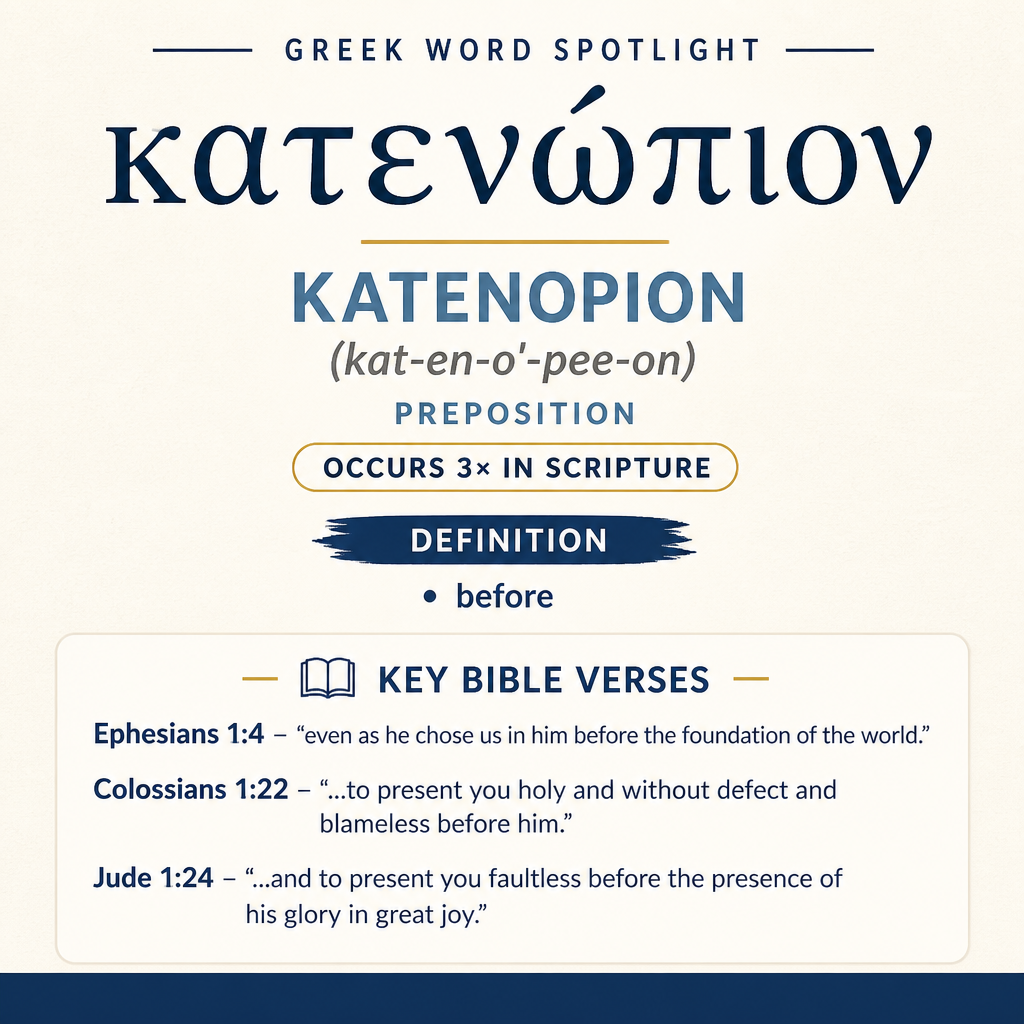
κατενώπιον means “before” and appears three times in Scripture: Ephesians 1:4, Colossians 1:22, and Jude 1:24.
Where It Appears
It occurs three times in Scripture: Ephesians 1:4; Colossians 1:22; Jude 1:24.
Learn More →Verse Usage
In Ephesians 1:4 and Colossians 1:22, it describes being holy and without defect before him. In Jude 1:24, it describes being presented faultless before the presence of his glory.
Learn More →Katenopion means “before” and appears in three New Testament passages that speak of God’s choosing, reconciling, and presenting his people in a condition suited for his presence. In each setting it marks the relational “in-front-of” standpoint in which holiness, blamelessness, or joy is described.
Root and Related Words
Katenopion is formed from enopion (ἐνώπιον), “before,” together with kata (κατά), “according to.”

Occurrences
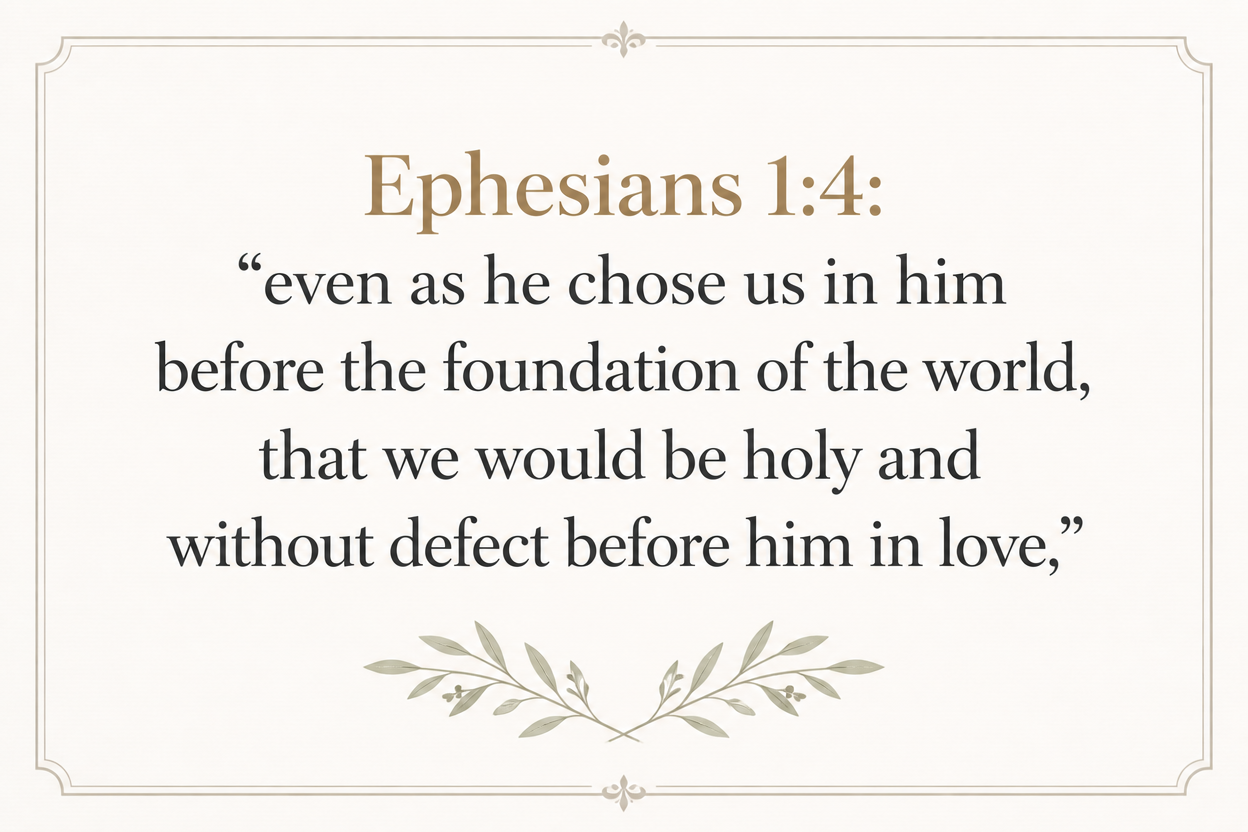
Ephesians 1:4: “even as he chose us in him before the foundation of the world, that we would be holy and without defect before him in love,”
In this sentence “before” first sets a time-frame (“before the foundation of the world”) and then shifts to a standing or placement (“before him”). Katenopion is the second use: “holy and without defect before him.” The phrase locates holiness not merely as a private quality but as a condition that holds up in God’s immediate regard. The verse joins this placement to “in love,” so the “before him” setting is not described as distant or impersonal; it is the arena in which holiness and love are spoken together.
Colossians 1:22: “yet now he has reconciled in the body of his flesh through death, to present you holy and without defect and blameless before him,”
Here “before him” belongs to a purpose statement: reconciliation “through death” aims “to present you” in a specific state. Katenopion marks the destination of that presentation—God himself as the one in whose presence the presented condition must stand. The cluster of descriptions (“holy and without defect and blameless”) is not offered as an abstract ideal; it is tied to being brought “before him.” The wording portrays a movement from estrangement to restored proximity, where the reconciled are set in front of God as an accomplished result of reconciliation.
Jude 1:24: “Now to him who is able to keep them from stumbling, and to present you faultless before the presence of his glory in great joy,”
In Jude, katenopion again appears in the phrase of presentation, but the immediate backdrop is God’s ability “to keep them from stumbling.” The “before” setting is intensified by the added phrase “the presence of his glory,” so the location is not only “before him” but before the manifested glory associated with him. Within this doxology the word anchors the hope that believers will be brought into that setting “faultless,” and the emotional tone is explicit: “in great joy.” Katenopion thus helps frame the end-point of divine keeping—not simply avoiding a fall, but being set safely in front of God’s glorious presence with the fitting condition and the fitting joy.
Sense and Usage
Across these three texts, katenopion consistently marks a relational standpoint: being placed in front of God as the one who sees, receives, and evaluates. In Ephesians and Colossians, the word appears after descriptions of moral integrity (“holy,” “without defect,” “blameless”), giving those descriptions a concrete orientation. The condition described is the kind that can be affirmed in God’s sight; the word pushes the reader to imagine the scene not as self-assessment but as standing where God is the immediate reference point.
At the same time, katenopion functions with slightly different emphases in each passage. Ephesians connects it to God’s prior choosing and speaks of the intended result (“that we would be holy and without defect before him in love”). The prepositional phrase helps depict God’s purpose as aiming at a lived reality in his presence. Colossians attaches the “before him” standing directly to reconciliation accomplished “through death,” so the word belongs to the logic of accomplished restoration and purposeful presentation. Jude places it within praise, coupling “before” with “the presence of his glory,” and adds the note of “great joy,” portraying the “before” setting as both safe and celebratory.
These passages also show that “before” can operate on more than one axis in the same context. Ephesians 1:4 uses “before” temporally (“before the foundation of the world”) and then uses katenopion spatially/relationally (“before him”). The pairing highlights a contrast between God’s action prior to creation and the intended outcome in personal proximity to him. In the other two occurrences, katenopion is not temporal but is tied to presentation language (“to present you … before him”), making “before” the endpoint of a movement: the reconciled and kept are brought into the position of being in front of God.
Finally, katenopion in these verses carries an implicit courtroom-or-ceremony feel without requiring technical imagery: being “presented” suggests an arranged appearing, where a person is set in view of an authority. The moral descriptors in Ephesians and Colossians, and the doxological confidence in Jude, all gain their force from this “before” perspective. The word gathers themes of purpose (Ephesians), accomplished reconciliation (Colossians), and assured keeping (Jude) into a single directional idea: God brings his people to stand in front of himself.
Imagery
Together these uses paint a repeated scene of approach and arrival: those chosen, reconciled, and kept are “presented” in front of God. Ephesians and Colossians describe that moment in terms of holiness and blamelessness, while Jude describes it as standing “before the presence of his glory in great joy,” giving the “before” setting a bright, celebratory atmosphere.
Sources: Lexical data from Strong’s Exhaustive Concordance and the Translators Brief Lexicon of Extended Strongs for Greek (STEPBible, CC BY). Occurrence data from the Translators Amalgamated Greek New Testament (STEPBible, CC BY). Scripture quotations from the World English Bible (public domain).





