Exploring the Meaning of Katastronnumi in Greek
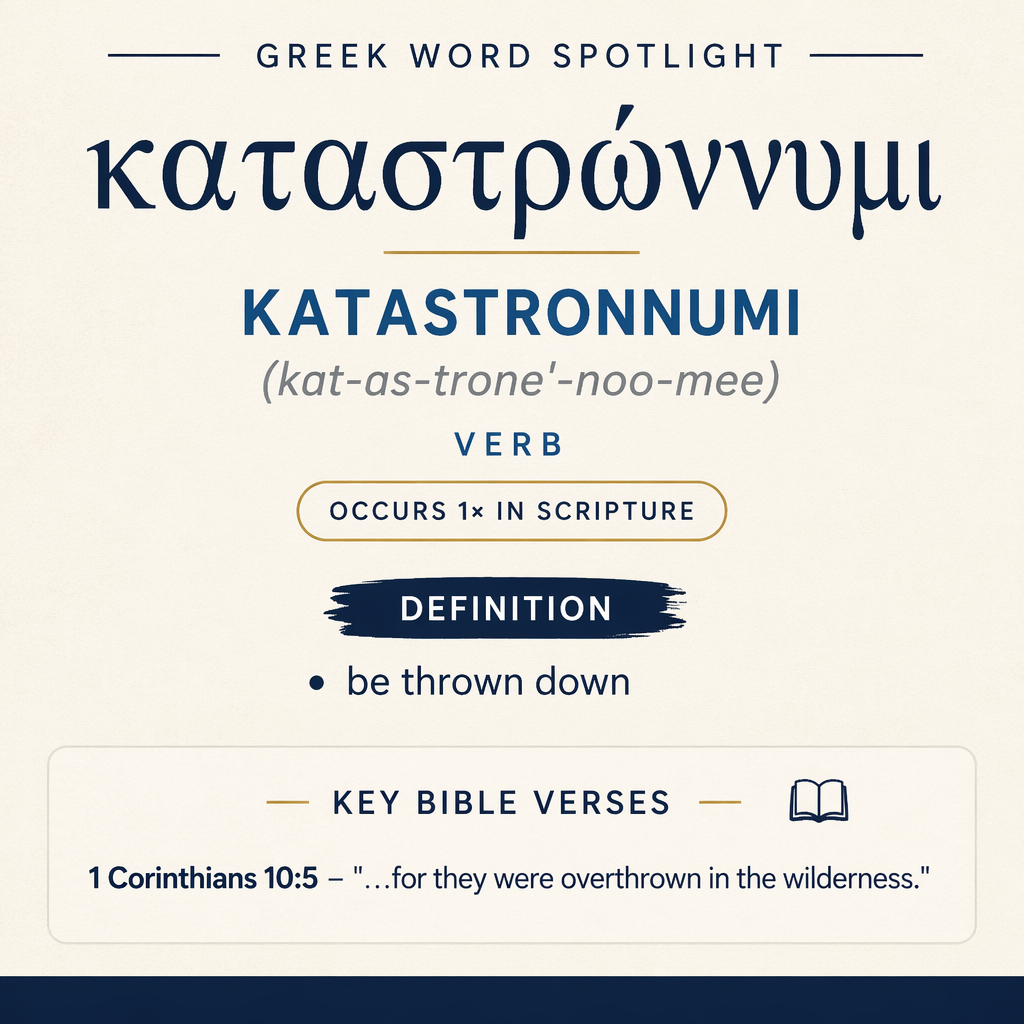
καταστρώννυμι means “be thrown down” and appears once in Scripture, in 1 Corinthians 10:5.
Verse Context
In 1 Corinthians 10:5, it describes people being “overthrown in the wilderness.”
Learn More →καταστρώννυμι means “be thrown down,” and it appears once in the New Testament, in Paul’s warning example drawn from Israel’s wilderness history in 1 Corinthians 10:5. In that setting the verb functions as a stark outcome-term: a decisive reversal experienced by those with whom God “was not well pleased.”
Root and Related Words
καταστρώννυμι is built from kata (κατά), “according to” (Strong’s G2596), and stronnymi (στρώννυμι), “to spread” (Strong’s G4766). The compound form places the action within a directional or resulting frame shaped by κατά, while retaining the core verbal idea carried by στρώννυμι.

Occurrences
“However with most of them, God was not well pleased, for they were overthrown in the wilderness.” (1 Corinthians 10:5)
Here καταστρώννυμι describes what happened to “most of them” as a consequence situated in “the wilderness.” The clause is built to contrast privilege and outcome: despite being among the people whose story is being recalled, “God was not well pleased,” and the verb supplies the culminating result—being “overthrown.” In the flow of the sentence, the overthrow is not presented as a minor setback but as the concrete evidence that divine displeasure had real, bodily, historical effect. The wilderness becomes the location that holds the aftermath of that displeasure, and the verb frames that aftermath as a bringing-down that leaves people where they fell.
The term also functions rhetorically: it compresses a longer narrative of failure into a single, forceful outcome. Instead of enumerating each step of disobedience, the line moves quickly to the end state—“they were overthrown.” As a result, the reader is left with an image of interruption and loss: a journey that does not resolve as intended, marked instead by bodies brought down across a harsh landscape. The verb’s passive sense in the translation (“they were overthrown”) makes the experience something that happened to them; the emphasis lies on the fact of the overthrow rather than on the mechanics of how it occurred.
Sense and Usage
In its lone New Testament use, “be thrown down” is applied to a collective group and tied directly to the evaluation, “God was not well pleased.” The verb therefore carries the weight of an outcome that validates the preceding assessment: displeasure is shown to be more than an attitude, because it is followed by a decisive bringing-down. Within the sentence, the overthrow is not portrayed as merely emotional defeat or internal discouragement; it is a concrete reversal that takes place in space (“in the wilderness”) and affects “most of them.”
The wilderness setting shapes how the sense lands. A wilderness is not an abstract arena; it is a place of exposure, distance, and vulnerability. To be “thrown down” there evokes the stoppage of movement and the collapse of strength in a location where recovery is not assumed. Thus the verb, as used here, serves as a warning-sign term: it represents the end of a course, the termination of participation, and the visibility of judgment in the open. Paul’s brief clause makes the overthrow the memorable point—an image that can be carried forward as a caution without needing additional elaboration.
Because the verse places καταστρώννυμι after “for,” it is also presented as an explanatory ground: “God was not well pleased, for they were overthrown.” The overthrow is treated as the fitting manifestation of divine displeasure; it is the evidence offered to support the evaluation. In this way the verb functions not only descriptively but also argumentatively: it anchors a moral warning by appealing to a tangible historical outcome.
Imagery
The single usage of καταστρώννυμι leaves a concentrated image: people brought down and left scattered “in the wilderness.” The line does not describe the moment of falling in detail; instead it presents the result as a settled state—overthrown—so that the reader’s attention rests on the aftermath, the stillness after the collapse, and the seriousness implied by God’s displeasure.
Sources: Lexical data from Strong’s Exhaustive Concordance and the Translators Brief Lexicon of Extended Strongs for Greek (STEPBible, CC BY). Occurrence data from the Translators Amalgamated Greek New Testament (STEPBible, CC BY). Scripture quotations from the World English Bible (public domain).