
Who was Job in the bible?
Job is the name of a blameless man in Uz in the book of Job, cited in Ezekiel 14:14,20 and James 5:11, and also an Israelite listed in Genesis 46:13.

What Happened
Job’s losses were reported, and “Job arose… and fell down on the ground, and worshiped” (Job 1:20). “In all this, Job didn’t sin, nor charge God with wrongdoing” (Job 1:22).
Learn More →Other Mentions
Ezekiel lists “Noah, Daniel, and Job” as men who “would deliver only their own souls by their righteousness” (Ezekiel 14:14; 14:20). James says, “You have heard of the perseverance of Job” (James 5:11).
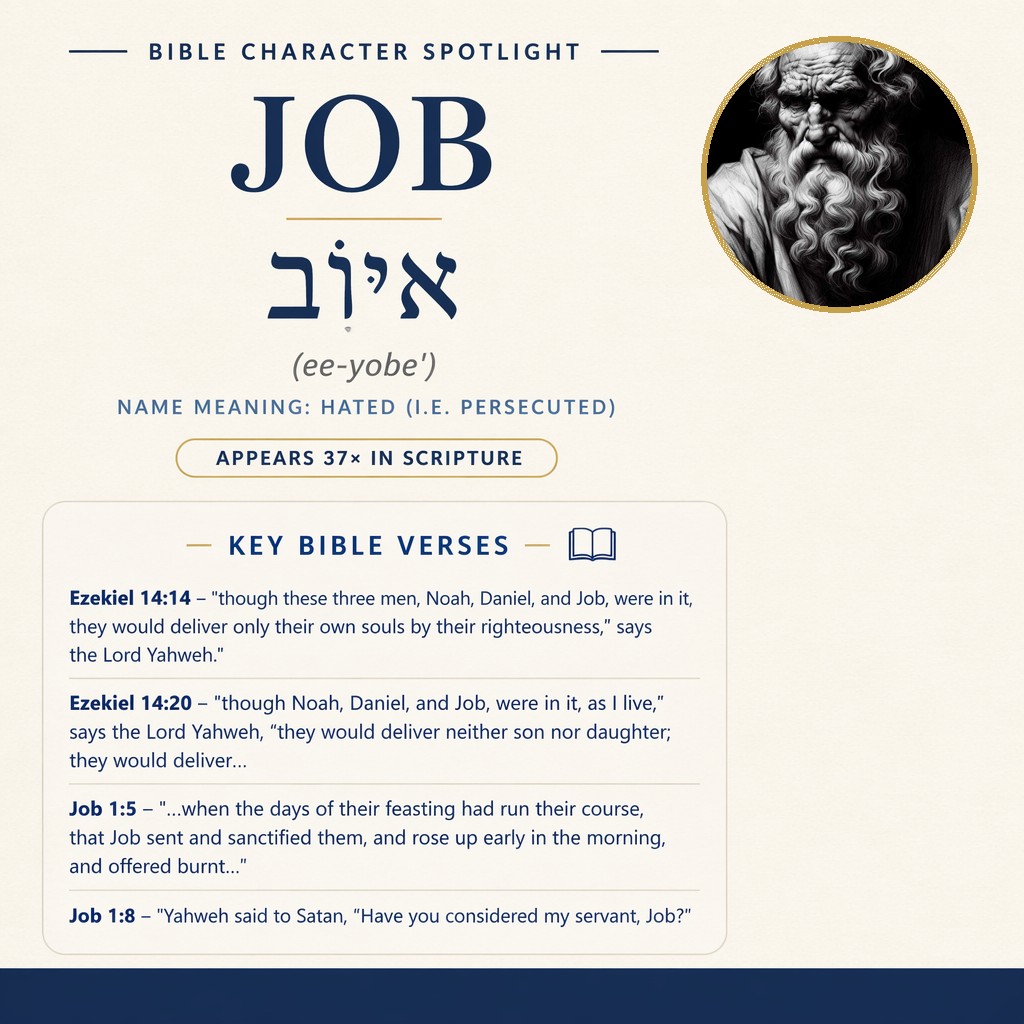
Learn More →Job (Hebrew ’Iyowb, pronounced “ee-yobe”) is presented as a blameless and upright man who feared God and turned away from evil; a lexicon gloss summarizes him as “the patriarch famous for his patience.” Another bearer of the name appears as “Iob,” listed among the sons of Issachar.
Job in Scripture
The book of Job introduces him with a compact character portrait and setting:
“There was a man in the land of Uz, whose name was Job. That man was blameless and upright, and one who feared God, and turned away from evil.” (Job 1:1)
Job’s household is described in terms of children, possessions, and status:
“There were born to him seven sons and three daughters.” (Job 1:2)
“His possessions also were seven thousand sheep, three thousand camels, five hundred yoke of oxen, five hundred female donkeys, and a very great household; so that this man was the greatest of all the children of the east.” (Job 1:3)
The narrative shows Job’s ongoing concern for his children’s spiritual state in connection with their feasting:
“It was so, when the days of their feasting had run their course, that Job sent and sanctified them, and rose up early in the morning, and offered burnt offerings according to the number of them all. For Job said, “It may be that my sons have sinned, and renounced God in their hearts.” Job did so continually.” (Job 1:5)
The scene then shifts to a heavenly assembly, where Yahweh draws attention to Job’s character:
“Now on the day when God’s sons came to present themselves before Yahweh, Satan also came among them.” (Job 1:6)
“Yahweh said to Satan, “Have you considered my servant, Job? For there is no one like him in the earth, a blameless and an upright man, one who fears God, and turns away from evil.”” (Job 1:8)
Satan disputes the purity of Job’s fear of God and points to Job’s protected prosperity:
“Then Satan answered Yahweh, and said, “Does Job fear God for nothing? Haven’t you made a hedge around him, and around his house, and around all that he has, on every side? You have blessed the work of his hands, and his substance is increased in the land.” (Job 1:9–10)
Yahweh permits Satan to touch what Job has, but not to stretch out a hand on Job himself:
“Yahweh said to Satan, “Behold, all that he has is in your power. Only on himself don’t stretch out your hand.” So Satan went out from the presence of Yahweh.” (Job 1:12)
In rapid succession, messengers arrive with reports of catastrophe. One begins:
“that there came a messenger to Job, and said, “The oxen were plowing, and the donkeys feeding beside them,”” (Job 1:14)
The sequence continues with losses to raids and destruction, culminating in the death of Job’s sons and daughters when a great wind strikes their house:
“and behold, there came a great wind from the wilderness, and struck the four corners of the house, and it fell on the young men, and they are dead. I alone have escaped to tell you.” (Job 1:19)
Job responds with grief and worship, interpreting his losses under Yahweh’s sovereignty:
“Then Job arose, and tore his robe, and shaved his head, and fell down on the ground, and worshiped.” (Job 1:20)
“He said, “Naked I came out of my mother’s womb, and naked will I return there. Yahweh gave, and Yahweh has taken away. Blessed be Yahweh’s name.”” (Job 1:21)
The chapter closes by evaluating Job’s response:
“In all this, Job didn’t sin, nor charge God with wrongdoing.” (Job 1:22)
A later exchange reprises Yahweh’s assessment of Job and adds that Job has “maintain[ed] his integrity,” even after suffering:
“Yahweh said to Satan, “Have you considered my servant Job? For there is no one like him in the earth, a blameless and an upright man, one who fears God, and turns away from evil. He still maintains his integrity, although you incited me against him, to ruin him without cause.”” (Job 2:3)
This time Job himself is struck physically:
“So Satan went out from the presence of Yahweh, and struck Job with painful sores from the sole of his foot to his head.” (Job 2:7)
In response to his wife, Job insists on receiving both good and evil from God; the text again summarizes his speech as free from sin:
“But he said to her, “You speak as one of the foolish women would speak. What? Shall we receive good at the hand of God, and shall we not receive evil?” In all this Job didn’t sin with his lips.” (Job 2:10)
Job’s suffering becomes known to companions who come together to comfort him:
“Now when Job’s three friends heard of all this evil that had come on him, they each came from his own place: Eliphaz the Temanite, Bildad the Shuhite, and Zophar the Naamathite; and they made an appointment together to come to sympathize with him and to comfort him.” (Job 2:11)
Outside the book of Job, Ezekiel names Job among exemplary righteous individuals, emphasizing that such righteousness delivers the individual, not others:
“though these three men, Noah, Daniel, and Job, were in it, they would deliver only their own souls by their righteousness,” says the Lord Yahweh.” (Ezekiel 14:14)
“though Noah, Daniel, and Job, were in it, as I live,” says the Lord Yahweh, “they would deliver neither son nor daughter; they would deliver only their own souls by their righteousness.” (Ezekiel 14:20)
In the New Testament, James appeals to Job as a well-known example of endurance, framing the outcome as a display of the Lord’s character:
“Behold, we call them blessed who endured. You have heard of the perseverance of Job, and have seen the Lord in the outcome, and how the Lord is full of compassion and mercy.” (James 5:11)
Multiple bearers
Scripture also uses the name form “Iob” for an Israelite in a genealogy. In the listing of Jacob’s family, one son of Issachar is named:
“The sons of Issachar: Tola, Puvah, Iob, and Shimron.” (Genesis 46:13)
This genealogical context is part of a larger enumeration: “These are the sons of Leah, whom she bore to Jacob in Paddan Aram, with his daughter Dinah.” (Genesis 46:15).
Name and Meaning
The principal figure’s name is written in Hebrew as אִיּוֹב (’Iyowb, pronounced “ee-yobe”). A lexicon derivation explains it as coming from a root connected with being “hated (i.e. persecuted),” tied to the verb אָיַב (’ayab), “to hate.” In Greek the name appears as Ἰώβ (Iob, pronounced “ee-obe”), described as being of Hebrew origin. A separate Hebrew form יוֹב (Yowb, pronounced “yobe”) is associated in lexicon discussion with forms related to יוֹבָב (Yowbab, “Jobab”) and יָשׁוּב (Yashuwb, “Jashub”).
Observation
Across the passages, Job is consistently linked with righteousness and endurance: “a blameless and an upright man” (Job 1:1), one who “still maintains his integrity” (Job 2:3), and one whose “perseverance” was widely “heard of” (James 5:11).
Frequently Asked Questions
What does the name Job mean?
The name Job is given as meaning “hated (i.e. persecuted).”
How many times does Job appear in the Bible?
Job appears 37 times across the listed Hebrew and Greek forms.
Who was Job?
Job is described as a patriarch famous for his patience. In Job 1:8, Yahweh calls him “a blameless and an upright man, one who fears God.”
Was there more than one person named Job?
Yes. One is Job the patriarch, and another is an Israelite listed among the sons of Issachar as “Iob” (Genesis 46:13).
Explore Further
If you found this page about Job interesting and would like to discover more about other biblical characters, explore our comprehensive Encyclopedia of Biblical Characters. For those looking to delve deeper into the Greek origins of these names and terms, our Greek Lexicon is an invaluable resource.
Sources: Name and occurrence data from Strong’s Exhaustive Concordance and STEPBible reference data (CC BY). Scripture quotations from the World English Bible (public domain).




