Who was Esar-Haddon in the bible?
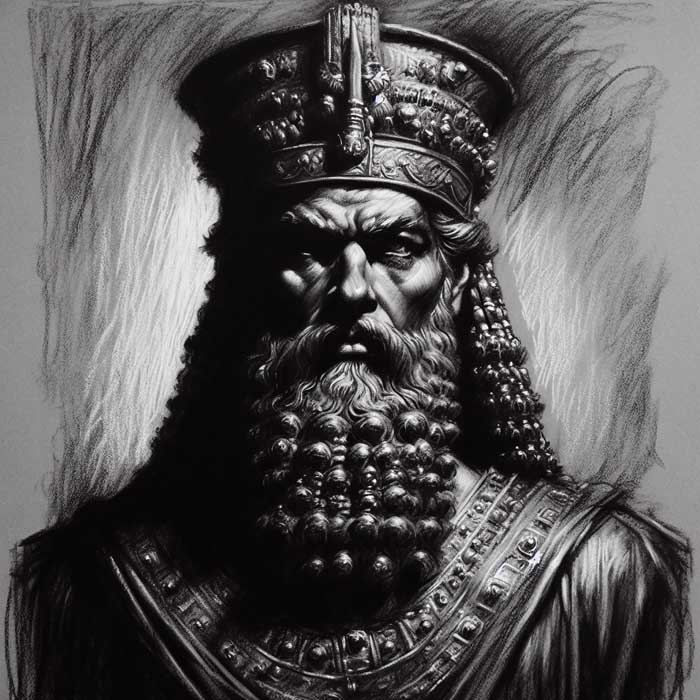
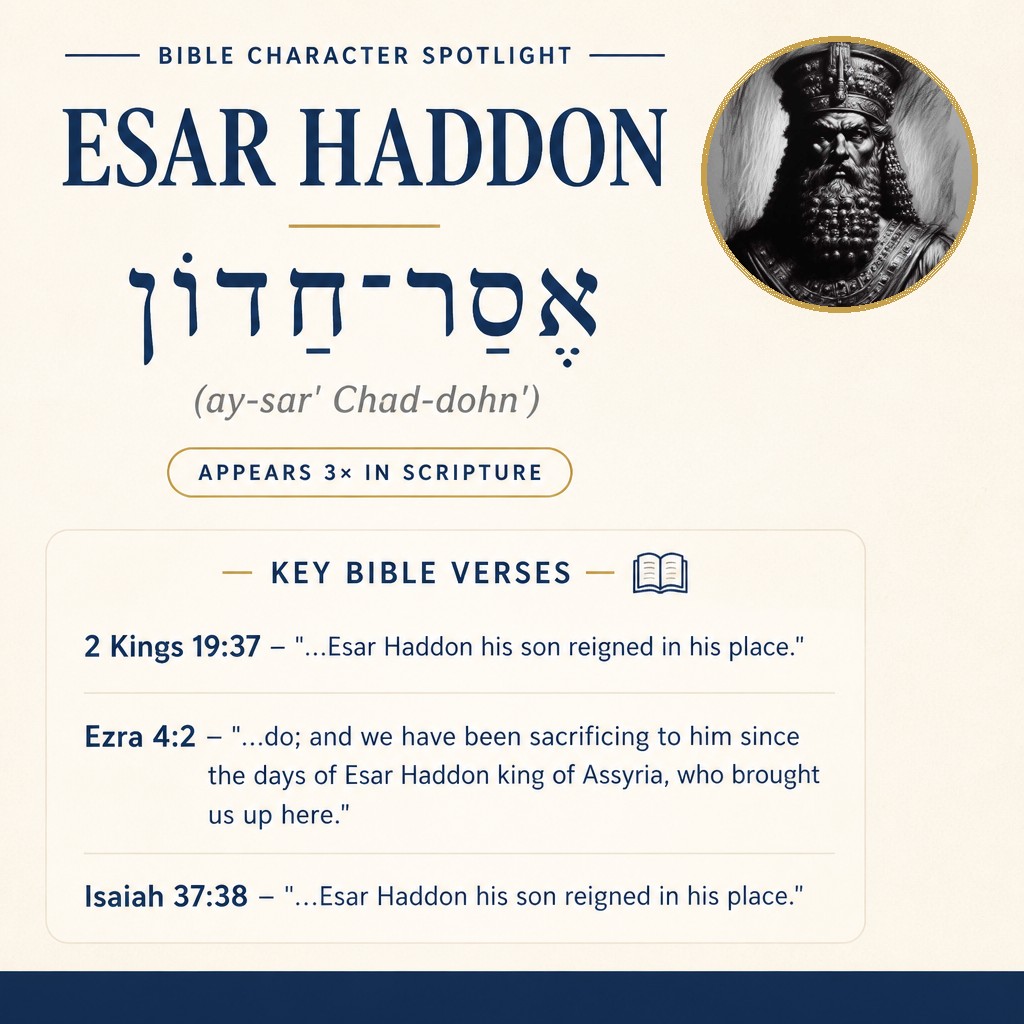
Esar Haddon is named as an Assyrian king in 2 Kings 19:37, Ezra 4:2, and Isaiah 37:38.
Succession Notice
After Sennacherib was struck down, “Esar Haddon his son reigned in his place” (2 Kings 19:37; Isaiah 37:38).
Learn More →Mention in Ezra
Some said they had been sacrificing “since the days of Esar Haddon king of Assyria, who brought us up here” (Ezra 4:2).
Learn More →Esar Haddon (אֵסַר־חַדּוֹן) is identified in the lexicon gloss as an Assyrian king. In Scripture he is mentioned as the son who succeeded Sennacherib, and as a king of Assyria whose actions were remembered by later speakers.
Esar Haddon in Scripture
Esar Haddon appears in the setting of Sennacherib king of Assyria’s departure from a military crisis and his return to Nineveh. The narrative context first reports a sudden disaster in the Assyrian camp, then Sennacherib’s withdrawal:
“That night, Yahweh’s angel went out, and struck one hundred eighty-five thousand in the camp of the Assyrians. When men arose early in the morning, behold, these were all dead bodies.” (2 Kings 19:35)
“So Sennacherib king of Assyria departed, and went and returned, and lived at Nineveh.” (2 Kings 19:36)
After Sennacherib’s return, the account describes his death while he was in an act of worship, and it names Esar Haddon as the successor:
“As he was worshiping in the house of Nisroch his god, Adrammelech and Sharezer struck him with the sword; and they escaped into the land of Ararat. Esar Haddon his son reigned in his place.” (2 Kings 19:37)
The parallel passage in Isaiah presents the same sequence in similar terms: a strike upon the Assyrian camp, Sennacherib’s retreat to Nineveh, and then the transition of rule to Esar Haddon after Sennacherib’s assassination.
“Then Yahweh’s angel went out and struck one hundred and eighty-five thousand men in the camp of the Assyrians. When men arose early in the morning, behold, these were all dead bodies.” (Isaiah 37:36)
“So Sennacherib king of Assyria departed, went away, returned to Nineveh, and stayed there.” (Isaiah 37:37)
“As he was worshiping in the house of Nisroch his god, Adrammelech and Sharezer his sons struck him with the sword; and they escaped into the land of Ararat. Esar Haddon his son reigned in his place.” (Isaiah 37:38)
Taken together, these passages locate Esar Haddon at a decisive moment of Assyrian royal succession: Sennacherib is killed, the killers flee “into the land of Ararat,” and “Esar Haddon his son reigned in his place” (2 Kings 19:37; Isaiah 37:38). The wording also presents Esar Haddon explicitly as Sennacherib’s son in both accounts.
Esar Haddon is also referenced in Ezra in a different setting: a dispute over rebuilding the temple in Jerusalem. “The adversaries of Judah and Benjamin” approach the Judean leaders with an offer to participate, grounding their claim in past religious practice and a past relocation associated with Esar Haddon:
“Now when the adversaries of Judah and Benjamin heard that the children of the captivity were building a temple to Yahweh, the God of Israel;” (Ezra 4:1)
“they came near to Zerubbabel, and to the heads of fathers’ households, and said to them, ‘Let us build with you; for we seek your God, as you do; and we have been sacrificing to him since the days of Esar Haddon king of Assyria, who brought us up here.’” (Ezra 4:2)
In this scene, Esar Haddon is directly called “king of Assyria” and is credited—by the speakers—with having “brought us up here” (Ezra 4:2). The narrative then reports the refusal from Zerubbabel, Jeshua, and other Israelite leaders, framing the offer as inappropriate for the rebuilding work:
“But Zerubbabel, and Jeshua, and the rest of the heads of fathers’ households of Israel, said to them, ‘You have nothing to do with us in building a house to our God; but we ourselves together will build to Yahweh, the God of Israel, as king Cyrus the king of Persia has commanded us.’” (Ezra 4:3)
The surrounding verses continue the picture of opposition and interference after the refusal:
“Then the people of the land weakened the hands of the people of Judah, and troubled them in building.” (Ezra 4:4)
“They hired counselors against them, to frustrate their purpose, all the days of Cyrus king of Persia, even until the reign of Darius king of Persia.” (Ezra 4:5)
Within this chapter context, Esar Haddon is not portrayed speaking or acting directly; rather, he is mentioned as a reference point for the adversaries’ history: they claim continuity of worship (“we have been sacrificing to him since the days of Esar Haddon king of Assyria”) and they attribute their presence in the land to him (“who brought us up here”) (Ezra 4:2).
Name and Meaning
The name is written in Hebrew as אֵסַר־חַדּוֹן, transliterated ‘Ecar-Chaddown, and pronounced ay-sar’ Chad-dohn’. Strong’s classifies it as being of foreign derivation, and the lexicon gloss identifies Esarchaddon as an Assyrian king.
Observation
Across Kings, Isaiah, and Ezra, Esar Haddon is consistently presented with royal authority connected to Assyria: he “reigned in his place” after Sennacherib (2 Kings 19:37; Isaiah 37:38) and is remembered as “Esar Haddon king of Assyria” in later disputes about the temple rebuilding (Ezra 4:2).
Frequently Asked Questions
What does the name Esar Haddon mean?
Esar Haddon is a name of foreign derivation used for Esarchaddon, an Assyrian king.
How many times does Esar Haddon appear in the Bible?
Esar Haddon appears 3 times.
Who was Esar Haddon?
Esar Haddon is identified as Esarchaddon, an Assyrian king.
What event is Esar Haddon mentioned in during the reign of Sennacherib?
After Sennacherib was struck with the sword by Adrammelech and Sharezer and they escaped into the land of Ararat, Esar Haddon is mentioned in the account (2 Kings 19:37; Isaiah 37:38).
Explore Further
If you found this page about Esar-Haddon interesting and would like to discover more about other biblical characters, explore our comprehensive Encyclopedia of Biblical Characters. For those looking to delve deeper into the Greek origins of these names and terms, our Greek Lexicon is an invaluable resource.
Sources: Name and occurrence data from Strong’s Exhaustive Concordance and STEPBible reference data (CC BY). Scripture quotations from the World English Bible (public domain).