Who was Enan in the bible?
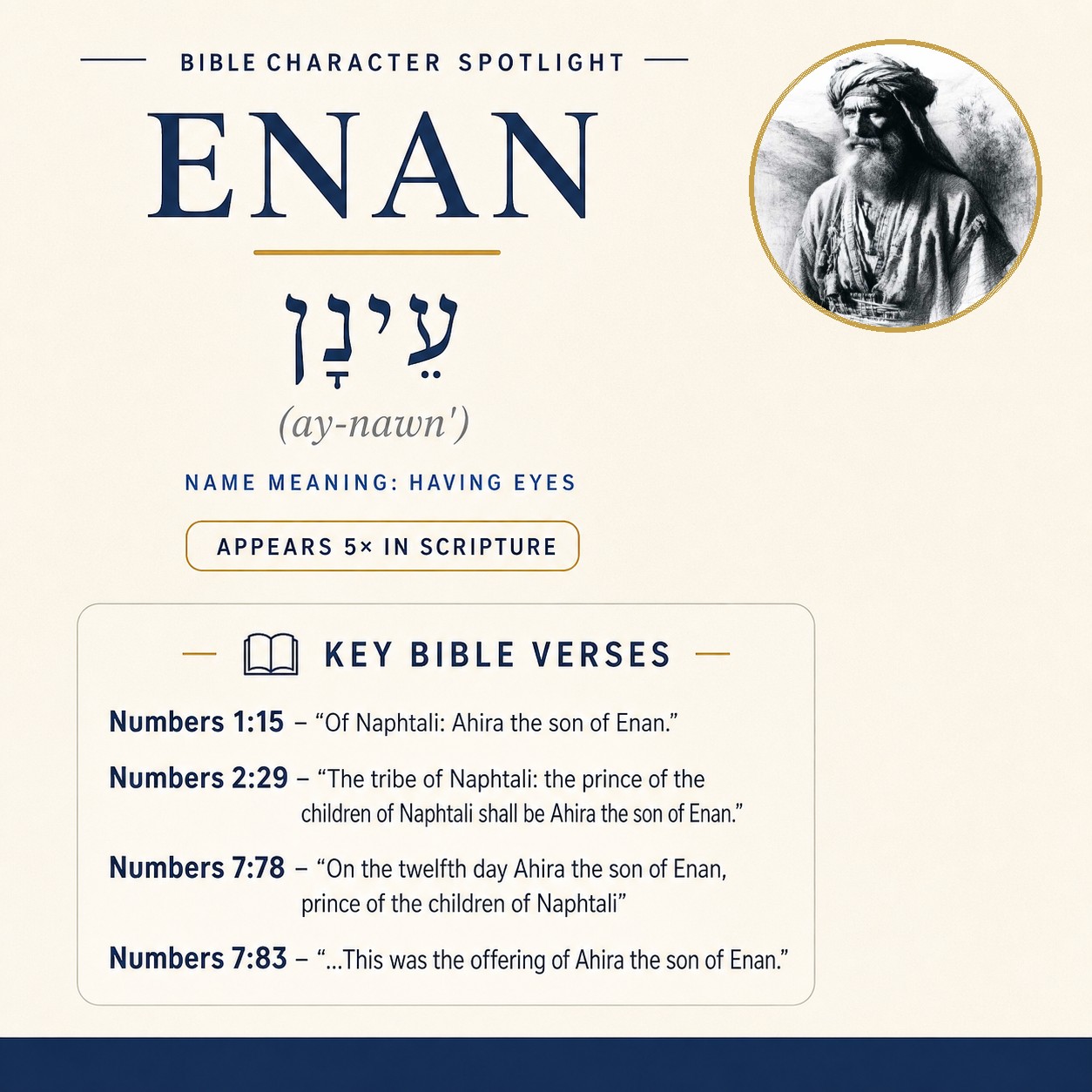
Enan is named in Numbers as the father of Ahira, identified with the tribe of Naphtali (Numbers 1:15; 2:29; 7:78; 7:83; 10:27).

Where Mentioned
Enan is referenced in census and camp listings: “the tribe of Naphtali… Ahira the son of Enan” (Numbers 2:29).
Learn More →In Tabernacle Rite
At the altar dedication, “Ahira the son of Enan, prince of the children of Naphtali,” presented an offering (Numbers 7:78), and it concludes, “This was the offering of Ahira the son of Enan” (Numbers 7:83).
Learn More →Enan is presented as an Israelite known through his connection to Ahira, who is repeatedly identified as “the son of Enan.” The name is explained in lexicon tradition as being derived from a term for “an eye,” giving the sense “having eyes.”
Enan in Scripture
Enan appears in the book of Numbers only in patronymic references that identify Ahira as his son, in settings that place Ahira among the leaders and military organizers of the tribe of Naphtali. In the census-related listing of tribal leadership, Enan is named when Naphtali’s representative is introduced:
“Of Naphtali: Ahira the son of Enan.” (Numbers 1:15)
This identification is repeated as the camp and its leadership are arranged by tribe, again anchoring Ahira’s identity in his descent from Enan:
“The tribe of Naphtali: the prince of the children of Naphtali shall be Ahira the son of Enan.” (Numbers 2:29)
Numbers 7 provides a longer narrative context in which Enan’s name appears near the end of a sequence of offerings brought by the “princes of Israel.” The chapter opens by describing the scene: the tabernacle has been set up and consecrated, and Israel’s leaders bring offerings before Yahweh. The narrative frames these events as taking place at the tabernacle and being directed by divine instruction. It begins:
“On the day that Moses had finished setting up the tabernacle, and had anointed it and sanctified it with all its furniture, and the altar with all its vessels, and had anointed and sanctified them; the princes of Israel, the heads of their fathers’ houses, offered.” (Numbers 7:1–2)
The text emphasizes that these leaders were tribal princes “over those who were counted” and that they brought shared resources—wagons and oxen—to be accepted for service at the Tent of Meeting. Yahweh’s speech to Moses commands their acceptance and distribution to the Levites “according to his service,” and Moses carries this out, assigning wagons and oxen to Gershon and Merari while giving none to Kohath because “they carried it on their shoulders” (Numbers 7:3–9). In this way, the chapter presents both the people’s offerings and the ordering of worship-related service under Yahweh’s direction to Moses.
The narrative then turns to offerings brought for the dedication of the altar, structured by another direct word from Yahweh that sets the order and rhythm of the leaders’ participation:
“Yahweh said to Moses, ‘They shall offer their offering, each prince on his day, for the dedication of the altar.’” (Numbers 7:11)
What follows is a day-by-day accounting, naming each prince and listing a set pattern of gifts. The account culminates on the twelfth day with Naphtali’s prince, who is identified again through Enan. Enan himself is not described acting or speaking; rather, his name functions as part of the formal identification of Ahira in the public religious proceedings surrounding the altar’s dedication:
“On the twelfth day Ahira the son of Enan, prince of the children of Naphtali,” (Numbers 7:78)
The report includes the details of Ahira’s offering and closes that section by repeating the patronymic, attaching Enan’s name to the recorded act of giving. After listing the items for the peace offering, the text states:
“and for the sacrifice of peace offerings, two head of cattle, five rams, five male goats, and five male lambs a year old. This was the offering of Ahira the son of Enan.” (Numbers 7:83)
The chapter then totals the dedication offerings brought by all the princes, enumerating the vessels, weights, and animals offered, and ends with a brief scene of Moses entering the Tent of Meeting and hearing Yahweh’s voice from above the mercy seat (Numbers 7:84–89). Within this larger narrative, Enan’s appearance is indirect but tied to a significant communal act: Naphtali’s prince is named, and Enan’s name is preserved in the formal record of leadership and offering.
Enan’s name also appears in the organization of Israel’s marching and military arrangement. In the description of who was “over the army” of the tribe of Naphtali, the same identification is used:
“Ahira the son of Enan was over the army of the tribe of the children of Naphtali.” (Numbers 10:27)
Across these references, Enan is consistently the father of Ahira and is linked to Naphtali’s leadership and organization in the wilderness setting described by Numbers.
Name and Meaning
The name is written עֵינָן, transliterated ‘Eynan (pronounced ay-nawn). Lexicon explanation derives it from a Hebrew root associated with “an eye” (עַיִן, literally or figuratively), yielding the sense of “having eyes.”
Observation
Enan is not portrayed by actions or speech, but his name repeatedly marks Ahira’s public role—“the prince of the children of Naphtali” (Numbers 2:29) and one who brought a recorded offering at the altar’s dedication (Numbers 7:78–83).
Frequently Asked Questions
What does the name Enan mean?
Enan means “having eyes.”
How many times does Enan appear in the Bible?
Enan appears 5 times.
Who was Enan?
Enan is identified as an Israelite and is named as the father of Ahira of the tribe of Naphtali (Numbers 1:15; 2:29).
Where is Enan mentioned in relation to the tribe of Naphtali?
He is mentioned in connection with Ahira, who is called “the son of Enan” and is described as a prince and as over the army of Naphtali (Numbers 7:78; 10:27).
Explore Further
If you found this page about Enan interesting and would like to discover more about other biblical characters, explore our comprehensive Encyclopedia of Biblical Characters. For those looking to delve deeper into the Greek origins of these names and terms, our Greek Lexicon is an invaluable resource.
Sources: Name and occurrence data from Strong’s Exhaustive Concordance and STEPBible reference data (CC BY). Scripture quotations from the World English Bible (public domain).