
Who was Eliphaz in the bible?
Eliphaz is the name of Esau’s son in Genesis 36 and 1 Chronicles 1, and of Job’s friend “Eliphaz the Temanite” in Job 2 and Job 42.

Esau’s Son
“Adah bore to Esau Eliphaz” (Genesis 36:4). “The sons of Eliphaz were Teman, Omar, Zepho, and Gatam, and Kenaz” (Genesis 36:11).
Learn More →Job’s Friend
Job’s friends included “Eliphaz the Temanite” who came “to sympathize with him and to comfort” him (Job 2:11). Yahweh said to him, “My wrath is kindled against you… for you have not spoken of me the thing that is right” (Job 42:7).
Learn More →Eliphaz is a biblical name borne by (1) a son of Esau and (2) one of Job’s three friends, identified as “the Temanite.” A lexicon-based gloss also associates the name with the idea “God of gold,” drawing from Hebrew components meaning “God/strength” and “pure gold.”
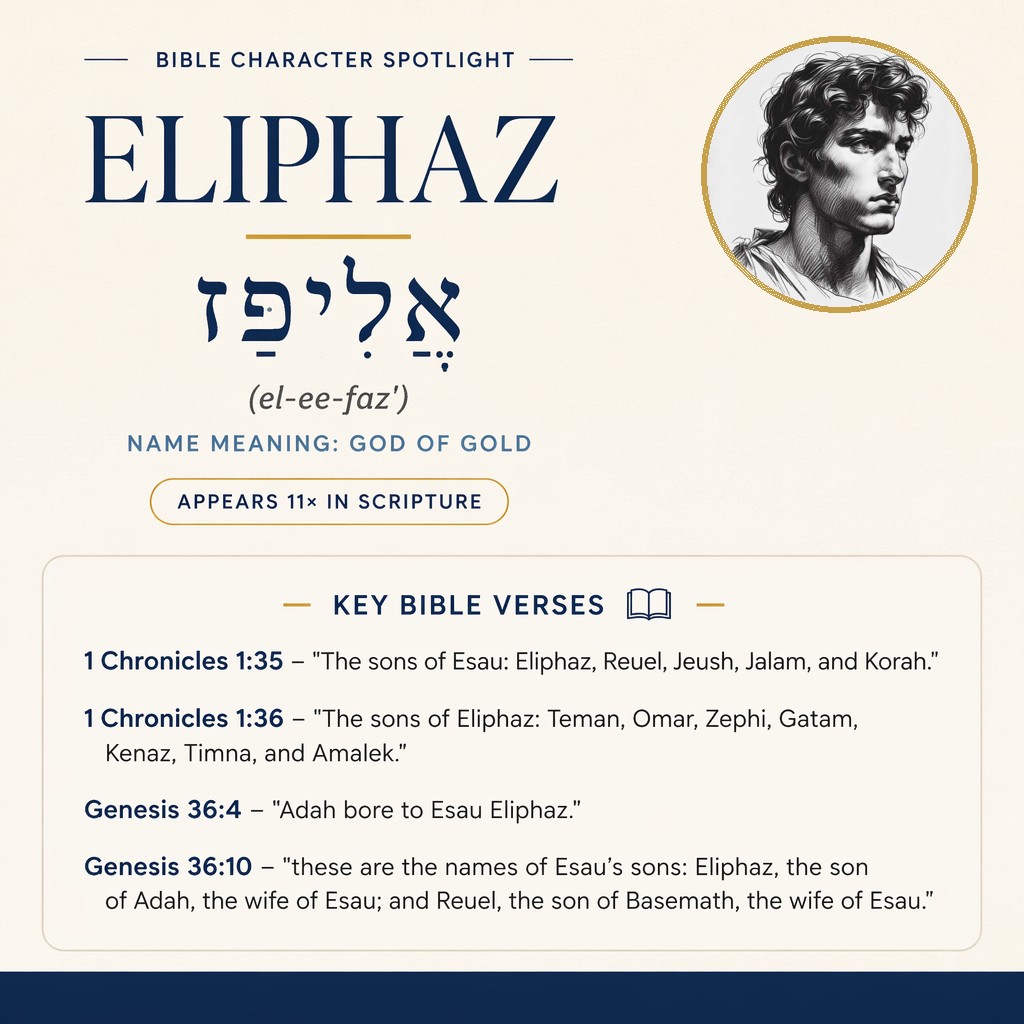
Eliphaz in Scripture
In Genesis and 1 Chronicles, Eliphaz appears in genealogical lists that situate him within Esau’s line and then enumerate his descendants and associated chiefs.
“Adah bore to Esau Eliphaz. Basemath bore Reuel.” (Genesis 36:4)
Genesis 36 introduces its setting as a record of Esau’s generations: “Now this is the history of the generations of Esau (that is, Edom)” (Genesis 36:1). Within that framework, Eliphaz is named among Esau’s sons: “these are the names of Esau’s sons: Eliphaz, the son of Adah, the wife of Esau; and Reuel, the son of Basemath, the wife of Esau” (Genesis 36:10). The chapter also includes wider context about Esau’s household and relocation: “Esau took his wives, his sons, his daughters, and all the members of his household… and went into a land away from his brother Jacob” (Genesis 36:6), and, “Esau lived in the hill country of Seir. Esau is Edom” (Genesis 36:8).
Genesis then lists Eliphaz’s sons.
“The sons of Eliphaz were Teman, Omar, Zepho, and Gatam, and Kenaz.” (Genesis 36:11)
An additional descendant is named through Timna.
“Timna was concubine to Eliphaz, Esau’s son; and she bore to Eliphaz Amalek. These are the descendants of Adah, Esau’s wife.” (Genesis 36:12)
Genesis 36 proceeds from personal genealogy to leadership designations among Esau’s descendants, naming chiefs connected to Eliphaz’s line:
“These are the chiefs of the sons of Esau: the sons of Eliphaz the firstborn of Esau: chief Teman, chief Omar, chief Zepho, chief Kenaz,” (Genesis 36:15)
“chief Korah, chief Gatam, chief Amalek. These are the chiefs who came of Eliphaz in the land of Edom. These are the sons of Adah.” (Genesis 36:16)
The chapter continues listing chiefs from other branches of Esau’s family and then gives a wider register of people and rulers “in the land of Edom,” including the concluding summary: “These are the sons of Esau (that is, Edom), and these are their chiefs” (Genesis 36:19), and at the end, “These are the chiefs of Edom, according to their habitations in the land of their possession. This is Esau, the father of the Edomites” (Genesis 36:43). Within this narrative, Eliphaz is presented as Esau’s son through Adah and as a progenitor whose descendants are named and whose line includes recognized “chiefs… in the land of Edom.”
The Chronicler repeats the genealogical information in a condensed form. First, Eliphaz is again listed among Esau’s sons:
“The sons of Esau: Eliphaz, Reuel, Jeush, Jalam, and Korah.” (1 Chronicles 1:35)
Then the sons of Eliphaz are listed, including Timna among the names given:
“The sons of Eliphaz: Teman, Omar, Zephi, Gatam, Kenaz, Timna, and Amalek.” (1 Chronicles 1:36)
In Job, Eliphaz is a different figure: one of Job’s “three friends,” identified by a geographic or clan designation, “the Temanite.” When Job’s friends hear of his suffering, they come together with a shared purpose.
“Now when Job’s three friends heard of all this evil that had come on him, they each came from his own place: Eliphaz the Temanite, Bildad the Shuhite, and Zophar the Naamathite; and they made an appointment together to come to sympathize with him and to comfort…” (Job 2:11)
Near the close of Job, Eliphaz is addressed directly by Yahweh after Yahweh has “spoken these words to Job.”
“It was so, that after Yahweh had spoken these words to Job, Yahweh said to Eliphaz the Temanite, ‘My wrath is kindled against you, and against your two friends; for you have not spoken of me the thing that is right, as my servant Job has.’” (Job 42:7)
The narrative then records that Eliphaz and the other two friends responded in obedience, and that Job was accepted by Yahweh.
“So Eliphaz the Temanite and Bildad the Shuhite and Zophar the Naamathite went, and did what Yahweh commanded them, and Yahweh accepted Job.” (Job 42:9)
Multiple Bearers
The name Eliphaz belongs to at least two distinct individuals in Scripture.
First, Eliphaz is “the son of Adah, the wife of Esau” (Genesis 36:10), born to Esau as recorded: “Adah bore to Esau Eliphaz” (Genesis 36:4). He is associated with a set of descendants—“Teman, Omar, Zepho, and Gatam, and Kenaz” (Genesis 36:11)—and also with Amalek through Timna: “she bore to Eliphaz Amalek” (Genesis 36:12). Genesis identifies “the sons of Eliphaz” as a leading branch among Esau’s line by naming chiefs connected to them (Genesis 36:15–16). 1 Chronicles 1:35–36 repeats these genealogical notices.
Second, Eliphaz is “Eliphaz the Temanite” (Job 2:11), one of Job’s three friends who come “to sympathize with him and to comfort” (Job 2:11). At the end of Job, Yahweh’s rebuke is directed to him by name: “Yahweh said to Eliphaz the Temanite, ‘My wrath is kindled against you, and against your two friends’” (Job 42:7), and he is included among those who “did what Yahweh commanded them” (Job 42:9).
Name and Meaning
In Hebrew script the name is אֱלִיפַז, transliterated ’Eliyphaz and pronounced “el-ee-faz.” A lexicon-derived explanation relates the name to Hebrew components often associated with “God/strength” (’el) and “pure gold” (paz), yielding the sense “God of gold.”
Observation
Across the passages, Eliphaz is tied either to Esau’s family line—where “chiefs… came of Eliphaz in the land of Edom” (Genesis 36:16)—or to Job’s story, where “Eliphaz the Temanite” is named both in the friends’ intent “to sympathize… and to comfort” (Job 2:11) and in Yahweh’s assessment: “you have not spoken of me the thing that is right” (Job 42:7).
Frequently Asked Questions
What does the name Eliphaz mean?
Eliphaz means “God of gold.”
How many times does Eliphaz appear in the Bible?
Eliphaz occurs 11 times.
Who was Eliphaz in the Bible?
Eliphaz is the name of one of Job’s friends (Job 2:11) and also a son of Esau (Genesis 36:4).
What did Yahweh say to Eliphaz after speaking to Job?
After Yahweh spoke to Job, Yahweh said to Eliphaz the Temanite, “My wrath is kindled against you, and against your two friends” (Job 42:7).
Explore Further
If you found this page about Eliphaz interesting and would like to discover more about other biblical characters, explore our comprehensive Encyclopedia of Biblical Characters. For those looking to delve deeper into the Greek origins of these names and terms, our Greek Lexicon is an invaluable resource.
Sources: Name and occurrence data from Strong’s Exhaustive Concordance and STEPBible reference data (CC BY). Scripture quotations from the World English Bible (public domain).





