
Who was Bukki in the bible?
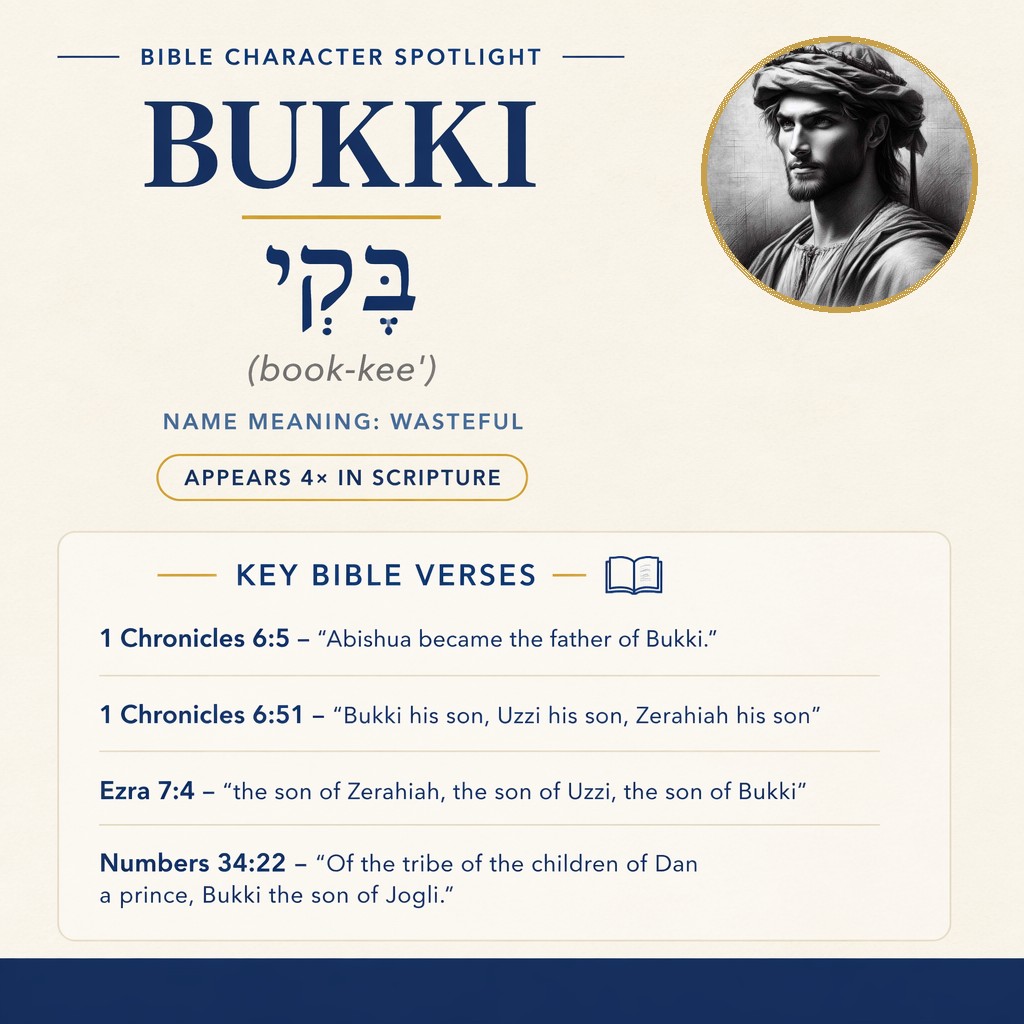
Bukki is the name of two Israelites: one in Aaron’s priestly line (1 Chronicles 6; Ezra 7), and one a prince of Dan, “Bukki the son of Jogli” (Numbers 34:22).
Priestly Lineage
“Abishua became the father of Bukki. Bukki became the father of Uzzi” (1 Chronicles 6:5). He appears again in the same lineage list: “Bukki his son, Uzzi his son” (1 Chronicles 6:51; Ezra 7:4).
Learn More →Danite Prince
In a tribal list, Scripture says: “Of the tribe of the children of Dan a prince, Bukki the son of Jogli” (Numbers 34:22).
Learn More →Bukki (Buqqiy) is the name of two Israelites in the Bible. One Bukki appears in priestly genealogies connected with Aaron’s line, and another Bukki is named as “a prince” from the tribe of Dan.
Bukki in Scripture
The name Bukki first appears within a genealogy in 1 Chronicles 6 that traces descent from Aaron through his son Eleazar. The wider setting begins with Aaron’s family:
The children of Amram: Aaron, Moses, and Miriam. The sons of Aaron: Nadab, Abihu, Eleazar, and Ithamar. (1 Chronicles 6:3)
The genealogy then narrows specifically to Eleazar’s line, placing Bukki between Abishua and Uzzi:
Eleazar became the father of Phinehas, Phinehas became the father of Abishua, (1 Chronicles 6:4)
Abishua became the father of Bukki. Bukki became the father of Uzzi. (1 Chronicles 6:5)
Uzzi became the father of Zerahiah. Zerahiah became the father of Meraioth. (1 Chronicles 6:6)
In this presentation, Bukki’s role is genealogical: he is identified by his place in a line of descent (“Abishua became the father of Bukki”) and by his own fathering of Uzzi (“Bukki became the father of Uzzi”).
Later in the same chapter, the Chronicler again frames this line in connection with Aaron and his sons’ priestly work:
But Aaron and his sons offered on the altar of burnt offering, and on the altar of incense, for all the work of the most holy place, and to make atonement for Israel, according to all that Moses the servant of God had commanded. (1 Chronicles 6:49)
Immediately following this statement, the text repeats a segment of the genealogy, again naming Bukki as part of Aaron’s descendants through Eleazar:
These are the sons of Aaron: Eleazar his son, Phinehas his son, Abishua his son, (1 Chronicles 6:50)
Bukki his son, Uzzi his son, Zerahiah his son, (1 Chronicles 6:51)
Meraioth his son, Amariah his son, Ahitub his son, (1 Chronicles 6:52)
Zadok his son, and Ahimaaz his son. (1 Chronicles 6:53)
In this second listing, Bukki is still presented as a link in the same priestly descent line (“Bukki his son, Uzzi his son”), embedded in a context that highlights Aaron and his sons’ sacrificial responsibilities.
The name Bukki appears once more in a later genealogy, this time in Ezra 7, as part of the lineage given for Ezra. The surrounding sequence in Ezra includes names also found in 1 Chronicles 6, and Bukki again appears as an ancestor:
the son of Shallum, the son of Zadok, the son of Ahitub, (Ezra 7:2)
the son of Amariah, the son of Azariah, the son of Meraioth, (Ezra 7:3)
the son of Zerahiah, the son of Uzzi, the son of Bukki, (Ezra 7:4)
the son of Abishua, the son of Phinehas, the son of Eleazar, the son of Aaron the chief priest— (Ezra 7:5)
Here Bukki is named in reverse order within the ancestral chain (“the son of Zerahiah, the son of Uzzi, the son of Bukki”), fitting the same line previously shown in 1 Chronicles 6: “Bukki became the father of Uzzi” (1 Chronicles 6:5). Ezra’s passage then continues into narrative about Ezra himself:
this Ezra went up from Babylon. He was a skilled scribe in the law of Moses, which Yahweh, the God of Israel had given; and the king granted him all his request, according to Yahweh his God’s hand on him. (Ezra 7:6)
Some of the children of Israel, including some of the priests, the Levites, the singers, the gatekeepers, and the temple servants went up to Jerusalem in the seventh year of Artaxerxes the king. (Ezra 7:7)
Within Ezra 7, then, Bukki’s significance remains genealogical: he is one ancestor in the line that culminates in Ezra, who is described as “a skilled scribe in the law of Moses” (Ezra 7:6). The genealogy specifically links back to “Aaron the chief priest” (Ezra 7:5), placing Bukki within a priestly ancestral framework.
A different Bukki appears in Numbers 34. In that chapter, a list of leaders (“princes”) is provided by tribe. Bukki is named as the prince for Dan:
Of the tribe of the children of Dan a prince, Bukki the son of Jogli. (Numbers 34:22)
The surrounding verses show the same format for other tribes, placing Bukki among a sequence of tribal leaders identified by both tribe and father’s name:
Of the tribe of the children of Simeon, Shemuel the son of Ammihud. (Numbers 34:20)
Of the tribe of Benjamin, Elidad the son of Chislon. (Numbers 34:21)
Of the children of Joseph: of the tribe of the children of Manasseh a prince, Hanniel the son of Ephod. (Numbers 34:23)
Of the tribe of the children of Ephraim a prince, Kemuel the son of Shiphtan. (Numbers 34:24)
Of the tribe of the children of Zebulun a prince, Elizaphan the son of Parnach. (Numbers 34:25)
In Numbers 34, Bukki is therefore identified not by descent from Aaron, but as “Bukki the son of Jogli” and as a representative leader within “the tribe of the children of Dan” (Numbers 34:22).
Two men named Bukki
The Bible uses the same name for at least two distinct individuals in these passages.
(1) Bukki in Aaron’s line. In 1 Chronicles 6, Bukki is positioned within a lineage introduced with “The sons of Aaron” (1 Chronicles 6:3) and later tied to Aaron’s sons who “offered on the altar of burnt offering, and on the altar of incense” (1 Chronicles 6:49). Bukki’s precise genealogical placement is stated directly: “Abishua became the father of Bukki. Bukki became the father of Uzzi.” (1 Chronicles 6:5). This same lineage is echoed in Ezra’s ancestry: “the son of Zerahiah, the son of Uzzi, the son of Bukki” (Ezra 7:4), and proceeds to “Aaron the chief priest—” (Ezra 7:5).
(2) Bukki the Danite prince. Numbers 34 presents Bukki in a different role and tribal setting: “Of the tribe of the children of Dan a prince, Bukki the son of Jogli.” (Numbers 34:22). The form and context align him with other tribal princes listed in the same way (Numbers 34:20–25), distinguishing him from the genealogical Bukki connected with Aaron’s descendants.
Name and Meaning
The name is written in Hebrew as בֻּקִּי, transliterated Buqqiy, and pronounced book-kee’. Lexically, the name is explained as deriving from a root associated with being “wasteful,” connected with the Hebrew verb baqaq (בָּקַק), “to pour out” or “to empty,” used figuratively as well.
Observation
Across these passages, Bukki is presented through concise identifiers: in the genealogies as the one of whom it is said, “Bukki became the father of Uzzi” (1 Chronicles 6:5), and in Numbers as “a prince, Bukki the son of Jogli” (Numbers 34:22).
Frequently Asked Questions
What does the name Bukki mean?
The name Bukki is given as meaning “wasteful.”
How many times does Bukki appear in the Bible?
Bukki appears 4 times.
Who was Bukki in the Bible?
Bukki is the name of two Israelites. One Bukki appears in a genealogy: “Abishua became the father of Bukki. Bukki became the father of Uzzi” (1 Chronicles 6:5).
What is Bukki’s role in Numbers 34:22?
In Numbers 34:22, Bukki is named as “a prince” from the tribe of Dan and is identified as “Bukki the son of Jogli.”
Explore Further
If you found this page about Bukki interesting and would like to discover more about other biblical characters, explore our comprehensive Encyclopedia of Biblical Characters. For those looking to delve deeper into the Greek origins of these names and terms, our Greek Lexicon is an invaluable resource.
Sources: Name and occurrence data from Strong’s Exhaustive Concordance and STEPBible reference data (CC BY). Scripture quotations from the World English Bible (public domain).





