
Exploring the Meaning of Katalalos in Greek
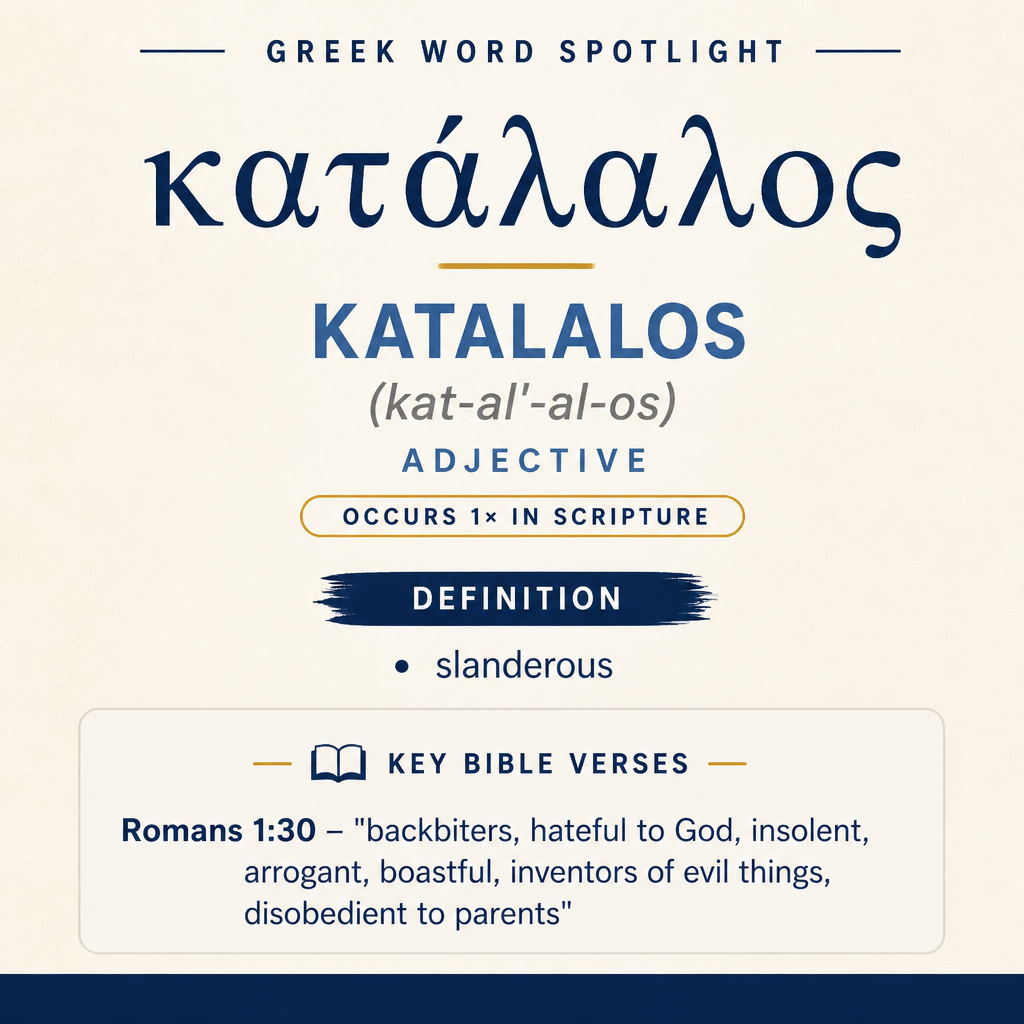
κατάλαλος means “slanderous” and appears once in Scripture in Romans 1:30.
Context in Romans
In Romans 1:30 it appears among descriptors including “backbiters” and “hateful to God.”
Learn More →κατάλαλος means “slanderous” and appears in the vice list of Romans 1:30. In that context it describes a kind of speech that harms others by what is said about them.
Root and Related Words
κατάλαλος is connected with kata (κατά), “according to,” and laleo (λαλέω), “to speak.” The combination points to speech characterized in a particular direction or manner, with the overall adjective describing speech as slanderous.

Occurrences
“backbiters, hateful to God, insolent, arrogant, boastful, inventors of evil things, disobedient to parents,” (Romans 1:30)
In Romans 1:30, κατάλαλος is rendered “backbiters” within a dense sequence of descriptions. The placement of this term among other relational and social vices highlights that the slanderous quality Paul names is not an abstract flaw but a destructive posture toward other people expressed through words. The surrounding items help frame how the term functions: it is listed alongside attitudes and behaviors that rupture proper regard for others (“insolent,” “arrogant,” “boastful”) and actions that breed harm (“inventors of evil things”), showing that slanderous speech is treated as part of a wider pattern of human wrongdoing rather than as a minor lapse.
The English “backbiters” evokes a particular social setting: harm done in another person’s absence, speech delivered where the target cannot respond. Without needing to supply additional glosses, the verse itself makes clear that κατάλαλος belongs to the sphere of interpersonal injury—damage inflicted through what one says about someone else. In the rhythm of the list, the word contributes a concrete, everyday expression of evil: not merely hostile feeling, but speech that turns hostility into reputational harm. That makes it a vice that spreads easily within communities, because it is carried by ordinary conversation.
Romans 1:30 also places this descriptor after “hateful to God.” In that sequence, slanderous speech stands as one expression of a larger moral disorder: the same distorted posture that is “hateful to God” can also appear in how people talk about people. The term therefore functions as a diagnostic label within the list—one piece of evidence of a life disordered in multiple directions at once. It is not isolated; it sits in a catalogue where each item presses the reader to recognize the breadth of corrupted conduct, including conduct that takes the form of speech.
Sense and Usage
The definition “slanderous” identifies κατάλαλος as describing speech that damages another person. In Romans 1:30, this damage is not described in detail; instead, the term is embedded in a compressed inventory of offenses. That style of listing has an effect: it assumes the reader can recognize what such speech looks like in practice, even without narrative illustration. The word is potent precisely because it does not require elaborate explanation; it names a recognizable vice with a clear social footprint.
Within the vice list, the term’s force comes from its proximity to other markers of pride and harm. “Insolent,” “arrogant,” and “boastful” describe a swollen self-regard, while “inventors of evil things” suggests active creativity in wrongdoing. Set among those, κατάλαλος depicts speech that is not neutral talk but talk enlisted into wrongdoing. In other words, the slanderous quality is treated as morally freighted speech, not merely unguarded conversation. Romans 1:30 presents it as part of a network: inner disposition (haughtiness), outward behavior (disobedience), and verbal harm (slanderous talk) appear together as mutually reinforcing expressions of evil.
The single attested use also shows how naturally the adjective can function as a character label. Rather than describing an isolated act—one moment of speaking—the word sits comfortably as a descriptor of people in general terms (“backbiters…”). In Romans 1:30 the concern is not one incident but a settled pattern that can be named alongside other settled traits. That grammatical choice makes the term weighty: it paints slanderous speech as characteristic conduct, a habit that can define someone’s social presence.
Because the verse places κατάλαλος in a list that moves quickly from one vice to the next, the word’s semantic contribution is sharpened by contrast. Some items emphasize attitude (“arrogant”), some emphasize self-presentation (“boastful”), some emphasize creativity in wrongdoing (“inventors of evil things”), and some emphasize family breakdown (“disobedient to parents”). κατάλαλος contributes a distinct category: harm done by speech. The passage thereby treats slander as a serious mode of wrongdoing in its own right, not merely a symptom of other faults. Even in a compressed list, it earns a place as a vice worth naming explicitly.
Imagery
Romans 1:30 pictures no scene, but the term itself suggests a recognizable human setting implied by “backbiters”: conversations where someone is discussed without being present, and words become a tool for injury. Within the list, that implied setting is one more arena where wrongdoing takes shape—not only in grand acts of evil, but in ordinary speech that turns against a neighbor.
Sources: Lexical data from Strong’s Exhaustive Concordance and the Translators Brief Lexicon of Extended Strongs for Greek (STEPBible, CC BY). Occurrence data from the Translators Amalgamated Greek New Testament (STEPBible, CC BY). Scripture quotations from the World English Bible (public domain).




