Who was Arah in the bible?
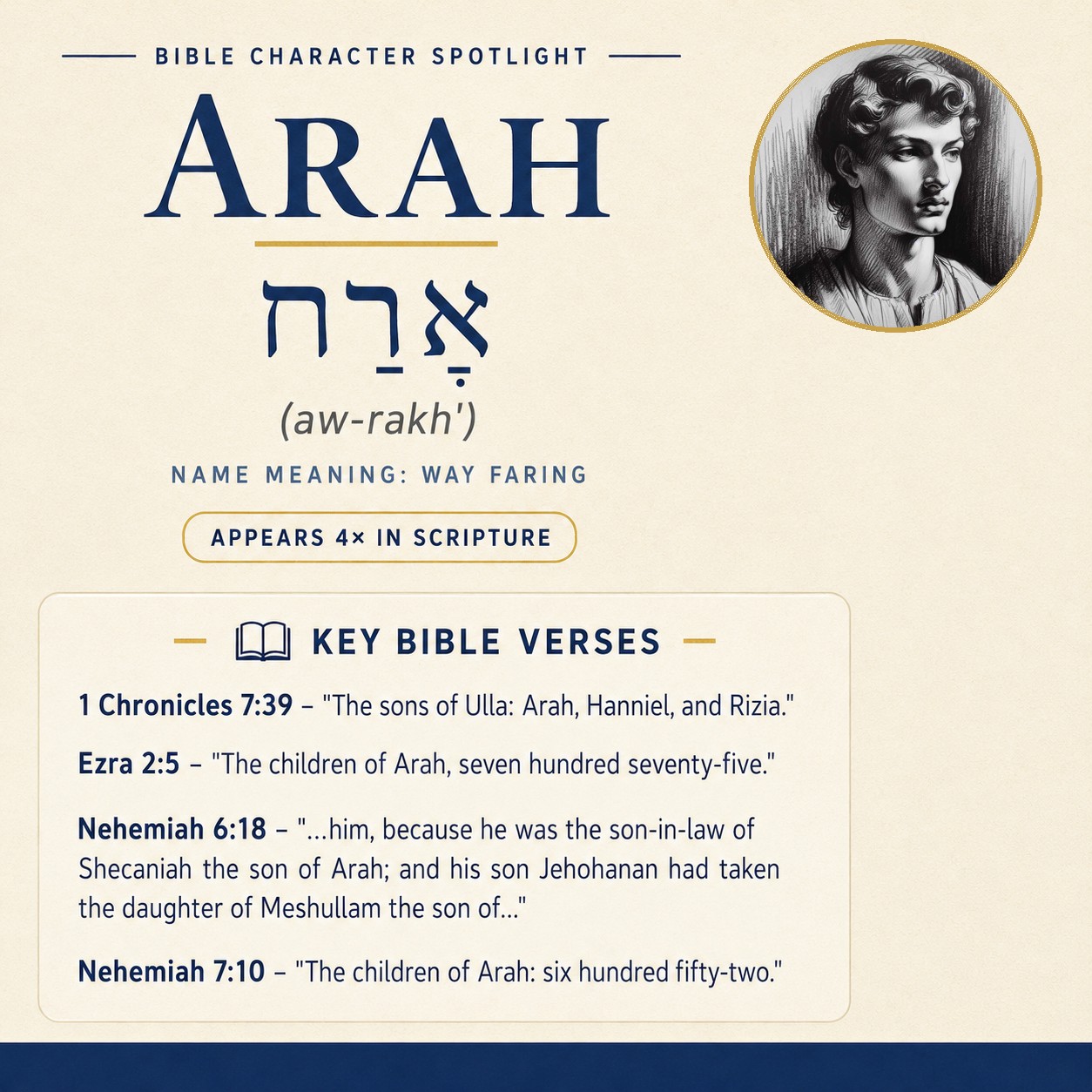
Arah (Arach) is the name of three Israelites mentioned in 1 Chronicles 7:39, Ezra 2:5, Nehemiah 6:18, and Nehemiah 7:10.

Family Line
In Judah, a man is identified as “the son-in-law of Shecaniah the son of Arah.” (Nehemiah 6:18).
Learn More →Children of Arah
Arah also appears as an ancestor of a counted group: “The children of Arah, seven hundred seventy-five.” (Ezra 2:5); “The children of Arah: six hundred fifty-two.” (Nehemiah 7:10).
Learn More →Arah (also spelled from the Hebrew form ‘Arach) is presented as the name of multiple Israelites in Scripture. One Arah appears in a genealogy among the children of Asher, another Arah is the eponym of a family group counted among “the children of” a returned community, and an Arah is named as an ancestor in a marriage connection mentioned during opposition to Nehemiah’s work.
Arah in Scripture
The first occurrence is in a genealogical context in 1 Chronicles 7. Arah is listed among the sons of Ulla, within a section that culminates by identifying these genealogies as belonging to Asher.
“The sons of Ulla: Arah, Hanniel, and Rizia.” (1 Chronicles 7:39)
The surrounding lines keep the setting within family lists: “The sons of Jether: Jephunneh, Pispa, and Ara.” (1 Chronicles 7:38). The passage then closes by locating these names within Asher and describing their status and numbers for war service:
“All these were the children of Asher, heads of the fathers’ houses, choice and mighty men of valor, chief of the princes. The number of them listed by genealogy for service in war was twenty-six thousand men.” (1 Chronicles 7:40)
Arah next appears as the head-name of a family group counted among “the children of” various houses in Ezra’s list. In that list, Arah’s group is enumerated between Parosh/Shephatiah and Pahathmoab/Elam/Zattu:
“The children of Arah, seven hundred seventy-five.” (Ezra 2:5)
The immediate context frames this as one item in a numbered series:
“The children of Parosh, two thousand one hundred seventy-two.” (Ezra 2:3)
“The children of Shephatiah, three hundred seventy-two.” (Ezra 2:4)
“The children of Arah, seven hundred seventy-five.” (Ezra 2:5)
“The children of Pahathmoab, of the children of Jeshua and Joab, two thousand eight hundred twelve.” (Ezra 2:6)
“The children of Elam, one thousand two hundred fifty-four.” (Ezra 2:7)
“The children of Zattu, nine hundred forty-five.” (Ezra 2:8)
In Nehemiah 6, Arah is mentioned as an ancestor in a report explaining why “many in Judah” were closely tied to Tobiah. The surrounding narrative describes pressure and communication involving Tobiah, set against the perception that the work had divine backing. The sequence reads:
“When all our enemies heard of it, all the nations that were around us were afraid, and they lost their confidence; for they perceived that this work was done by our God.” (Nehemiah 6:16)
“Moreover in those days the nobles of Judah sent many letters to Tobiah, and Tobiah’s letters came to them.” (Nehemiah 6:17)
“For there were many in Judah sworn to him, because he was the son-in-law of Shecaniah the son of Arah; and his son Jehohanan had taken the daughter of Meshullam the son of Berechiah as wife.” (Nehemiah 6:18)
“Also they spoke of his good deeds before me, and reported my words to him. Tobiah sent letters to put me in fear.” (Nehemiah 6:19)
Within this unit, Arah is not described directly beyond being the father of Shecaniah; the point of the reference is to trace how Tobiah’s marital ties connected him to influential people in Judah, alongside another marriage noted in the same verse (“Jehohanan had taken the daughter of Meshullam the son of Berechiah as wife”).
Nehemiah 7 contains another numbered list of “the children of” various houses, again including Arah. Here the count attached to Arah differs from Ezra 2’s figure, and Arah is positioned similarly among nearby entries:
“The children of Arah: six hundred fifty-two.” (Nehemiah 7:10)
The immediate context in Nehemiah’s list reads:
“The children of Parosh: two thousand one hundred seventy-two.” (Nehemiah 7:8)
“The children of Shephatiah: three hundred seventy-two.” (Nehemiah 7:9)
“The children of Arah: six hundred fifty-two.” (Nehemiah 7:10)
“The children of Pahathmoab, of the children of Jeshua and Joab: two thousand eight hundred eighteen.” (Nehemiah 7:11)
“The children of Elam: one thousand two hundred fifty-four.” (Nehemiah 7:12)
“The children of Zattu: eight hundred forty-five.” (Nehemiah 7:13)
Multiple Bearers
Scripture uses the name Arah for more than one Israelite, and the references fall into distinct contexts:
(1) Arah son of Ulla (genealogical listing). In a list that is gathered under Asher, Arah is identified as one of Ulla’s sons: “The sons of Ulla: Arah, Hanniel, and Rizia.” (1 Chronicles 7:39). The wider frame adds, “All these were the children of Asher…” (1 Chronicles 7:40).
(2) Arah as a family head-name in numbered lists. Ezra records, “The children of Arah, seven hundred seventy-five.” (Ezra 2:5). Nehemiah records, “The children of Arah: six hundred fifty-two.” (Nehemiah 7:10). In both places, Arah functions as the name by which a group (“the children of Arah”) is counted alongside other groups in the same format.
(3) Arah as the father of Shecaniah in Nehemiah’s narrative. Nehemiah 6:18 identifies a relational chain: Tobiah “was the son-in-law of Shecaniah the son of Arah” (Nehemiah 6:18). This Arah is not otherwise described in the supplied verses, but is named to establish a connection affecting Judah’s nobles and their correspondence with Tobiah (Nehemiah 6:17–19).
Name and Meaning
The name is written in Hebrew as אָרַח and transliterated ‘Arach (pronounced aw-rakh). Lexicon information connects it to a root glossed with the sense of traveling, giving the name an associated idea of “wayfaring,” from a component verb arach meaning “to travel.”
Observation
Across these passages, Arah is remembered in Scripture in three concise ways: as a named son within Asher’s genealogies (1 Chronicles 7:39–40), as the identifier of a counted household (“The children of Arah…” in Ezra 2:5; Nehemiah 7:10), and as an ancestor referenced to explain a politically significant marriage tie (Nehemiah 6:18).
Frequently Asked Questions
What does the name Arah mean?
Arah means “wayfaring.”
How many times does Arah appear in the Bible?
Arah appears 4 times.
Who was Arah in the Bible?
Arah is the name of three Israelites. In 1 Chronicles 7:39, Arah is listed as a son of Ulla.
What is recorded about Arah’s descendants in Ezra and Nehemiah?
Ezra 2:5 lists “the children of Arah” as 775, and Nehemiah 7:10 lists “the children of Arah” as 652.
Explore Further
If you found this page about Arah interesting and would like to discover more about other biblical characters, explore our comprehensive Encyclopedia of Biblical Characters. For those looking to delve deeper into the Greek origins of these names and terms, our Greek Lexicon is an invaluable resource.
Sources: Name and occurrence data from Strong’s Exhaustive Concordance and STEPBible reference data (CC BY). Scripture quotations from the World English Bible (public domain).