Who was Anani in the bible?
Anani is named once in Scripture as one of Elioenai’s seven sons in 1 Chronicles 3:24.

Scripture Mention
Anani appears in a genealogical listing: “The sons of Neariah: Elioenai, Hizkiah, and Azrikam, three” (1 Chronicles 3:23), followed by Anani’s mention (1 Chronicles 3:24).
Learn More →Name Meaning
Strong’s gloss derives Anani from a Hebrew root meaning “cloudy” (H6054) and identifies him as “an Israelite.”
Learn More →Anani is the name of an Israelite mentioned in a genealogical list in 1 Chronicles; the name is associated in lexicon glosses with the idea of being “cloudy.” In the verses provided, Anani appears as one of seven sons of Elioenai.
Anani in Scripture
Anani is mentioned once, in a sequence of genealogical notices that move from Shecaniah to Shemaiah, then to Neariah, and then to Elioenai and his sons.
“The son of Shecaniah: Shemaiah. The sons of Shemaiah: Hattush, Igal, Bariah, Neariah, and Shaphat, six.” (1 Chronicles 3:22, WEB)
“The sons of Neariah: Elioenai, Hizkiah, and Azrikam, three.” (1 Chronicles 3:23, WEB)
“The sons of Elioenai: Hodaviah, Eliashib, Pelaiah, Akkub, Johanan, Delaiah, and Anani, seven.” (1 Chronicles 3:24, WEB)
Within this context, Anani’s role is not described beyond his place in Elioenai’s family: he is listed last among “Hodaviah, Eliashib, Pelaiah, Akkub, Johanan, Delaiah, and Anani,” and the verse totals them as “seven.”
Multiple Bearers
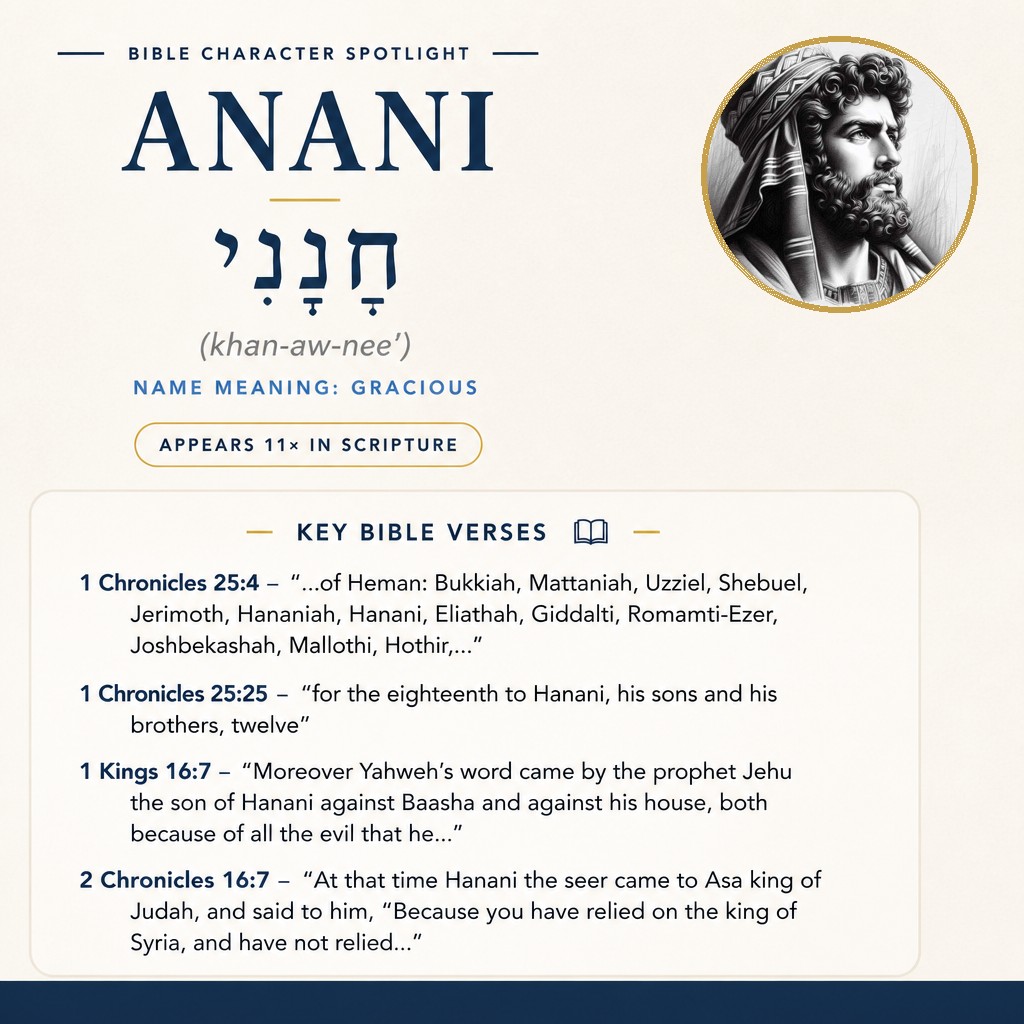
The spelling Anani also overlaps in English with a different Hebrew name rendered Hanani (glossed in a separate lexicon entry as borne by multiple Israelites). Those occurrences are distinct from the single appearance of Anani in 1 Chronicles 3:24. For clarity, the verses provided include several references to Hanani, including a musician in David’s arrangements, a seer, and others.
In David’s organization of temple musicians, Hanani appears among “the sons of Heman” and as the head of a numbered lot:
“Of Heman, the sons of Heman: Bukkiah, Mattaniah, Uzziel, Shebuel, Jerimoth, Hananiah, Hanani, Eliathah, Giddalti, Romamti-Ezer, Joshbekashah, Mallothi, Hothir, and Mahazioth.” (1 Chronicles 25:4, WEB)
“for the eighteenth to Hanani, his sons and his brothers, twelve;” (1 Chronicles 25:25, WEB)
The same chapter frames these names within a larger appointment “for the service” of song, describing the groups as being “set apart” and as those “who were to prophesy with harps, with stringed instruments, and with cymbals” (1 Chronicles 25:1). It adds that “All these were under the hands of their father for song in Yahweh’s house” (1 Chronicles 25:6), and that the assignments were distributed by lot: “They cast lots for their offices, all alike” (1 Chronicles 25:8). Hanani’s mention in 1 Chronicles 25:4 and 25:25 belongs to this musical-service setting, where each lot is said to include “his sons and his brothers, twelve” (1 Chronicles 25:25).
Other verses present a Hanani who is “the seer,” and a different focus appears: prophetic confrontation of kings and the identification of Jehu as his son.
“Moreover Yahweh’s word came by the prophet Jehu the son of Hanani against Baasha and against his house, both because of all the evil that he did in Yahweh’s sight, to provoke him to anger with the work of his hands, in being like the house of Jeroboam, and bec” (1 Kings 16:7, WEB)
“At that time Hanani the seer came to Asa king of Judah, and said to him, ‘Because you have relied on the king of Syria, and have not relied on Yahweh your God, therefore the army of the king of Syria has escaped out of your hand.” (2 Chronicles 16:7, WEB)
“Jehu the son of Hanani the seer went out to meet him, and said to king Jehoshaphat, ‘Should you help the wicked, and love those who hate Yahweh? Because of this, wrath is on you from before Yahweh.” (2 Chronicles 19:2, WEB)
“Now the rest of the acts of Jehoshaphat, first and last, behold, they are written in the history of Jehu the son of Hanani, which is included in the book of the kings of Israel.” (2 Chronicles 20:34, WEB)
In addition to these, the name Hanani appears in post-exilic lists and narrative settings: “Of the sons of Immer: Hanani and Zebadiah” (Ezra 10:20); “Hanani, one of my brothers, came, he and certain men out of Judah; and I asked them about the Jews who had escaped, who were left of the captivity, and concerning Jerusalem” (Nehemiah 1:2); “I put my brother Hanani, and Hananiah the governor of the fortress, in charge of Jerusalem; for he was a faithful man, and feared God above many” (Nehemiah 7:2); and in a procession list, “and his brothers, Shemaiah, Azarel, Milalai, Gilalai, Maai, Nethanel, Judah, and Hanani, with the musical instruments of David the man of God; and Ezra the scribe was before them” (Nehemiah 12:36).
These Hanani passages are included here only to distinguish them from Anani of 1 Chronicles 3:24; the provided Scripture evidence for Anani itself is limited to his appearance as a son of Elioenai.
Name and Meaning
Anani is presented in the lexicon information with the Hebrew script עֲנָנִי, transliterated ‘Ananiy and pronounced “an-aw-nee.” Its derivation is traced to a root associated with “cloudy,” connected with the component word עָנָן (‘anan), “a cloud (as covering the sky).” In Scripture, this name occurs in the genealogical notice: “The sons of Elioenai: Hodaviah, Eliashib, Pelaiah, Akkub, Johanan, Delaiah, and Anani, seven” (1 Chronicles 3:24).
Observation
In the biblical text provided, Anani is known entirely through his placement in a family list—one named son among “seven” (1 Chronicles 3:24)—a brief identification that still anchors him within the larger genealogical framework spanning 1 Chronicles 3:22–24.
Frequently Asked Questions
What does the name Anani mean?
Anani (Hebrew: עֲנָנִי, ‘Ananiy) means “cloudy.” Hanani (Hebrew: חֲנָנִי, Chananiy) means “gracious.”
How many times does Anani appear in the Bible?
Across these two Hebrew names (Anani and Hanani), the name appears 11 times total: 10 times as Hanani and 1 time as Anani.
Who was Anani?
Anani is named as an Israelite and is listed among “the sons of Elioenai” (1 Chronicles 3:24).
Was there more than one person named Anani?
Yes. Hanani is the name of six Israelites, and Anani is the name of an Israelite (1 Chronicles 3:24).
Explore Further
If you found this page about Anani interesting and would like to discover more about other biblical characters, explore our comprehensive Encyclopedia of Biblical Characters. For those looking to delve deeper into the Greek origins of these names and terms, our Greek Lexicon is an invaluable resource.
Sources: Name and occurrence data from Strong’s Exhaustive Concordance and STEPBible reference data (CC BY). Scripture quotations from the World English Bible (public domain).