Who was Ahishar in the bible?
Ahishar is named in 1 Kings 4:6 as an Israelite who served in Solomon’s administration as “over the household.”

Name Meaning
Strong’s derives the name from Hebrew elements meaning “brother” and “to sing,” paraphrased as “brother of (the) singer.”
Learn More →Ahishar (Achishar) is presented as an Israelite official; his name is explained in lexicon tradition as meaning “brother of (the) singer.” In Scripture he appears once, identified by his office in King Solomon’s administration.
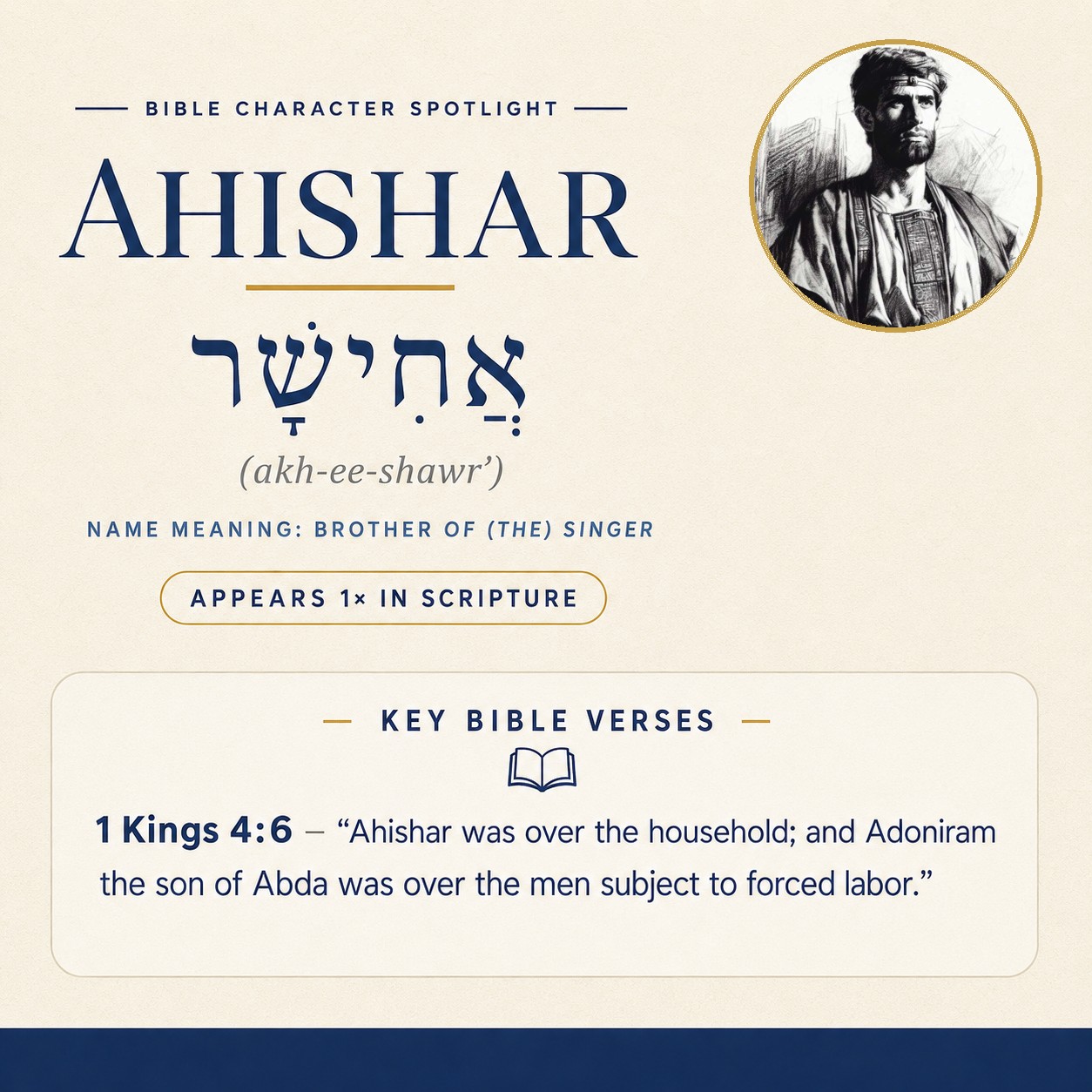
Ahishar in Scripture
Ahishar is mentioned in a list describing key figures serving in Solomon’s government. The immediate context names military, priestly, and court officials, then places Ahishar among them by stating his specific responsibility.
“Benaiah the son of Jehoiada was over the army; Zadok and Abiathar were priests;” (1 Kings 4:4, WEB)
“Azariah the son of Nathan was over the officers; Zabud the son of Nathan was chief minister, the king’s friend;” (1 Kings 4:5, WEB)
“Ahishar was over the household; and Adoniram the son of Abda was over the men subject to forced labor.” (1 Kings 4:6, WEB)
Within this administrative setting, Ahishar’s role is summarized with the statement that he “was over the household” (1 Kings 4:6). The verse pairs his appointment with another official’s assignment: “Adoniram the son of Abda was over the men subject to forced labor” (1 Kings 4:6). The text does not expand on Ahishar’s background, family, or the day-to-day scope of the office; it simply situates him among the named leaders around the king.
The chapter continues by describing a broader system of provisioning for the king, indicating how Solomon’s household was supplied. This gives additional context for what “the household” involved in that administrative picture, since the narrative immediately turns to household provision for the king.
“Solomon had twelve officers over all Israel, who provided food for the king and his household. Each man had to make provision for a month in the year.” (1 Kings 4:7, WEB)
After stating that Solomon’s provision came through “twelve officers over all Israel” who supplied “food for the king and his household” (1 Kings 4:7), the passage begins naming those officers and their assigned regions.
“These are their names: Ben Hur, in the hill country of Ephraim;” (1 Kings 4:8, WEB)
“Ben Deker, in Makaz, in Shaalbim, Beth Shemesh, and Elon Beth Hanan;” (1 Kings 4:9, WEB)
In the flow of the chapter, then, Ahishar appears as one of the chief officials identified before the text enumerates the twelve provisioning officers. His single biblical description—“over the household” (1 Kings 4:6)—stands as the sole direct evidence of who he was and what he did.
Name and Meaning
The name is written אֲחִישָׁר, transliterated ‘Achiyshar, and pronounced “akh-ee-shawr.” Lexicon tradition connects it to Hebrew elements meaning “a brother” (in a broad sense) and “to sing,” yielding the sense “brother of (the) singer.”
Observation
Ahishar’s brief mention places him among Solomon’s principal administrators at a point where the text is emphasizing how the king’s household and governance were organized (1 Kings 4:4–7).
Frequently Asked Questions
Who was Ahishar?
Ahishar was an Israelite. In 1 Kings 4:6, Ahishar was over the household.
What does the name Ahishar mean?
Ahishar means “brother of (the) singer.”
How many times does Ahishar appear in the Bible?
Ahishar appears 1 time.
What role did Ahishar have in 1 Kings 4:6?
According to 1 Kings 4:6, Ahishar was over the household.
Explore Further
If you found this page about Ahishar interesting and would like to discover more about other biblical characters, explore our comprehensive Encyclopedia of Biblical Characters. For those looking to delve deeper into the Greek origins of these names and terms, our Greek Lexicon is an invaluable resource.
Sources: Name and occurrence data from Strong’s Exhaustive Concordance and STEPBible reference data (CC BY). Scripture quotations from the World English Bible (public domain).