
Who was Ahishahar in the bible?
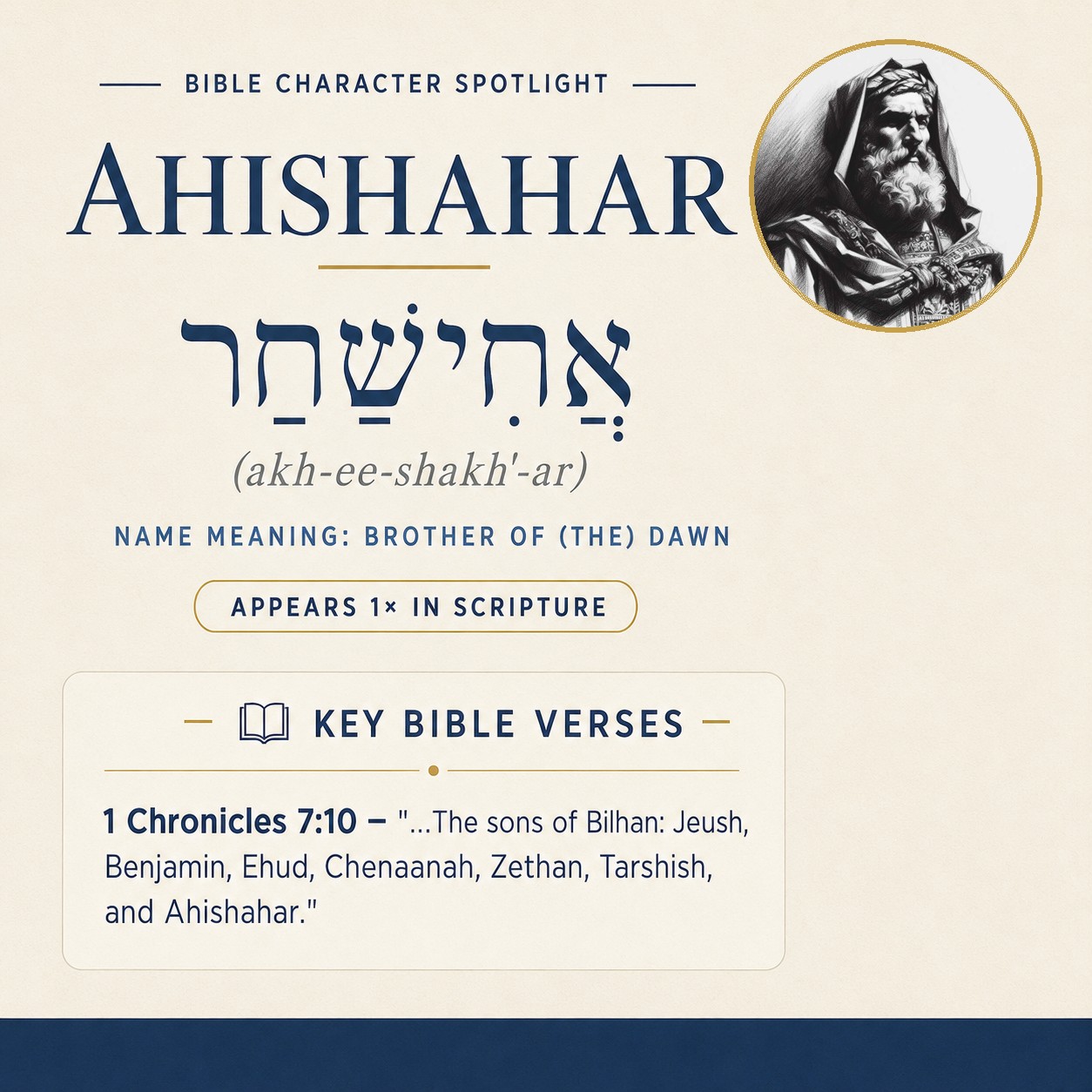
Ahishahar is named as one of Bilhan’s sons in the genealogy of 1 Chronicles 7:10.
Family Listing
His name appears in the line “The son of Jediael: Bilhan,” followed by Bilhan’s sons. “The son of Jediael: Bilhan. The sons of Bilhan: … Ahishahar.” (1 Chronicles 7:10)
Learn More →Name Meaning
The name is derived from Hebrew elements meaning “brother” and “dawn.” A lexicon identifies Ahishahar as an Israelite.
Learn More →Ahishahar (Achishachar) is named in Scripture as an Israelite in a genealogical list. The name is explained in the lexicon as meaning “brother of (the) dawn.”
Ahishahar in Scripture
Ahishahar appears once, within a sequence of genealogical notices in 1 Chronicles 7. The immediate context first lists descendants connected with Becher:
“The sons of Becher: Zemirah, Joash, Eliezer, Elioenai, Omri, Jeremoth, Abijah, Anathoth, and Alemeth. All these were the sons of Becher.” (1 Chronicles 7:8, WEB)
This list is followed by a brief characterization of those recorded:
“They were listed by genealogy, after their generations, heads of their fathers’ houses, mighty men of valor, twenty thousand two hundred.” (1 Chronicles 7:9, WEB)
Within the next genealogical unit, Ahishahar is placed as one of the sons of Bilhan, who is identified as the son of Jediael. The verse that directly names him reads:
“The son of Jediael: Bilhan. The sons of Bilhan: Jeush, Benjamin, Ehud, Chenaanah, Zethan, Tarshish, and Ahishahar.” (1 Chronicles 7:10, WEB)
In this setting, Ahishahar is not described by personal deeds, offices, or speech; he is presented as a member of a family line, named alongside his brothers. The surrounding passage continues by summarizing this group as “sons of Jediael,” describing them in military terms and counting those “able to go out in the army for war”:
“All these were sons of Jediael, according to the heads of their fathers’ households, mighty men of valor, seventeen thousand two hundred, who were able to go out in the army for war.” (1 Chronicles 7:11, WEB)
The chapter then moves on to other names and groupings, indicating the continuing genealogical scope of the passage:
“So were Shuppim, Huppim, the sons of Ir, Hushim, and the sons of Aher.” (1 Chronicles 7:12, WEB)
“The sons of Naphtali: Jahziel, Guni, Jezer, Shallum, and the sons of Bilhah.” (1 Chronicles 7:13, WEB)
Within this run of lists and summaries, Ahishahar’s place is clear: he is included among “The sons of Bilhan” in the line that begins, “The son of Jediael: Bilhan” (1 Chronicles 7:10). This establishes him as part of that household as the genealogy is presented.
Name and Meaning
The name is written in Hebrew script as אֲחִישַׁחַר, transliterated ‘Achiyshachar, and pronounced akh-ee-shakh’-ar. Strong’s derives it from H251 and H7837, with the component word ‘ach (אָח) meaning “a brother” (in a wide sense) and shachar (שַׁחַר) meaning “dawn” (literal, figurative, or adverbial), yielding the sense “brother of (the) dawn.”
Brief observation
In 1 Chronicles 7, Ahishahar is remembered not by an individual narrative but by being named within a genealogy—“The sons of Bilhan… and Ahishahar” (1 Chronicles 7:10)—as part of a record that also speaks of “heads of their fathers’ houses” and “mighty men of valor” (1 Chronicles 7:9, 7:11).
Frequently Asked Questions
What does the name Ahishahar mean?
Ahishahar means “brother of (the) dawn.”
How many times does Ahishahar appear in the Bible?
Ahishahar appears 1 time.
Who was Ahishahar?
Ahishahar was an Israelite mentioned in a genealogy. In 1 Chronicles 7:10 he is listed as one of the sons of Bilhan.
Where is Ahishahar mentioned?
Ahishahar is mentioned in 1 Chronicles 7:10.
Explore Further
If you found this page about Ahishahar interesting and would like to discover more about other biblical characters, explore our comprehensive Encyclopedia of Biblical Characters. For those looking to delve deeper into the Greek origins of these names and terms, our Greek Lexicon is an invaluable resource.
Sources: Name and occurrence data from Strong’s Exhaustive Concordance and STEPBible reference data (CC BY). Scripture quotations from the World English Bible (public domain).





