Who was Abimelech in the bible?
Abimelech was a king of Gerar who took Sarah, appears in Genesis 20 and is also named in 2 Samuel 11:21 and 1 Chronicles 18:16.

His Story
Abimelech “restored Sarah, his wife, to” Abraham and gave gifts (Genesis 20:14). After “Abraham prayed to God,” “God healed Abimelech” and his household (Genesis 20:17–18).
Learn More →Name and Uses
Strong’s gloss describes Abimelech as a name borne by multiple people (two Philistine kings and two Israelites). The name is derived from words meaning “father” and “king.”
Learn More →Abimelech is a biblical name (meaning “father of (the) king,” from its Hebrew components) borne by more than one person in Scripture, including a Philistine king of Gerar and at least two Israelites. In the verses provided, Abimelech appears as a king involved in the episode with Abraham and Sarah, as a man identified as the son of Jerubbesheth, and as a priest identified as the son of Abiathar.
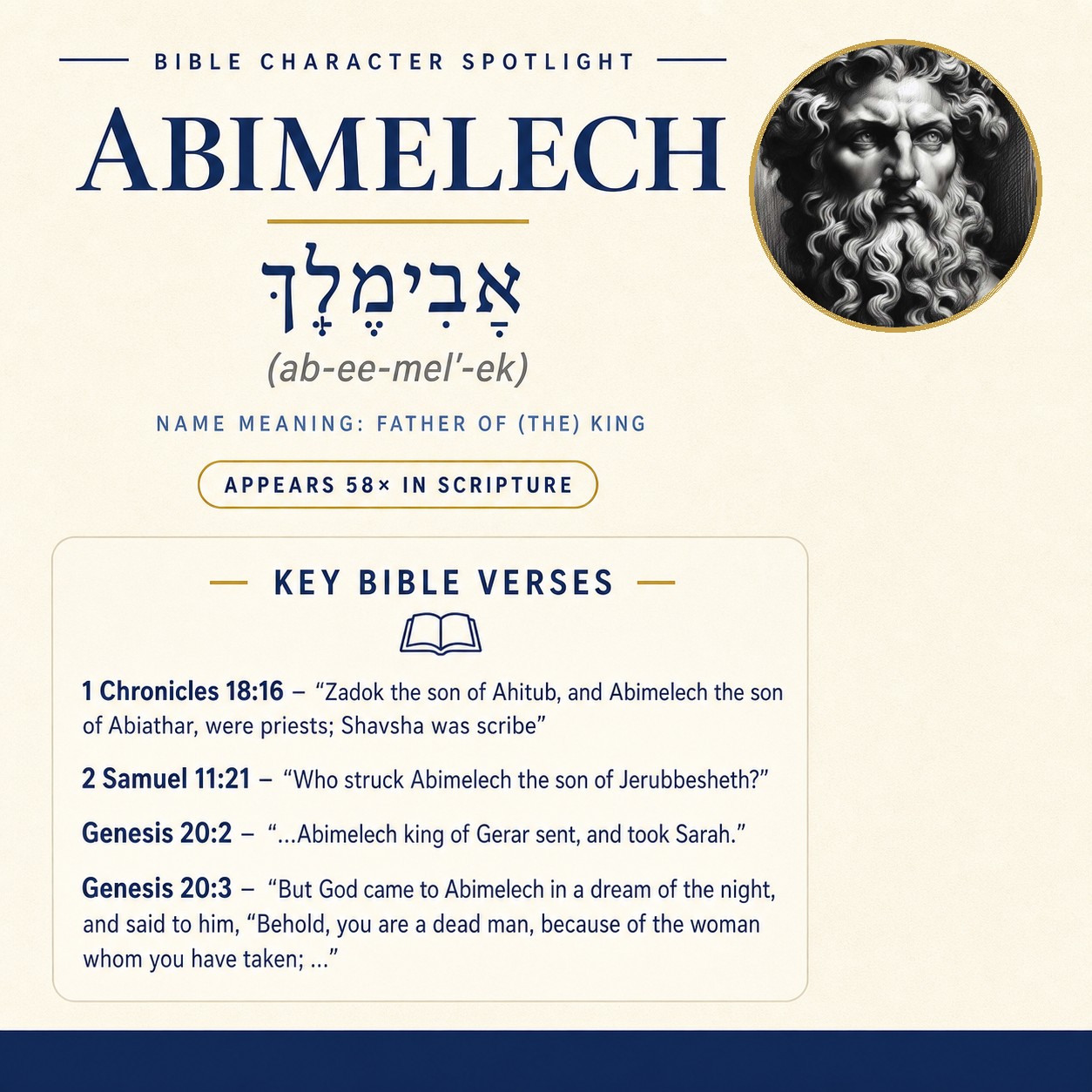
Abimelech in Scripture
The fullest narrative concerns “Abimelech king of Gerar” in Genesis 20. While Abraham was living as a foreigner in Gerar, a crisis arose from Abraham’s words about Sarah.
“Abraham said about Sarah his wife, ‘She is my sister.’ Abimelech king of Gerar sent, and took Sarah.” (Genesis 20:2)
God confronted Abimelech in a dream, warning him about Sarah’s true status as another man’s wife.
“But God came to Abimelech in a dream of the night, and said to him, ‘Behold, you are a dead man, because of the woman whom you have taken; for she is a man’s wife.’ ” (Genesis 20:3)
Abimelech responded by asserting that he had not approached Sarah and appealed to God’s justice, describing his actions as innocent given what he had been told.
“Now Abimelech had not come near her. He said, ‘Lord, will you kill even a righteous nation?’ ” (Genesis 20:4)
“Didn’t he tell me, ‘She is my sister’? She, even she herself, said, ‘He is my brother.’ I have done this in the integrity of my heart and the innocence of my hands.” (Genesis 20:5)
God acknowledged Abimelech’s integrity in what he had done, and also stated that God himself had restrained Abimelech from sinning in the matter. Abimelech was then commanded to restore Sarah, with a warning of death if he did not comply.
“God said to him in the dream, ‘Yes, I know that in the integrity of your heart you have done this, and I also withheld you from sinning against me. Therefore I didn’t allow you to touch her.’ ” (Genesis 20:6)
“Now therefore, restore the man’s wife. For he is a prophet, and he will pray for you, and you will live. If you don’t restore her, know for sure that you will die, you, and all who are yours.” (Genesis 20:7)
Abimelech took the dream seriously and immediately brought the matter to his household and court. The report of the dream produced fear among his servants.
“Abimelech rose early in the morning, and called all his servants, and told all these things in their ear. The men were very scared.” (Genesis 20:8)
He then confronted Abraham directly, emphasizing the harm and “great sin” that Abimelech believed had been brought upon his kingdom by Abraham’s actions and words.
“Then Abimelech called Abraham, and said to him, ‘What have you done to us? How have I sinned against you, that you have brought on me and on my kingdom a great sin? You have done deeds to me that ought not to be done!’ ” (Genesis 20:9)
“Abimelech said to Abraham, ‘What did you see, that you have done this thing?’ ” (Genesis 20:10)
In the exchange that follows, Abraham explained his fear of danger in the place, and further explained his claim about Sarah’s kinship. Abimelech then acted to rectify the situation through restitution and restoration: he returned Sarah to Abraham and gave gifts.
“Abimelech took sheep and cattle, male servants and female servants, and gave them to Abraham, and restored Sarah, his wife, to him.” (Genesis 20:14)
He also offered Abraham freedom to settle in Abimelech’s land.
“Abimelech said, ‘Behold, my land is before you. Dwell where it pleases you.’ ” (Genesis 20:15)
The chapter closes by describing a divine judgment that had affected Abimelech’s household and its reversal after Abraham’s prayer. The healing is described broadly as encompassing Abimelech, his wife, and his female servants, resulting in their ability to bear children.
“Abraham prayed to God. God healed Abimelech, and his wife, and his female servants, and they bore children.” (Genesis 20:17)
“For Yahweh had closed up tight all the wombs of the house of Abimelech, because of Sarah, Abraham’s wife.” (Genesis 20:18)
Outside Genesis 20, the name Abimelech appears in two brief, distinct identifications. In 2 Samuel, Abimelech is mentioned as the son of Jerubbesheth and is recalled in a rhetorical question about a death caused during a battle at Thebez.
“Who struck Abimelech the son of Jerubbesheth? Didn’t a woman cast an upper millstone on him from the wall, so that he died at Thebez?” (2 Samuel 11:21)
In 1 Chronicles, Abimelech is named among priests, identified as the son of Abiathar.
“Zadok the son of Ahitub, and Abimelech the son of Abiathar, were priests; Shavsha was scribe;” (1 Chronicles 18:16)
Multiple People Named Abimelech
The lexicon gloss describes Abimelech as “the name of two Philistine kings and of two Israelites.” In the verses provided, at least three distinct bearers are clearly in view:
(1) Abimelech king of Gerar, the figure in Genesis 20 who “sent, and took Sarah” (Genesis 20:2), was warned by God in a dream (Genesis 20:3), restored Sarah to Abraham (Genesis 20:14), and whose household experienced both closure of wombs and subsequent healing (Genesis 20:17–18).
(2) Abimelech the son of Jerubbesheth, mentioned in connection with his death at Thebez: “a woman cast an upper millstone on him from the wall, so that he died at Thebez” (2 Samuel 11:21).
(3) Abimelech the son of Abiathar, listed among priests alongside Zadok: “Zadok the son of Ahitub, and Abimelech the son of Abiathar, were priests” (1 Chronicles 18:16).
Name and Meaning
The name is written in Hebrew as אֲבִימֶלֶךְ, transliterated ‘Abiymelek and pronounced ab-ee-mel’-ek. According to the name derivation given, it is formed from the Hebrew components ’ab (אָב), meaning “father,” and melek (מֶלֶךְ), meaning “a king,” yielding the sense “father of (the) king.”
Closing Observation
In Genesis 20, Abimelech is portrayed as responding promptly to divine warning—he “rose early in the morning” (Genesis 20:8)—and the narrative connects the restoration of Sarah and Abraham’s prayer with the healing of Abimelech’s household (Genesis 20:14, 17–18).
Frequently Asked Questions
What does the name Abimelech mean?
Abimelech means “father of (the) king.”
How many times does Abimelech appear in the Bible?
Abimelech occurs 58 times.
Who was Abimelech in the Bible?
Abimelech is the name of two Philistine kings and of two Israelites. In Genesis, one Abimelech is described as “king of Gerar” (Genesis 20:2).
What did Abimelech do with Sarah in Genesis 20?
“Abimelech king of Gerar sent, and took Sarah” after Abraham said she was his sister (Genesis 20:2). Later Abimelech restored Sarah to Abraham (Genesis 20:14).
Explore Further
If you found this page about Abimelech interesting and would like to discover more about other biblical characters, explore our comprehensive Encyclopedia of Biblical Characters. For those looking to delve deeper into the Greek origins of these names and terms, our Greek Lexicon is an invaluable resource.
Sources: Name and occurrence data from Strong’s Exhaustive Concordance and STEPBible reference data (CC BY). Scripture quotations from the World English Bible (public domain).