Who was Abihail in the bible?
Abihail is a name borne by multiple people in Scripture, appearing in Numbers 3:35; 1 Chronicles 2:29; 1 Chronicles 5:14; 2 Chronicles 11:18; Esther 2:15; and Esther 9:29.

Genealogies Listed
One Abihail is named as Abishur’s wife: “The name of the wife of Abishur was Abihail; and she bore him Ahban and Molid” (1 Chronicles 2:29). Another is in a lineage: “These were the sons of Abihail, the son of Huri...” (1 Chronicles 5:14).
Learn More →In Royal Accounts
A woman named Abihail is named in Rehoboam’s marriage record: “Abihail the daughter of Eliab the son of Jesse” (2 Chronicles 11:18). Esther is also identified as “the daughter of Abihail” (Esther 2:15; Esther 9:29).
Learn More →Abihail is a biblical name borne by multiple Israelites, including women and men. The name is explained in a lexicon as meaning “father (i.e. possessor) of might,” and Scripture uses it for several distinct people in genealogical and narrative settings.
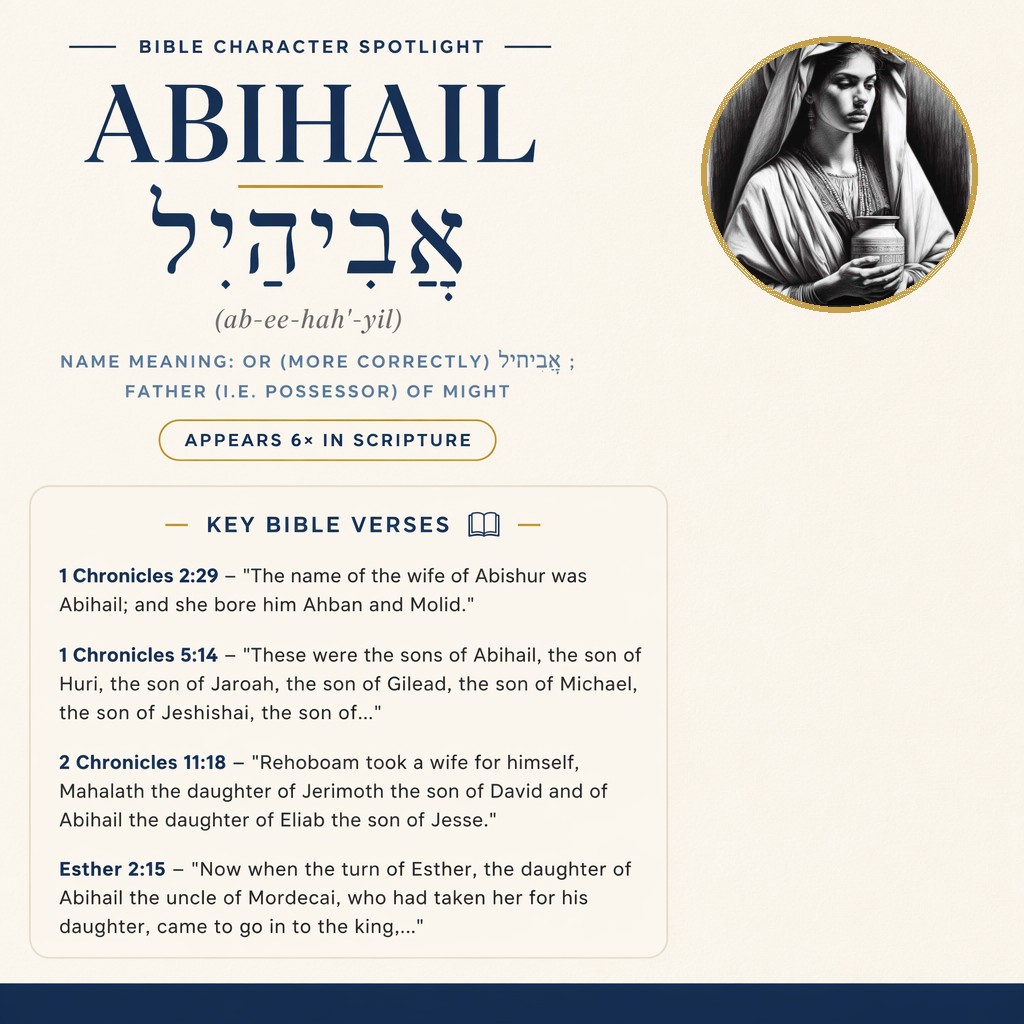
Abihail in Scripture
The first Abihail appears in a Judahite genealogy in 1 Chronicles 2. After listing the sons of Israel and tracing Judah’s line down through Perez and Hezron, the chapter moves into the family of Jerahmeel and his descendants. In that context, Abihail is identified as the wife of Abishur and the mother of two sons.
“The name of the wife of Abishur was Abihail; and she bore him Ahban and Molid.” (1 Chronicles 2:29, WEB)
Within the chapter’s broader setting, this detail sits among many brief notices that connect individuals by parentage and sibling lines. The genealogy runs from “These are the sons of Israel” (1 Chronicles 2:1, WEB) through Judah’s descendants, including the line that reaches “Jesse” and his sons (1 Chronicles 2:12–15, WEB), before focusing at length on various branches. Abihail’s mention functions as one of these connective points: Abishur is named among “The sons of Shammai” (1 Chronicles 2:28, WEB), and Abihail’s children, “Ahban and Molid” (1 Chronicles 2:29, WEB), are recorded as part of that same lineage.
A second Abihail is named in a different genealogical listing in 1 Chronicles 5, where the text traces ancestry through a chain of fathers and then speaks of sons who stand at the end of that chain. Here Abihail is male and is situated within a line that includes Gilead and other named ancestors.
“These were the sons of Abihail, the son of Huri, the son of Jaroah, the son of Gilead, the son of Michael, the son of Jeshishai, the son of Jahdo, the son of Buz;” (1 Chronicles 5:14, WEB)
This verse presents Abihail as “the son of Huri” and also as a father whose sons are about to be listed (“These were the sons of Abihail,” 1 Chronicles 5:14, WEB). In this occurrence, the name marks both a link in a paternal line and a heading for his descendants.
A third Abihail is a woman mentioned in connection with Rehoboam’s marriage alliances in 2 Chronicles 11. The verse identifies Mahalath as a daughter linked both to Jerimoth and to Abihail, and it further identifies Abihail by her own parentage.
“Rehoboam took a wife for himself, Mahalath the daughter of Jerimoth the son of David and of Abihail the daughter of Eliab the son of Jesse.” (2 Chronicles 11:18, WEB)
In this statement, Abihail is “the daughter of Eliab the son of Jesse” (2 Chronicles 11:18, WEB), and Mahalath is described as “the daughter of Jerimoth the son of David and of Abihail” (2 Chronicles 11:18, WEB). The verse thus places Abihail within a network of named parentage and marriage, while giving no further narrative about her beyond this identification.
Another Abihail appears in the book of Esther as the father of Esther. In Esther 2, the text describes Esther’s turn to go in to the king and notes her connection to Mordecai.
“Now when the turn of Esther, the daughter of Abihail the uncle of Mordecai, who had taken her for his daughter, came to go in to the king, she required nothing but what Hegai the king’s eunuch, the keeper of the women, advised. Esther obtained favor in the sig” (Esther 2:15, WEB)
This verse identifies Esther as “the daughter of Abihail” and also describes Abihail as “the uncle of Mordecai” (Esther 2:15, WEB). It further states that Mordecai “had taken her for his daughter” (Esther 2:15, WEB). The narrative detail in this passage centers on Esther’s conduct—“she required nothing but what Hegai… advised” (Esther 2:15, WEB)—and the favor she received, while still anchoring her identity to Abihail.
Later, Esther 9 refers again to this Abihail when describing the authority behind a letter connected with Purim.
“Then Esther the queen, the daughter of Abihail, and Mordecai the Jew, wrote with all authority to confirm this second letter of Purim.” (Esther 9:29, WEB)
Here Abihail is mentioned only to identify Esther as “the daughter of Abihail” (Esther 9:29, WEB), while the verse emphasizes that Esther and Mordecai “wrote with all authority” (Esther 9:29, WEB).
Finally, Abihail is named in Numbers 3 in connection with the Levitical camp arrangement around the tabernacle. In this occurrence, Abihail is male and is identified as the father of Zuriel.
“The prince of the fathers’ house of the families of Merari was Zuriel the son of Abihail. They shall encamp on the north side of the tabernacle.” (Numbers 3:35, WEB)
This verse presents Zuriel’s leadership role—“The prince of the fathers’ house of the families of Merari” (Numbers 3:35, WEB)—and it grounds Zuriel’s identity by naming his father: “Zuriel the son of Abihail” (Numbers 3:35, WEB). It also assigns the families’ location: “They shall encamp on the north side of the tabernacle” (Numbers 3:35, WEB).
Multiple Bearers
The name Abihail belongs to several distinct individuals in Scripture:
1) Abihail, wife of Abishur (female). She is named in a Judahite genealogy, with her children recorded: “The name of the wife of Abishur was Abihail; and she bore him Ahban and Molid” (1 Chronicles 2:29, WEB).
2) Abihail, son of Huri (male). He stands within a paternal line and is presented as an ancestor with sons: “These were the sons of Abihail, the son of Huri…” (1 Chronicles 5:14, WEB).
3) Abihail, daughter of Eliab (female). She is identified by her father and connected to Rehoboam’s wife Mahalath: “Abihail the daughter of Eliab the son of Jesse” (2 Chronicles 11:18, WEB).
4) Abihail, father of Esther (male). He is named in Esther as Esther’s father and described as “the uncle of Mordecai” (Esther 2:15, WEB); Esther is again called “the daughter of Abihail” (Esther 9:29, WEB).
5) Abihail, father of Zuriel (male). He is mentioned in Numbers 3 as the father of a Merarite leader: “Zuriel the son of Abihail” (Numbers 3:35, WEB).
Name and Meaning
In Hebrew script the name is written אֲבִיהַיִל, transliterated ‘Abiyhayil, and pronounced ab-ee-hah’-yil. A lexicon explains it as formed from ’ab (אָב), “father,” and chayil (חַיִל), “might” or “force,” yielding the sense “father (i.e. possessor) of might.”
Observation
Across its occurrences, Abihail functions as a name that anchors identity through family links—“wife,” “daughter,” and “son”—and appears in both genealogical records and narrative moments where authority and ordering are highlighted, such as “wrote with all authority” (Esther 9:29, WEB) and “encamp on the north side of the tabernacle” (Numbers 3:35, WEB).
Frequently Asked Questions
What does the name Abihail mean?
Abihail means “father (possessor) of might.”
How many times does Abihail appear in the Bible?
Abihail appears 6 times.
Who was Abihail in the Bible?
Abihail (also spelled Abichail) is the name of three Israelites and two Israelitesses. The name is used for different people in passages such as 1 Chronicles 2:29, Numbers 3:35, and Esther 2:15.
How is Abihail connected to Esther?
Esther is identified as “the daughter of Abihail” (Esther 2:15; Esther 9:29).
Explore Further
If you found this page about Abihail interesting and would like to discover more about other biblical characters, explore our comprehensive Encyclopedia of Biblical Characters. For those looking to delve deeper into the Greek origins of these names and terms, our Greek Lexicon is an invaluable resource.
Sources: Name and occurrence data from Strong’s Exhaustive Concordance and STEPBible reference data (CC BY). Scripture quotations from the World English Bible (public domain).