Who was Zebulun in the bible?
Zebulun is named among Israel’s tribes (and as Jacob’s son) and appears in lists and scenes such as Deuteronomy 33:18 and 2 Chronicles 30:10–18.

Where He Appears
In Hezekiah’s Passover proclamation, couriers went “even to Zebulun” (2 Chronicles 30:10), and “some men of… Zebulun… came to Jerusalem” (2 Chronicles 30:11).
Learn More →Tribe Mentions
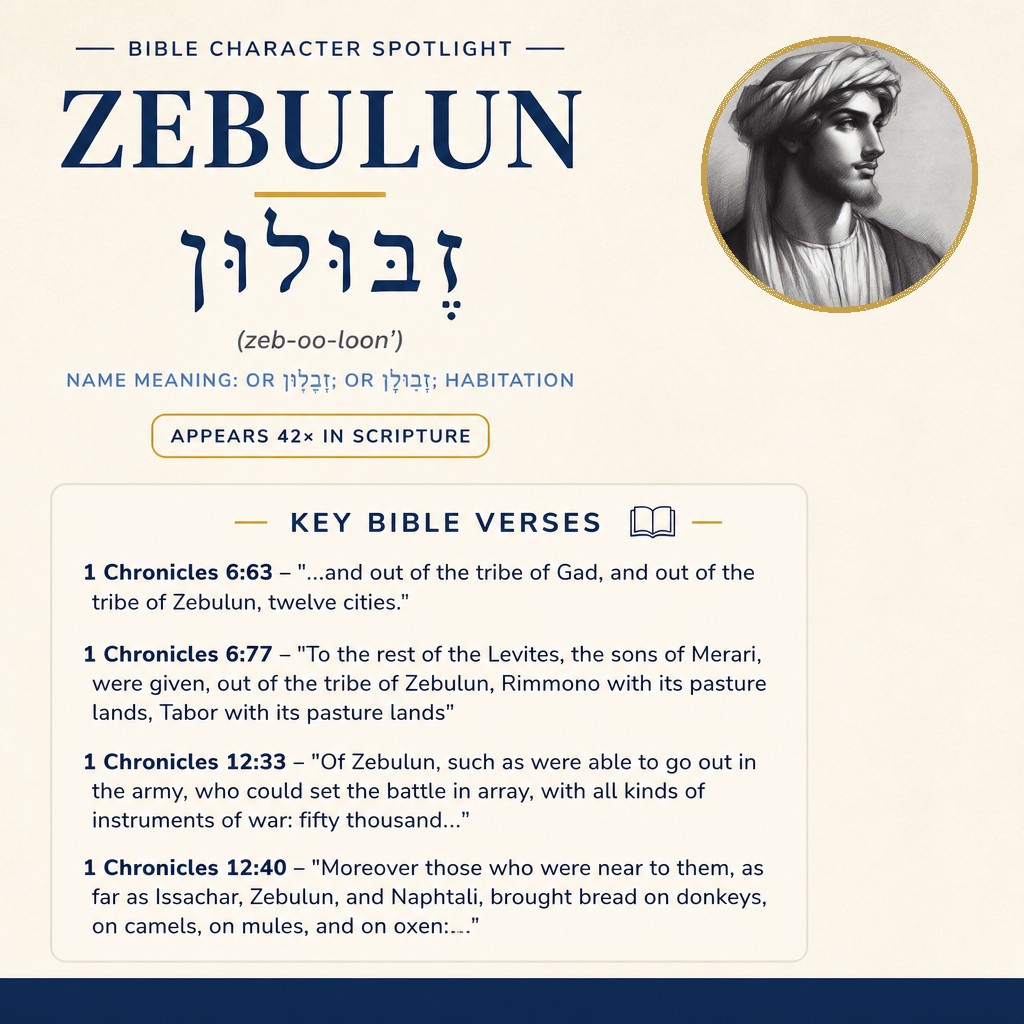
“Of Zebulun” warriors are described as “fifty thousand” who “were not of double heart” (1 Chronicles 12:33). Levites also received cities “out of the tribe of Zebulun” (1 Chronicles 6:63; 6:77).
Learn More →Zebulun is presented as a son of Jacob, and also as the name of a tribe and territorial portion associated with him. The name is connected (by lexicon derivation) with the idea of a “habitation,” from a root meaning “to reside.”
Zebulun in Scripture
Zebulun appears first in a list of Jacob’s sons as Israel is described in Egypt:
“Issachar, Zebulun, and Benjamin,” (Exodus 1:3)
Later, Zebulun is named among the tribes appointed for a covenant ceremony:
“These shall stand on Mount Ebal for the curse: Reuben, Gad, Asher, Zebulun, Dan, and Naphtali.” (Deuteronomy 27:13)
Zebulun is also addressed in a spoken blessing:
“About Zebulun he said, ‘Rejoice, Zebulun, in your going out; and Issachar, in your tents.’” (Deuteronomy 33:18)
In the Chronicler’s account, Zebulun is included in a major national invitation issued by King Hezekiah to celebrate the Passover at Jerusalem. Hezekiah “sent to all Israel and Judah” and invited them “to keep the Passover to Yahweh, the God of Israel” (2 Chronicles 30:1). Because the priests were not ready and the people had not gathered, “the king had taken counsel with his princes and all the assembly in Jerusalem to keep the Passover in the second month” (2 Chronicles 30:2). A proclamation went out “throughout all Israel, from Beersheba even to Dan,” calling the people “to come to keep the Passover to Yahweh, the God of Israel, at Jerusalem” (2 Chronicles 30:5).
The couriers carried a message urging the people to return to Yahweh and not repeat earlier unfaithfulness: “You children of Israel, turn again to Yahweh, the God of Abraham, Isaac, and Israel” (2 Chronicles 30:6), and “Now don’t be stiff-necked, as your fathers were, but yield yourselves to Yahweh, and enter into his sanctuary” (2 Chronicles 30:8). The appeal included the promise that “Yahweh your God is gracious and merciful, and will not turn away his face from you, if you return to him” (2 Chronicles 30:9).
Zebulun is specifically named as part of the route and reception of this invitation. The couriers went “through the country of Ephraim and Manasseh, even to Zebulun,” but the response was mixed:
“So the couriers passed from city to city through the country of Ephraim and Manasseh, even to Zebulun, but people ridiculed them and mocked them.” (2 Chronicles 30:10)
Yet the narrative immediately notes that some did respond positively, including men from Zebulun:
“Nevertheless some men of Asher, Manasseh, and Zebulun humbled themselves, and came to Jerusalem.” (2 Chronicles 30:11)
As the observance proceeds, the account emphasizes both the size of the gathering and issues of ritual readiness. “Many people assembled at Jerusalem” (2 Chronicles 30:13). When the Passover was kept, “there were many in the assembly who had not sanctified themselves” (2 Chronicles 30:17). Zebulun is again named among groups with many participants who were not properly cleansed, though they still ate the Passover:
“For a multitude of the people, even many of Ephraim, Manasseh, Issachar, and Zebulun, had not cleansed themselves, yet they ate the Passover other than the way it is written.” (2 Chronicles 30:18)
Hezekiah’s prayer for such people is quoted within the chapter: “May the good Yahweh pardon everyone who sets his heart to seek God, Yahweh, the God of his fathers” (2 Chronicles 30:18–19). The chapter states the outcome: “Yahweh listened to Hezekiah, and healed the people” (2 Chronicles 30:20). The celebration continued with extended gladness: “The children of Israel who were present at Jerusalem kept the feast of unleavened bread seven days with great gladness” (2 Chronicles 30:21), and then “The whole assembly took counsel to keep another seven days, and they kept another seven days with gladness” (2 Chronicles 30:23). The chapter closes with priestly blessing and prayer: “Their voice was heard, and their prayer came up to his holy habitation, even to heaven” (2 Chronicles 30:27).
Elsewhere in Chronicles, Zebulun appears as a tribe contributing cities assigned to Levites. In one listing of Levitical allotments, “the tribe of Zebulun” is included among those from which cities were given:
“To the sons of Merari were given by lot, according to their families, out of the tribe of Reuben, and out of the tribe of Gad, and out of the tribe of Zebulun, twelve cities.” (1 Chronicles 6:63)
A further detail names specific cities from that tribal allotment:
“To the rest of the Levites, the sons of Merari, were given, out of the tribe of Zebulun, Rimmono with its pasture lands, Tabor with its pasture lands;” (1 Chronicles 6:77)
Zebulun is also depicted as providing substantial and capable military support. In a roster describing those who joined for war, the text says:
“Of Zebulun, such as were able to go out in the army, who could set the battle in array, with all kinds of instruments of war: fifty thousand who could command and were not of double heart.” (1 Chronicles 12:33)
In the same context, Zebulun is named among groups who brought provisions in abundance:
“Moreover those who were near to them, as far as Issachar, Zebulun, and Naphtali, brought bread on donkeys, on camels, on mules, and on oxen: supplies of flour, cakes of figs, clusters of raisins, wine, oil, cattle, and sheep in abundance; for there was joy in” (1 Chronicles 12:40)
A later administrative listing assigns a named leader connected with the tribe:
“of Zebulun, Ishmaiah the son of Obadiah; of Naphtali, Jeremoth the son of Azriel;” (1 Chronicles 27:19)
Finally, in a prophetic-style description of land portions, Zebulun is presented as a designated “portion” bordered by Issachar:
“By the border of Issachar, from the east side to the west side, Zebulun, one portion.” (Ezekiel 48:26)
Name and Meaning
The name is written in Hebrew as זְבוּלוּן (also attested in variant spellings זְבֻלוּן and זְבוּלֻן), transliterated Zebuwluwn and pronounced “zeb-oo-loon’.” According to the supplied lexicon derivation, it is linked to the sense of “habitation,” derived from H2082, with the component root zabal (זָבַל) meaning “to reside.”
Brief observation
The passages portray “Zebulun” both as a named son within Israel’s family list (Exodus 1:3) and as a tribal identity that could be mocked yet still include people who “humbled themselves, and came to Jerusalem” (2 Chronicles 30:11), while also being described as “fifty thousand who could command and were not of double heart” (1 Chronicles 12:33).
Frequently Asked Questions
What does the name Zebulun mean?
Zebulun means “habitation.”
How many times does Zebulun appear in the Bible?
Zebulun appears 42 time(s).
Who was Zebulun?
Zebulun was a son of Jacob; the name is also used for his territory and tribe.
What is said about Zebulun in Deuteronomy 33:18?
“About Zebulun he said, ‘Rejoice, Zebulun, in your going out; and Issachar, in your tents’” (Deuteronomy 33:18).
Explore Further
If you found this page about Zebulun interesting and would like to discover more about other biblical characters, explore our comprehensive Encyclopedia of Biblical Characters. For those looking to delve deeper into the Greek origins of these names and terms, our Greek Lexicon is an invaluable resource.
Sources: Name and occurrence data from Strong’s Exhaustive Concordance and STEPBible reference data (CC BY). Scripture quotations from the World English Bible (public domain).