Who was Sarah in the bible?
Sarah was Abraham’s wife in Genesis 17–18, where God renamed her and promised she would bear a son.

Name and Meaning
God said to Abraham, “You shall not call her name Sarai, but her name will be Sarah” (Genesis 17:15). Lexicon information derives her name from a term meaning a mistress or female noble.
Learn More →Promise of Son
God said, “Sarah, your wife, will bear you a son. You shall call his name Isaac” (Genesis 17:19). Yahweh added, “At the set time I will return to you… and Sarah will have a son” (Genesis 18:14).
Learn More →Sarah is identified as Abraham’s wife, a woman whose name is associated (by lexicon derivation) with the idea of a “mistress” or female noble. In Genesis, God directs that her earlier name “Sarai” be changed to “Sarah.”
Sarah in Scripture
Sarah first appears in these passages at the moment God speaks to Abraham about her name and about a promised child. God explicitly connects her new name with Abraham’s family life and with the promise of a son.
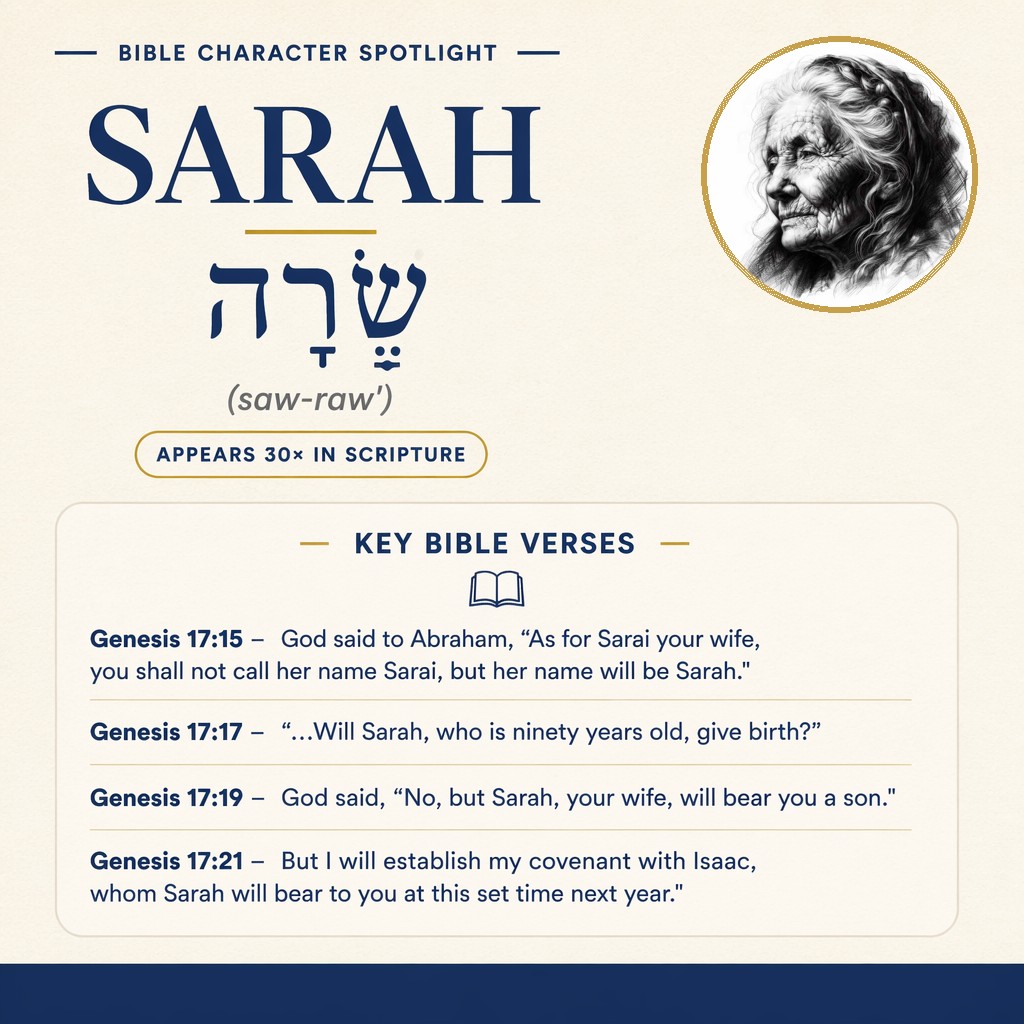
“God said to Abraham, ‘As for Sarai your wife, you shall not call her name Sarai, but her name will be Sarah.’” (Genesis 17:15)
Abraham’s reaction is described as laughter and inward questioning about the possibility of a birth at their advanced ages.
“Then Abraham fell on his face, and laughed, and said in his heart, ‘Will a child be born to him who is one hundred years old? Will Sarah, who is ninety years old, give birth?’” (Genesis 17:17)
God answers by stating that Sarah, as Abraham’s wife, will bear a son, and that the son is to be named Isaac. God also speaks of establishing a covenant with Isaac and his offspring.
“God said, ‘No, but Sarah, your wife, will bear you a son. You shall call his name Isaac. I will establish my covenant with him for an everlasting covenant for his offspring after him.’” (Genesis 17:19)
The promise is also given with a specific time frame: Isaac is the one “whom Sarah will bear,” and the statement is tied to “this set time next year.”
“But I will establish my covenant with Isaac, whom Sarah will bear to you at this set time next year.” (Genesis 17:21)
Genesis 18 then provides a longer narrative in which Sarah is present in and around Abraham’s tent during a visit from three men, in a scene introduced as Yahweh’s appearing to Abraham “by the oaks of Mamre.” Abraham shows hospitality, and Sarah is drawn into the event through Abraham’s urgent instructions and through the visitors’ questions and announcement.
“Yahweh appeared to him by the oaks of Mamre, as he sat in the tent door in the heat of the day.” (Genesis 18:1)
Abraham sees “three men” standing near, runs to meet them, bows, and invites them to rest and be refreshed. After the visitors agree, Abraham acts quickly to provide food and water. Within these preparations, Sarah is portrayed as being inside the tent, and Abraham calls on her to make bread.
“Abraham hurried into the tent to Sarah, and said, ‘Quickly prepare three seahs of fine meal, knead it, and make cakes.’” (Genesis 18:6)
As Abraham completes the meal—bringing “butter, milk, and the calf which he had dressed”—Sarah remains associated with the tent setting, and the visitors ask about her directly. Abraham answers that she is “in the tent,” establishing her presence nearby while the conversation continues.
“They asked him, ‘Where is Sarah, your wife?’ He said, ‘There, in the tent.’” (Genesis 18:9)
One of the visitors speaks a renewed promise that Sarah will have a son within the next year. Sarah, positioned so that she can hear from “the tent door,” listens to the announcement.
“He said, ‘I will certainly return to you at about this time next year; and behold, Sarah your wife will have a son.’ Sarah heard in the tent door, which was behind him.” (Genesis 18:10)
The narrative emphasizes the couple’s age and Sarah’s physical condition relative to childbearing, framing why the promise sounded impossible from a human standpoint.
“Now Abraham and Sarah were old, well advanced in age. Sarah had passed the age of childbearing.” (Genesis 18:11)
Sarah responds inwardly with laughter and a private statement that reflects her sense of the improbability of the promise, also noting Abraham’s age (“my lord being old also”).
“Sarah laughed within herself, saying, ‘After I have grown old will I have pleasure, my lord being old also?’” (Genesis 18:12)
Yahweh addresses Abraham about Sarah’s laughter and repeats the central question embedded in the promise: whether Sarah will “really bear a child” when she is old. The passage then presents a direct theological assertion about Yahweh’s power, followed by a reaffirmation of the promised timing and outcome: “Sarah will have a son.”
“Yahweh said to Abraham, ‘Why did Sarah laugh, saying, “Will I really bear a child when I am old?”’” (Genesis 18:13)
“Is anything too hard for Yahweh? At the set time I will return to you, when the season comes round, and Sarah will have a son.” (Genesis 18:14)
When confronted, Sarah denies laughing, and the text explains her motivation as fear. The reply is brief and emphatic: her denial is contradicted.
“Then Sarah denied it, saying, ‘I didn’t laugh,’ for she was afraid. He said, ‘No, but you did laugh.’” (Genesis 18:15)
After this exchange, the narrative moves on from Sarah’s immediate presence: “The men rose up from there” and look toward Sodom, while Abraham accompanies them. The rest of the chapter records a sustained conversation between Abraham and Yahweh concerning Sodom and Gomorrah, while Sarah is no longer mentioned by name in that section. The chapter closes with “Yahweh” departing after finishing “communing with Abraham,” and Abraham returning “to his place” (Genesis 18:33).
Name and Meaning
In Hebrew script Sarah is written שָׂרָה, transliterated Sarah and pronounced saw-raw’. According to the lexicon derivation, the name is the same as H8282 and is tied to the component word sarah (שָׂרָה), meaning “a mistress,” that is, a female noble. In Genesis 17, God expressly directs the change of her name from Sarai to Sarah: “you shall not call her name Sarai, but her name will be Sarah” (Genesis 17:15).
Closing observation
Across these passages, Sarah is presented in close connection to Abraham—“Sarah, your wife”—and as the specific person through whom the promised son Isaac would come, despite the text’s emphasis that she “had passed the age of childbearing” (Genesis 18:11) and her own laughter at the announcement (Genesis 18:12–15).
Frequently Asked Questions
What does the name Sarah mean?
Sarah means “Abraham’s wife.”
How many times does Sarah appear in the Bible?
Sarah appears 30 times.
Who was Sarah?
Sarah was Abraham’s wife. God told Abraham, “you shall not call her name Sarai, but her name will be Sarah” (Genesis 17:15).
What happened when Sarah heard she would have a son?
Sarah laughed after hearing she would have a son (Genesis 18:12). Yahweh said to Abraham, “Why did Sarah laugh…?” (Genesis 18:13).
Explore Further
If you found this page about Sarah interesting and would like to discover more about other biblical characters, explore our comprehensive Encyclopedia of Biblical Characters. For those looking to delve deeper into the Greek origins of these names and terms, our Greek Lexicon is an invaluable resource.
Sources: Name and occurrence data from Strong’s Exhaustive Concordance and STEPBible reference data (CC BY). Scripture quotations from the World English Bible (public domain).