
Who was Ruth in the bible?
Ruth is “Ruth the Moabitess” in the book of Ruth, appearing in Ruth 1–4.
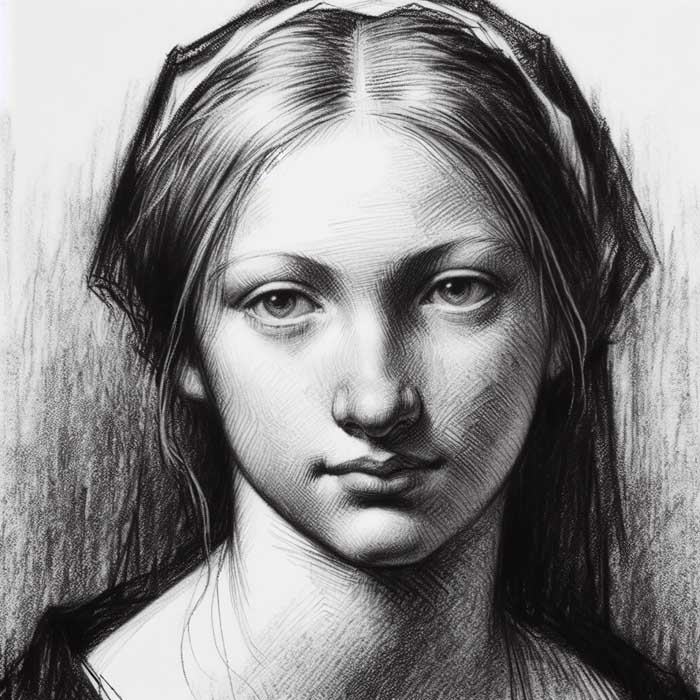
Her Story
When Orpah left, “Ruth stayed with” Naomi and vowed, “Your people will be my people, and your God my God” (Ruth 1:14,16). She returned with Naomi to Bethlehem and later became Boaz’s wife (Ruth 1:22; 4:13).
Learn More →Name Meaning
Strong’s links Ruth’s name (Ruwth) to the sense of “friend” and a “female associate.” In Ruth, she is repeatedly called “Ruth the Moabitess” (Ruth 1:22; 2:2).
Learn More →Ruth (a name likely meaning “friend”) is identified in Scripture as “Ruth the Moabitess,” a woman of Moab who became Naomi’s daughter-in-law and returned with her to Bethlehem.
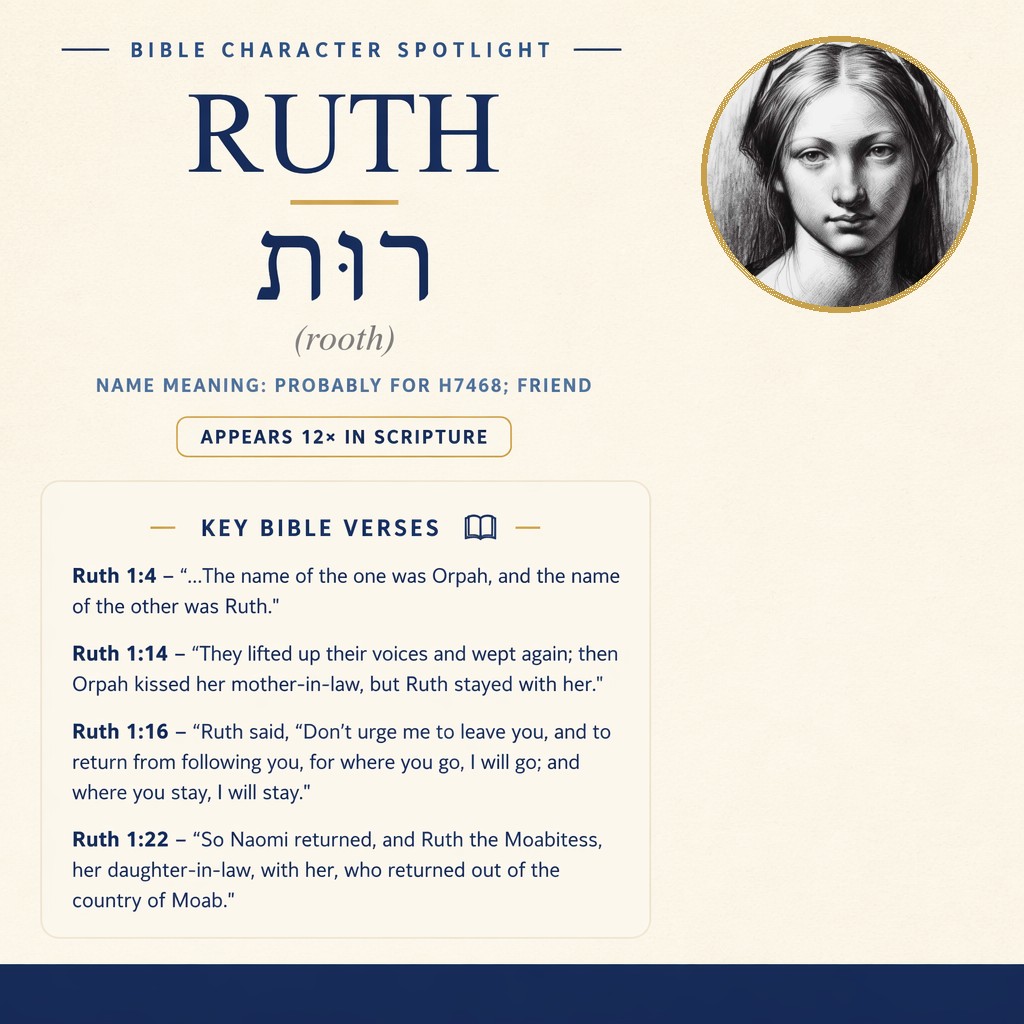
Ruth in Scripture
Ruth appears in the narrative set “in the days when the judges judged,” when “there was a famine in the land,” and “a certain man of Bethlehem Judah went to live in the country of Moab with his wife and his two sons” (Ruth 1:1). That family is introduced by name: “The name of the man was Elimelech, and the name of his wife Naomi. The names of his two sons were Mahlon and Chilion, Ephrathites of Bethlehem Judah. They came into the country of Moab and lived there” (Ruth 1:2).
After Naomi’s husband died (Ruth 1:3), the sons married Moabite women, including Ruth.
“They took for themselves wives of the women of Moab. The name of the one was Orpah, and the name of the other was Ruth. They lived there about ten years.” (Ruth 1:4)
When both sons died (Ruth 1:5), Naomi prepared to return from Moab because she “had heard in the country of Moab how Yahweh had visited his people in giving them bread” (Ruth 1:6). Ruth and Orpah initially traveled with her as she left (Ruth 1:7), but Naomi urged them to return to their homes, asking that Yahweh deal kindly with them and grant them rest (Ruth 1:8–9). The daughters-in-law wept and said, “No, but we will return with you to your people” (Ruth 1:10). Naomi pressed them further, reasoning that she could not provide them future husbands (Ruth 1:11–13).
The parting of ways between the two women is described briefly but decisively.
“They lifted up their voices and wept again; then Orpah kissed her mother-in-law, but Ruth stayed with her.” (Ruth 1:14)
Naomi pointed to Orpah’s decision as a model, saying, “Behold, your sister-in-law has gone back to her people and to her god. Follow your sister-in-law” (Ruth 1:15). Ruth’s reply expresses her determination to remain with Naomi and to attach herself to Naomi’s people and God.
“Ruth said, ‘Don’t urge me to leave you, and to return from following you, for where you go, I will go; and where you stay, I will stay. Your people will be my people, and your God my God.’” (Ruth 1:16)
She continues with further commitments concerning death and burial, ending with an oath formula: “May Yahweh do so to me, and more also, if anything but death parts you and me” (Ruth 1:17). Naomi, seeing Ruth’s resolve, “stopped urging her” (Ruth 1:18). Together they traveled to Bethlehem, where “all the city was excited about them” (Ruth 1:19). Naomi spoke of her bitterness and affliction, attributing her losses to the Almighty (Ruth 1:20–21). The chapter closes by identifying Ruth’s status and origin and setting their arrival in an agricultural season.
“So Naomi returned, and Ruth the Moabitess, her daughter-in-law, with her, who returned out of the country of Moab. They came to Bethlehem in the beginning of barley harvest.” (Ruth 1:22)
In Bethlehem, Ruth is shown taking initiative to provide through gleaning. She speaks to Naomi with a request framed around finding favor.
“Ruth the Moabitess said to Naomi, ‘Let me now go to the field, and glean among the ears of grain after him in whose sight I find favor.’ She said to her, ‘Go, my daughter.’” (Ruth 2:2)
Ruth’s interaction with Boaz includes instruction and protection connected to where she should glean and with whom she should remain.
“Then Boaz said to Ruth, ‘Listen, my daughter. Don’t go to glean in another field, and don’t go from here, but stay here close to my maidens.’” (Ruth 2:8)
Later, Ruth reports Boaz’s directions in terms of proximity to his workers through the harvest, and Naomi affirms that this is good counsel. Ruth is again identified as “the Moabitess” in her own report.
“Ruth the Moabitess said, ‘Yes, he said to me, “You shall stay close to my young men until they have finished all my harvest.”’” (Ruth 2:21)
“Naomi said to Ruth her daughter-in-law, ‘It is good, my daughter, that you go out with his maidens, and that they not meet you in any other field.’” (Ruth 2:22)
In a later encounter, Ruth identifies herself to Boaz as his servant and appeals to him because of his kinship position, using symbolic language tied to a garment.
“He said, ‘Who are you?’ She answered, ‘I am Ruth your servant. Therefore spread the corner of your garment over your servant; for you are a near kinsman.’” (Ruth 3:9)
The legal and familial dimension of Ruth’s situation is stated when Boaz explains that acquiring a field from Naomi includes taking Ruth, described explicitly by origin and by her prior marital status, with a purpose connected to preserving the dead man’s name and inheritance.
“Then Boaz said, ‘On the day you buy the field from the hand of Naomi, you must buy it also from Ruth the Moabitess, the wife of the dead, to raise up the name of the dead on his inheritance.’” (Ruth 4:5)
Boaz later announces publicly that he has acquired Ruth as his wife with the same stated purpose.
“Moreover, Ruth the Moabitess, the wife of Mahlon, I have purchased to be my wife, to raise up the name of the dead on his inheritance, that the name of the dead may not be cut off from among his brothers and from the gate of his place. You are witnesses today.” (Ruth 4:10)
The narrative concludes Ruth’s story in these citations by recording her marriage to Boaz and the birth of a son, attributed to Yahweh’s enabling.
“So Boaz took Ruth and she became his wife; and he went in to her, and Yahweh enabled her to conceive, and she bore a son.” (Ruth 4:13)
Name and Meaning
The name is written in Hebrew script as רוּת, transliterated Ruwth and pronounced “rooth.” Lexicon tradition connects the name with the sense of “friend,” and relates it to a component term re’uwth (רְעוּת), described as referring to a female associate.
Observation
Across these passages Ruth is repeatedly identified as “the Moabitess” (Ruth 1:22; 2:2; 2:21; 4:5; 4:10), yet she binds herself to Naomi with the pledge, “Your people will be my people, and your God my God” (Ruth 1:16), and her story culminates in marriage and childbirth: “Boaz took Ruth and she became his wife… and she bore a son” (Ruth 4:13).
Frequently Asked Questions
What does the name Ruth mean?
The name Ruth is given as meaning “friend.”
How many times does Ruth appear in the Bible?
Ruth appears 12 times.
Who was Ruth?
Ruth is identified as a Moabitess (Ruth 1:22). She is also called Naomi’s daughter-in-law (Ruth 1:22).
What did Ruth say about staying with Naomi?
Ruth said, “Don’t urge me to leave you… for where you go, I will go; and where you stay, I will stay. Your people will be my…” (Ruth 1:16).
Explore Further
If you found this page about Ruth interesting and would like to discover more about other biblical characters, explore our comprehensive Encyclopedia of Biblical Characters. For those looking to delve deeper into the Greek origins of these names and terms, our Greek Lexicon is an invaluable resource.
Sources: Name and occurrence data from Strong’s Exhaustive Concordance and STEPBible reference data (CC BY). Scripture quotations from the World English Bible (public domain).





