Who was Rachel in the bible?
Rachel, a wife of Jacob, appears in Genesis 29 and is also mentioned in 1 Samuel 10:2 at “Rachel’s tomb.”

Genesis Narrative
Rachel came “with her father’s sheep, for she kept them” when Jacob arrived (Genesis 29:9). “Jacob loved Rachel” and served seven years for her (Genesis 29:18, 20).
Learn More →Name Meaning
The name Rachel is derived from a term meaning “a ewe” (Strong’s H7354). In Genesis 29, Rachel is described as “beautiful in form and attractive” (Genesis 29:17).
Learn More →Rachel (רָחֵל; transliterated Rachel) is presented in Scripture as Jacob’s wife, and her name is explained in lexicon tradition as relating to “a ewe.” In Genesis 29 she appears as Laban’s younger daughter, first met by Jacob at a well as she comes with her father’s sheep.
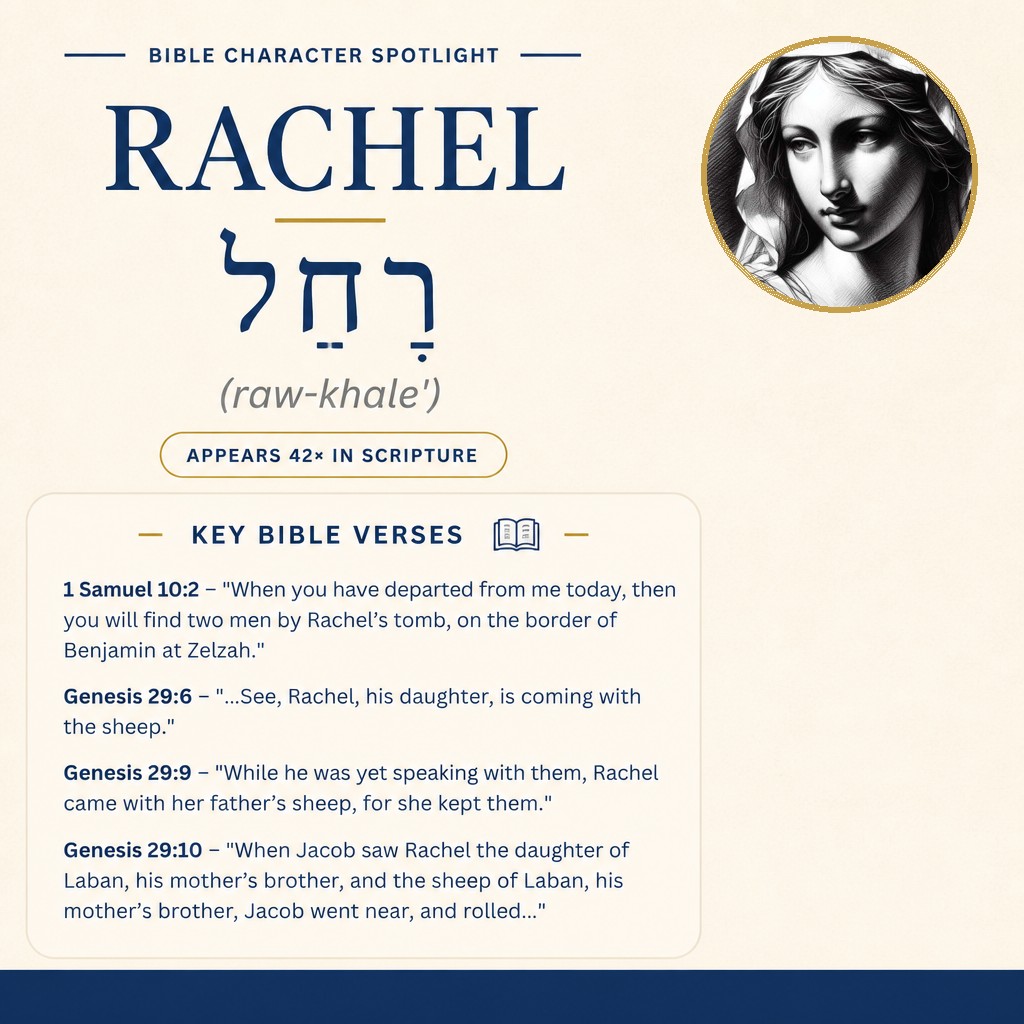
Rachel in Scripture
Rachel is introduced in the setting of Jacob arriving among people connected with Laban. When Jacob asks about Laban’s wellbeing, he is told Rachel is approaching with the flock.
“He said to them, ‘Is it well with him?’ They said, ‘It is well. See, Rachel, his daughter, is coming with the sheep.’” (Genesis 29:6)
The narrative immediately shows her as an active shepherd: she comes with sheep, because “she kept them.” Jacob responds with decisive action at the well, then an emotional greeting. The text states both her work and Jacob’s response in close succession.
“While he was yet speaking with them, Rachel came with her father’s sheep, for she kept them.” (Genesis 29:9)
“When Jacob saw Rachel the daughter of Laban, his mother’s brother, and the sheep of Laban, his mother’s brother, Jacob went near, and rolled the stone from the well’s mouth, and watered the flock of Laban his mother’s brother.” (Genesis 29:10)
“Jacob kissed Rachel, and lifted up his voice, and wept.” (Genesis 29:11)
Rachel is then told how Jacob understands his place in relation to her family, and she runs to report to her father. The text frames this as the immediate social consequence of their meeting.
“Jacob told Rachel that he was her father’s relative, and that he was Rebekah’s son. She ran and told her father.” (Genesis 29:12)
Within the broader household setting, Genesis identifies Laban’s two daughters by name and birth order. Rachel is explicitly the younger, and her appearance is described in contrast with Leah.
“Laban had two daughters. The name of the elder was Leah, and the name of the younger was Rachel.” (Genesis 29:16)
“Leah’s eyes were weak, but Rachel was beautiful in form and attractive.” (Genesis 29:17)
Jacob’s preference for Rachel becomes central to the chapter’s events. The narrative says plainly that he loved her, and it records the terms he proposes to Laban: years of service in exchange for marriage to Rachel, whom he specifies as the “younger daughter.”
“Jacob loved Rachel. He said, ‘I will serve you seven years for Rachel, your younger daughter.’” (Genesis 29:18)
The text emphasizes the intensity of Jacob’s affection by describing the long service as feeling short to him.
“Jacob served seven years for Rachel. They seemed to him but a few days, for the love he had for her.” (Genesis 29:20)
The wedding sequence turns on deception: Jacob expects Rachel but receives Leah. The morning after, Jacob confronts Laban with a direct appeal to what he had served for, naming Rachel as the agreed bride.
“In the morning, behold, it was Leah! He said to Laban, ‘What is this you have done to me? Didn’t I serve with you for Rachel? Why then have you deceived me?’” (Genesis 29:25)
After Laban’s response (including the instruction to fulfill Leah’s week and to serve additional years), Jacob complies. Rachel is then given to Jacob “as wife,” which matches the lexicon identity gloss describing her as Jacob’s wife.
“Jacob did so, and fulfilled her week. He gave him Rachel his daughter as wife.” (Genesis 29:28)
The chapter continues by stating that Rachel had her own servant, and it again reports Jacob’s special love for Rachel in contrast to Leah. In the same flow, it introduces the household’s tension by stating Rachel’s barrenness.
“Laban gave Bilhah, his servant, to his daughter Rachel to be her servant.” (Genesis 29:29)
“He went in also to Rachel, and he loved also Rachel more than Leah, and served with him seven more years.” (Genesis 29:30)
“Yahweh saw that Leah was hated, and he opened her womb, but Rachel was barren.” (Genesis 29:31)
From that point, Genesis 29 records Leah’s successive conceptions and the naming of her sons (Reuben, Simeon, Levi, and Judah). Rachel is not further narrated in that portion except for the earlier statement that she was barren; the chapter’s focus shifts to Leah’s childbirth and the names given in response to Leah’s experience.
Outside Genesis 29, Rachel appears in a later geographical reference connected with a tomb bearing her name. When Saul is told what he will find after departing, the sign includes meeting two men “by Rachel’s tomb,” located “on the border of Benjamin at Zelzah.”
“When you have departed from me today, then you will find two men by Rachel’s tomb, on the border of Benjamin at Zelzah. They will tell you, ‘The donkeys which you went to look for have been found; and behold, your father has stopped caring about the donkeys, a” (1 Samuel 10:2)
Name and Meaning
The name is written רָחֵל, transliterated Rachel, and pronounced raw-khale’. Lexicon tradition explains it as connected to the Hebrew term for “a ewe,” with the note that it is the same as H7353 and built from the component word rachel (רָחֵל), understood as “a ewe.”
Observation
Genesis 29 presents Rachel as a shepherd who “came with her father’s sheep” (Genesis 29:9) and as the one for whom Jacob willingly labored—“They seemed to him but a few days, for the love he had for her” (Genesis 29:20)—yet it also sets the household’s strain by stating, “Rachel was barren” (Genesis 29:31).
Frequently Asked Questions
What does the name Rachel mean?
Rachel means “Rachel,” identified as a wife of Jacob.
How many times does Rachel appear in the Bible?
Rachel occurs 42 time(s).
Who was Rachel in the Bible?
Rachel is identified as a wife of Jacob. In Genesis 29:28, Laban “gave him Rachel his daughter as wife.”
Where is Rachel’s tomb mentioned?
Rachel’s tomb is mentioned in 1 Samuel 10:2, which says, “you will find two men by Rachel’s tomb, on the border of Benjamin at Zelzah.”
Explore Further
If you found this page about Rachel interesting and would like to discover more about other biblical characters, explore our comprehensive Encyclopedia of Biblical Characters. For those looking to delve deeper into the Greek origins of these names and terms, our Greek Lexicon is an invaluable resource.
Sources: Name and occurrence data from Strong’s Exhaustive Concordance and STEPBible reference data (CC BY). Scripture quotations from the World English Bible (public domain).