Who was Martha in the bible?
Martha was a woman who received Jesus into her house and appears in Luke 10 and John 11–12 alongside her sister Mary and Lazarus.

Key Moments
Martha was “distracted with much serving” and said, “my sister left me to serve alone” (Luke 10:40). When Lazarus died, she met Jesus and said, “I have come to believe that you are the Christ, God’s Son” (John 11:20, 27).
Learn More →Name Meaning
Strong’s lexicon derives the name Martha as probably of Chaldee origin, meaning “mistress.” John says, “Jesus loved Martha, and her sister, and Lazarus” (John 11:5).
Learn More →Martha is a woman named in the Gospels who is shown receiving Jesus into her home and later speaking with him about the death of her brother Lazarus. Her name is likely of Chaldee origin and is explained in the lexicon tradition as meaning “mistress.”
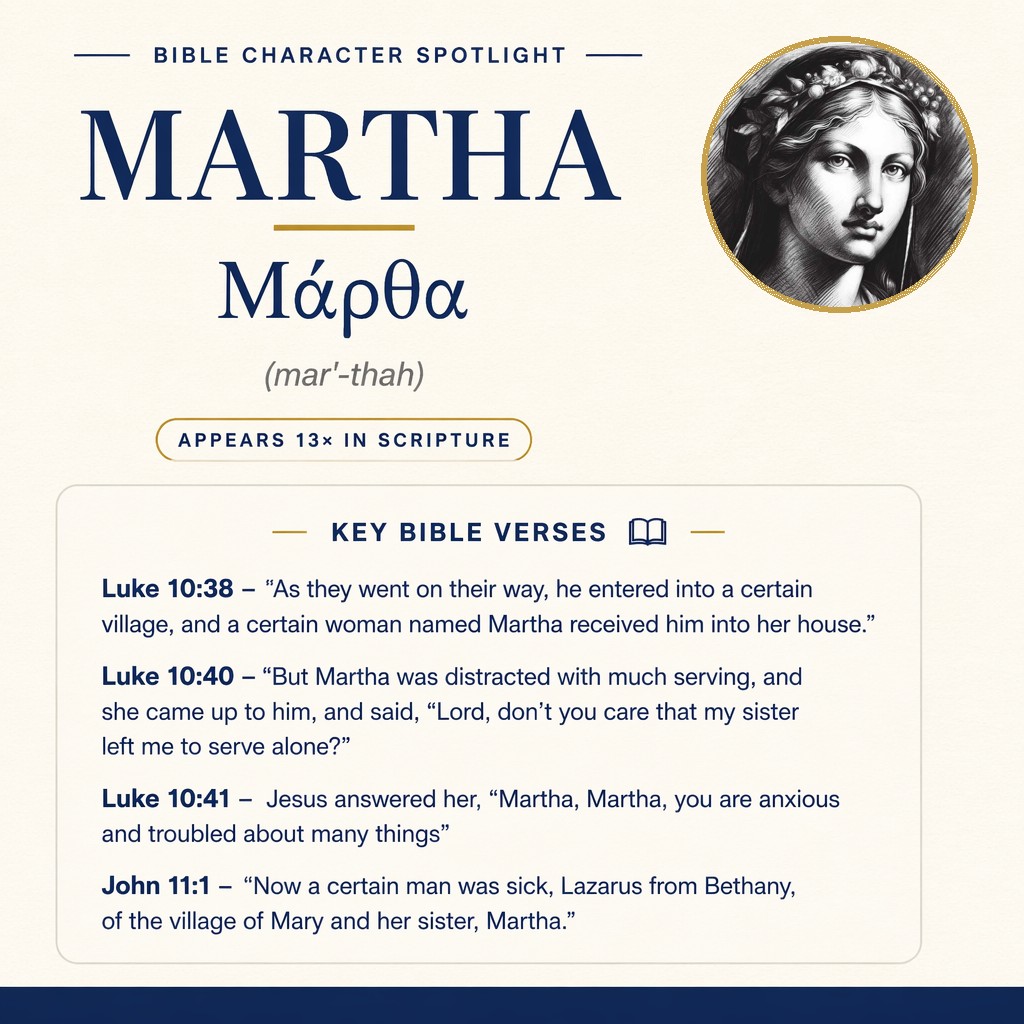
Martha in Scripture
Martha first appears in Luke’s narrative as a hostess who welcomes Jesus and is occupied with serving. Luke introduces her succinctly:
“As they went on their way, he entered into a certain village, and a certain woman named Martha received him into her house.” (Luke 10:38)
In the same scene, Martha is depicted as heavily engaged in household work and expressing distress that her sister is not helping. The account gives her direct words to Jesus:
“But Martha was distracted with much serving, and she came up to him, and said, “Lord, don’t you care that my sister left me to serve alone? Ask her therefore to help me.”” (Luke 10:40)
Jesus responds by addressing her by name and describing her inner state:
“Jesus answered her, “Martha, Martha, you are anxious and troubled about many things,”” (Luke 10:41)
In John’s Gospel, Martha is placed in a family and village setting connected with Lazarus and Mary. John identifies Lazarus as “from Bethany” and specifies Martha as Mary’s sister:
“Now a certain man was sick, Lazarus from Bethany, of the village of Mary and her sister, Martha.” (John 11:1)
Within the same chapter, the bond between Jesus and this household is stated plainly:
“Now Jesus loved Martha, and her sister, and Lazarus.” (John 11:5)
John 11 presents Martha in the midst of bereavement and public consoling. After Lazarus has died and been placed in a tomb, the chapter notes the presence of many Jewish mourners who came to console the sisters:
“Many of the Jews had joined the women around Martha and Mary, to console them concerning their brother.” (John 11:19)
When Martha hears that Jesus is coming, she acts quickly and goes out to meet him, while Mary remains inside:
“Then when Martha heard that Jesus was coming, she went and met him, but Mary stayed in the house.” (John 11:20)
Martha addresses Jesus with grief and a sense of what might have been, speaking of her brother’s death:
“Therefore Martha said to Jesus, “Lord, if you would have been here, my brother wouldn’t have died.”” (John 11:21)
In the extended narrative of John 11, Martha’s words then move from lament to confidence in God’s hearing of Jesus. She says, “Even now I know that whatever you ask of God, God will give you.” (John 11:22). Jesus answers with a promise concerning Lazarus: “Your brother will rise again.” (John 11:23). Martha responds with a statement of belief about resurrection:
“Martha said to him, “I know that he will rise again in the resurrection at the last day.”” (John 11:24)
Jesus continues by declaring, “I am the resurrection and the life. He who believes in me will still live, even if he dies.” (John 11:25), and asks Martha directly, “Do you believe this?” (John 11:26). Martha replies with a confession of belief centered on Jesus’ identity and mission:
“She said to him, “Yes, Lord. I have come to believe that you are the Christ, God’s Son, he who comes into the world.”” (John 11:27)
After this exchange, Martha returns to summon her sister privately, telling Mary, “The Teacher is here and is calling you.” (John 11:28). John remarks on the location of Jesus at that moment:
“Now Jesus had not yet come into the village, but was in the place where Martha met him.” (John 11:30)
The chapter then proceeds through Mary’s meeting with Jesus, the crowd’s grief, and Jesus’ arrival at Lazarus’ tomb. When Jesus comes to the tomb—described as “a cave, and a stone lay against it” (John 11:38)—he issues a command: “Take away the stone.” (John 11:39). At this point Martha speaks again, and John explicitly identifies her as Lazarus’ sister:
“Jesus said, “Take away the stone.” Martha, the sister of him who was dead, said to him, “Lord, by this time there is a stench, for he has been dead four days.”” (John 11:39)
Her words show practical concern about the condition of the body after several days in the tomb. Jesus replies by reminding her of what belief will allow her to see: “Didn’t I tell you that if you believed, you would see God’s glory?” (John 11:40). The stone is removed, Jesus prays, and then calls Lazarus out: “Lazarus, come out!” (John 11:43). The narrative concludes the sign with Lazarus emerging alive and Jesus’ instruction, “Free him, and let him go.” (John 11:44). The chapter notes the impact on those who witnessed it: “Therefore many of the Jews who came to Mary and saw what Jesus did believed in him.” (John 11:45).
Martha appears again in a later scene of shared table fellowship. John describes a supper made for Jesus where Martha again serves:
“So they made him a supper there. Martha served, but Lazarus was one of those who sat at the table with him.” (John 12:2)
Across these passages, Martha is consistently portrayed as active in hospitality and service, as well as personally engaged with Jesus in grief, belief, and dialogue concerning Lazarus.
Name and Meaning
The name is written in Greek as Μάρθα, transliterated Martha and pronounced mar’-thah. According to the lexicon’s etymological note, it is probably of Chaldee origin and is understood to carry the sense of “mistress.”
Closing observation
Martha’s portrait combines practical service—“Martha was distracted with much serving” (Luke 10:40) and “Martha served” (John 12:2)—with forthright speech to Jesus, including both sorrow (“my brother wouldn’t have died,” John 11:21) and confession (“I have come to believe that you are the Christ, God’s Son,” John 11:27).
Frequently Asked Questions
What does the name Martha mean?
Martha is probably of Chaldee origin and means “mistress.”
How many times does Martha appear in the Bible?
Martha appears 13 times.
Who was Martha in the Bible?
Martha was a woman who received Jesus into her house (Luke 10:38). She is identified as the sister of Mary, and Lazarus is from the village of Mary and her sister Martha (John 11:1).
What did Martha say to Jesus when Lazarus died?
Martha said, “Lord, if you would have been here, my brother wouldn’t have died” (John 11:21).
Explore Further
If you found this page about Martha interesting and would like to discover more about other biblical characters, explore our comprehensive Encyclopedia of Biblical Characters. For those looking to delve deeper into the Greek origins of these names and terms, our Greek Lexicon is an invaluable resource.
Sources: Name and occurrence data from Strong’s Exhaustive Concordance and STEPBible reference data (CC BY). Scripture quotations from the World English Bible (public domain).