
Who was Ishmael in the bible?
Ishmael is a biblical name borne by Abraham’s son and several other Israelites, appearing in Genesis, 1 Chronicles, 2 Kings, 2 Chronicles, and Ezra.
Ishmael’s Sons
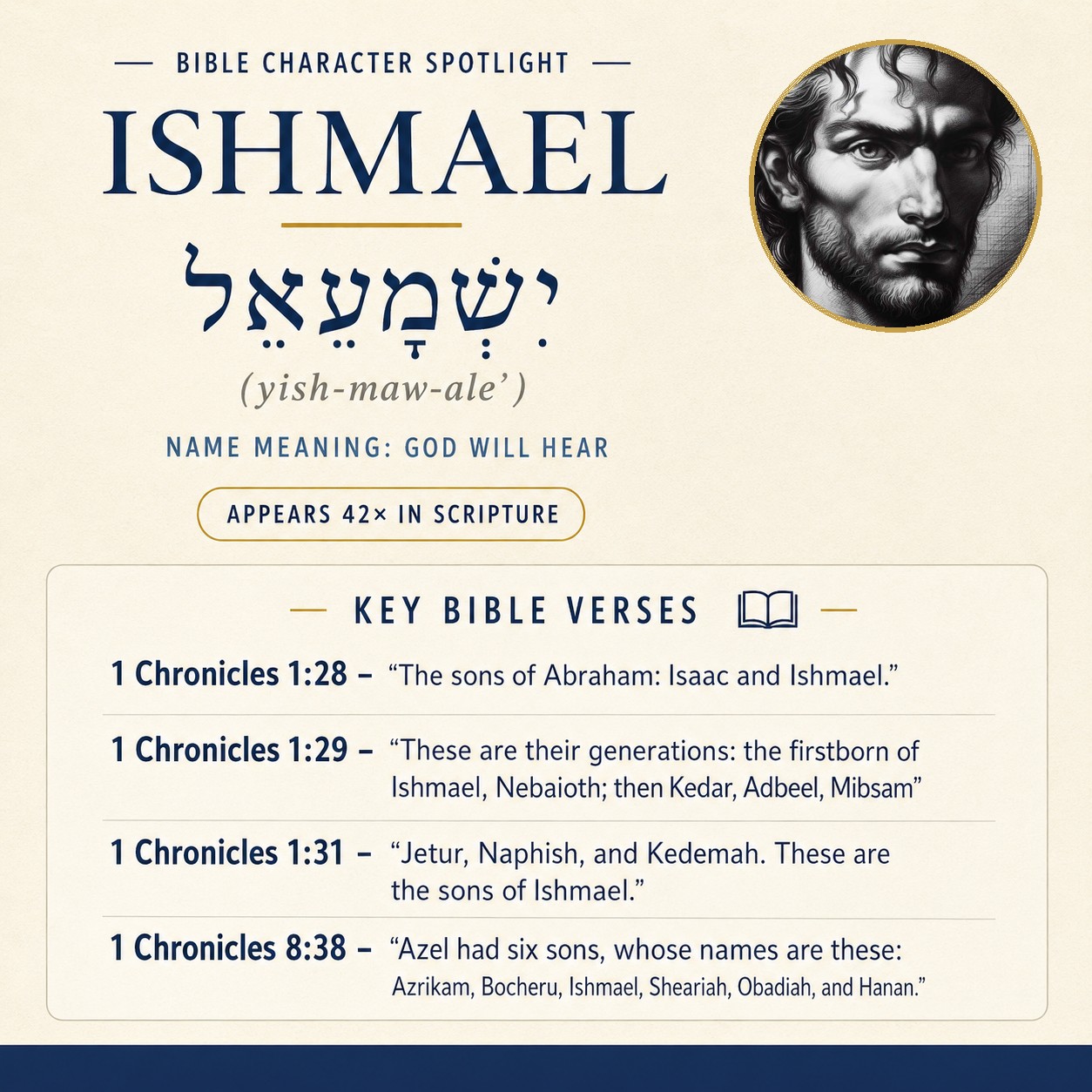
“These are their generations: the firstborn of Ishmael, Nebaioth; then Kedar, Adbeel, Mibsam,” (1 Chronicles 1:29) “Jetur, Naphish, and Kedemah. These are the sons of Ishmael.” (1 Chronicles 1:31)
Learn More →Other Bearers
One Ishmael is listed among Azel’s sons: “Azel had six sons, whose names are these: Azrikam, Bocheru, Ishmael, Sheariah, Obadiah, and Hanan.” (1 Chronicles 8:38) Another is named in Gedaliah’s account: “Ishmael the son of Nethaniah… came… and struck Gedaliah, so that he died.” (2 Kings 25:25)
Learn More →Ishmael (Hebrew Yishma’e’l) is presented in Scripture as a son born to Abram through Hagar, named in connection with God hearing affliction. The same name also appears for several other Israelites in genealogies and historical notices.
Ishmael in Scripture
The first explicit mention of Ishmael comes in the words spoken by “Yahweh’s angel” to Hagar, delivering a promise and naming instruction tied to God’s hearing. The scene is reported directly:
“Yahweh’s angel said to her, ‘Behold, you are with child, and will bear a son. You shall call his name Ishmael, because Yahweh has heard your affliction.’” (Genesis 16:11)
The narrative then records the birth and the act of naming as Abram’s response to the birth through Hagar:
“Hagar bore a son for Abram. Abram called the name of his son, whom Hagar bore, Ishmael.” (Genesis 16:15)
The passage also places Ishmael’s birth in relation to Abram’s age:
“Abram was eighty-six years old when Hagar bore Ishmael to Abram.” (Genesis 16:16)
In the genealogical presentation of the Chronicler, Ishmael is listed as one of Abraham’s sons alongside Isaac:
“The sons of Abraham: Isaac and Ishmael.” (1 Chronicles 1:28)
The same chapter continues by giving a line of “generations” associated with Ishmael, beginning with a statement about his firstborn and continuing with a list of sons. The text introduces the list and identifies the firstborn:
“These are their generations: the firstborn of Ishmael, Nebaioth; then Kedar, Adbeel, Mibsam,” (1 Chronicles 1:29)
The list continues within the chapter and concludes with a summary statement that identifies these names as Ishmael’s sons:
“Jetur, Naphish, and Kedemah. These are the sons of Ishmael.” (1 Chronicles 1:31)
Within the wider flow of 1 Chronicles 1, Ishmael appears as part of a long genealogical sequence moving from the earliest figures through many family lines until it reaches Abram:
“Abram (also called Abraham).” (1 Chronicles 1:27)
Immediately after naming Abraham, the record states, “The sons of Abraham: Isaac and Ishmael” (1 Chronicles 1:28), then pauses to itemize “their generations” (1 Chronicles 1:29) for Ishmael’s line before continuing to other descendants and lines in the chapter. This positions Ishmael within the Chronicler’s broad mapping of ancestry and peoples, in which individual names are presented in ordered succession.
Outside Genesis 16 and the genealogy in 1 Chronicles 1, the name Ishmael occurs in other settings, indicating different individuals. One Ishmael is listed as a son within the family of Azel:
“Azel had six sons, whose names are these: Azrikam, Bocheru, Ishmael, Sheariah, Obadiah, and Hanan. All these were the sons of Azel.” (1 Chronicles 8:38)
The same information is repeated in another genealogical notice:
“Azel had six sons, whose names are these: Azrikam, Bocheru, Ishmael, Sheariah, Obadiah, and Hanan. These were the sons of Azel.” (1 Chronicles 9:44)
Another occurrence appears in an administrative context, where Zebadiah is identified by his father’s name:
“Behold, Amariah the chief priest is over you in all matters of Yahweh; and Zebadiah the son of Ishmael, the ruler of the house of Judah, in all the king’s matters.” (2 Chronicles 19:11)
In the account connected to Gedaliah at Mizpah, Ishmael is named among those who came to Gedaliah after hearing that Babylon’s king had appointed him governor:
“Now when all the captains of the forces, they and their men, heard that the king of Babylon had made Gedaliah governor, they came to Gedaliah to Mizpah, even Ishmael the son of Nethaniah, and Johanan the son of Kareah, and Seraiah the son of Tanhumeth…” (2 Kings 25:23)
The same chapter later describes a violent act attributed to this Ishmael and identifies him further:
“But in the seventh month, Ishmael the son of Nethaniah, the son of Elishama, of the royal offspring came, and ten men with him, and struck Gedaliah, so that he died, with the Jews and the Chaldeans that were with him at Mizpah.” (2 Kings 25:25)
In the postexilic list of names in Ezra, Ishmael appears among “the sons of Pashhur”:
“Of the sons of Pashhur: Elioenai, Maaseiah, Ishmael, Nethanel, Jozabad, and Elasah.” (Ezra 10:22)
Multiple Bearers
Scripture uses the name Ishmael for more than one person. One Ishmael is explicitly tied to Abram and Hagar—“Hagar bore a son for Abram… Ishmael” (Genesis 16:15)—and is placed among Abraham’s sons in a genealogy: “The sons of Abraham: Isaac and Ishmael” (1 Chronicles 1:28). Another Ishmael is a son of Azel (1 Chronicles 8:38; 9:44). Another is mentioned as the father of Zebadiah—“Zebadiah the son of Ishmael” (2 Chronicles 19:11). Another is “Ishmael the son of Nethaniah” who came to Gedaliah and later “struck Gedaliah, so that he died” (2 Kings 25:23, 25). Another Ishmael is listed among “the sons of Pashhur” (Ezra 10:22). These references present distinct individuals identified by different family connections and contexts.
Name and Meaning
The name is written יִשְׁמָעֵאל, transliterated Yishma’e’l and pronounced “yish-maw-ale’.” Its traditional lexical derivation connects it to the Hebrew verb shama’ (“to hear”) joined with ‘el (“God,” also used with the sense of strength or might), yielding the sense “God will hear.” In Genesis, that meaning is explicitly tied to the naming: “You shall call his name Ishmael, because Yahweh has heard your affliction” (Genesis 16:11).
Observation
Across these passages, the name Ishmael repeatedly functions as an identifying marker in genealogies and official notices, while Genesis 16 anchors it in a specific declaration: “Yahweh has heard your affliction” (Genesis 16:11).
Frequently Asked Questions
What does the name Ishmael mean?
The name Ishmael means “God will hear.”
How many times does Ishmael appear in the Bible?
Ishmael appears 42 times.
Who was Ishmael?
Ishmael is named as Abraham’s oldest son (1 Chronicles 1:28). Genesis records that Hagar bore Ishmael to Abram (Genesis 16:15).
Why was Ishmael given that name?
An angel of Yahweh told Hagar, “You shall call his name Ishmael, because Yahweh has heard your affliction” (Genesis 16:11).
Explore Further
If you found this page about Ishmael interesting and would like to discover more about other biblical characters, explore our comprehensive Encyclopedia of Biblical Characters. For those looking to delve deeper into the Greek origins of these names and terms, our Greek Lexicon is an invaluable resource.
Sources: Name and occurrence data from Strong’s Exhaustive Concordance and STEPBible reference data (CC BY). Scripture quotations from the World English Bible (public domain).




