
Who was Goliath in the bible?
Goliath was a Philistine champion of Gath, appearing chiefly in 1 Samuel 17 and also in 1 Samuel 21:9; 1 Samuel 22:10; 1 Chronicles 20:5; and 2 Samuel 21:19.

Challenge and Death
He said, "I defy the armies of Israel today! Give me a man, that we may fight together!" (1 Samuel 17:10). "David prevailed over the Philistine with a sling and with a stone" (1 Samuel 17:50).
Learn More →Name and Links
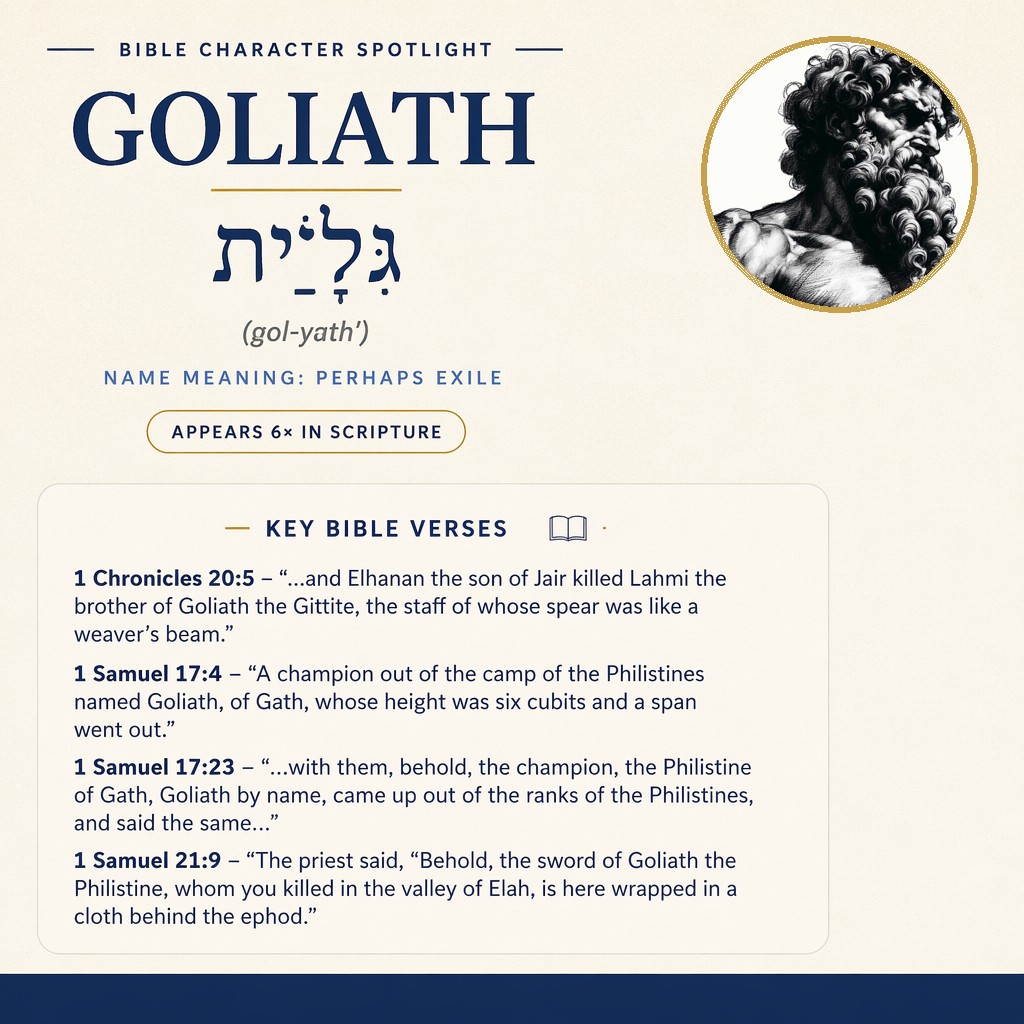
Strong’s gloss identifies Goliath as a Philistine, and the name has been connected with "exile" (Strong’s H1555, paraphrase). Elhanan is said to have killed "Lahmi the brother of Goliath the Gittite" (1 Chronicles 20:5) and "Goliath the Gittite’s brother" (2 Samuel 21:19).
Learn More →Goliath was a Philistine champion from Gath, portrayed as a heavily armed warrior who challenged Israel to single combat and was killed by David. Lexicon tradition associates the name with the idea of “exile,” connected to a Hebrew root meaning “to denude,” especially in a disgraceful sense.
Goliath in Scripture
Goliath appears most fully in the battle account of 1 Samuel 17, set when “the Philistines gathered together their armies to battle” and Israel “encamped in the valley of Elah” facing them across a valley (1 Samuel 17:1–3). Into this standoff stepped the Philistine champion.
A champion out of the camp of the Philistines named Goliath, of Gath, whose height was six cubits and a span went out. (1 Samuel 17:4)
The narrative stresses his intimidating equipment and stature. He is described with extensive armor and weapons: “a helmet of bronze,” “a coat of mail,” “bronze shin armor,” and “a bronze javelin,” and his spear is singled out for its size and weight (1 Samuel 17:5–7). He also does not come alone: “His shield bearer went before him” (1 Samuel 17:7).
Goliath’s role in the conflict is as a challenger who seeks to decide the outcome by representative combat. He calls out to Israel’s army and frames the issue as the Philistines versus Saul’s servants.
He stood and cried to the armies of Israel, and said to them, “Why have you come out to set your battle in array? Am I not a Philistine, and you servants to Saul? Choose a man for yourselves, and let him come down to me.” (1 Samuel 17:8)
“If he is able to fight with me and kill me, then will we be your servants; but if I prevail against him and kill him, then you will be our servants and serve us.” (1 Samuel 17:9)
The Philistine said, “I defy the armies of Israel today! Give me a man, that we may fight together!” (1 Samuel 17:10)
The immediate effect is fear: “When Saul and all Israel heard those words of the Philistine, they were dismayed, and greatly afraid” (1 Samuel 17:11). The scene continues with Goliath’s repeated appearance: “The Philistine came near morning and evening, and presented himself forty days” (1 Samuel 17:16).
David arrives at the battlefield as part of a family errand, sent to bring food and to check on his brothers (1 Samuel 17:17–22). While David is talking with them, Goliath again appears in his champion role.
As he talked with them, behold, the champion, the Philistine of Gath, Goliath by name, came up out of the ranks of the Philistines, and said the same words; and David heard them. (1 Samuel 17:23)
Israel’s soldiers “fled from him, and were terrified” (1 Samuel 17:24). The men also describe the challenge as a public disgrace and speak of a royal reward for anyone who kills him (1 Samuel 17:25). David’s own speech focuses on the offense of Goliath’s defiance.
David spoke to the men who stood by him, saying, “What shall be done to the man who kills this Philistine, and takes away the reproach from Israel? For who is this uncircumcised Philistine, that he should defy the armies of the living God?” (1 Samuel 17:26)
After conflict with his brother Eliab about why he has come (1 Samuel 17:28–30), David is brought before Saul. He offers himself as the challenger to fight Goliath: “Your servant will go and fight with this Philistine” (1 Samuel 17:32). Saul objects, contrasting David’s youth with Goliath’s experience: “for you are but a youth, and he a man of war from his youth” (1 Samuel 17:33). David answers by recounting his defense of sheep against a lion and a bear, applying the same confidence to Goliath because of the Philistine’s defiance (1 Samuel 17:34–36). Saul permits him to go with a blessing (1 Samuel 17:37).
Although Saul attempts to outfit David with armor, David rejects it as untested (1 Samuel 17:38–39). Instead, David takes his staff, selects stones from the brook, and approaches the Philistine with a sling (1 Samuel 17:40). The confrontation intensifies as Goliath comes forward with his shield bearer.
When the Philistine looked around, and saw David, he disdained him; for he was but a youth, and ruddy, and had a good looking face. (1 Samuel 17:42)
The Philistine said to David, “Am I a dog, that you come to me with sticks?” The Philistine cursed David by his gods. (1 Samuel 17:43)
The Philistine said to David, “Come to me, and I will give your flesh to the birds of the sky, and to the animals of the field.” (1 Samuel 17:44)
David answers by contrasting Goliath’s weapons with his own reliance on “Yahweh of Armies,” identifying Goliath’s offense as defiance against Israel’s God (1 Samuel 17:45). David also declares that the outcome will display divine power and that “the battle is Yahweh’s” (1 Samuel 17:46–47).
Then David said to the Philistine, “You come to me with a sword, with a spear, and with a javelin; but I come to you in the name of Yahweh of Armies, the God of the armies of Israel, whom you have defied.” (1 Samuel 17:45)
“…that all this assembly may know that Yahweh doesn’t save with sword and spear; for the battle is Yahweh’s, and he will give you into our hand.” (1 Samuel 17:47)
The fight is decided swiftly. As Goliath advances, David runs forward, slings a stone, and strikes the Philistine’s forehead; “he fell on his face to the earth” (1 Samuel 17:48–49). The narrator emphasizes that David initially has no sword; he prevails “with a sling and with a stone” (1 Samuel 17:50). Then David uses Goliath’s own sword to complete the victory and removes his head (1 Samuel 17:51). When the Philistines see their champion dead, they flee and are pursued by Israel (1 Samuel 17:51–53). David takes the Philistine’s head to Jerusalem and keeps the armor (1 Samuel 17:54). Saul then questions who David is, and David identifies himself as “the son of your servant Jesse the Bethlehemite” (1 Samuel 17:55–58).
Later references to Goliath appear through the continued significance of his sword. In one scene, a priest says to David:
The priest said, “Behold, the sword of Goliath the Philistine, whom you killed in the valley of Elah, is here wrapped in a cloth behind the ephod. If you would like to take that, take it; for there is no other except that here.” (1 Samuel 21:9)
Another verse summarizes the same idea, saying of the priest: “He inquired of Yahweh for him, gave him food, and gave him the sword of Goliath the Philistine” (1 Samuel 22:10).
Other Goliath References
Two additional passages refer to “Goliath the Gittite” in connection with later wars involving Philistines, and both compare a spear’s staff to “a weaver’s beam.” One says:
There was again war with the Philistines at Gob; and Elhanan the son of Jaare-Oregim the Bethlehemite killed Goliath the Gittite’s brother, the staff of whose spear was like a weaver’s beam. (2 Samuel 21:19)
A parallel statement appears in Chronicles:
Again there was war with the Philistines; and Elhanan the son of Jair killed Lahmi the brother of Goliath the Gittite, the staff of whose spear was like a weaver’s beam. (1 Chronicles 20:5)
These verses do not recount Goliath’s own actions, but they show his name used to identify a relative (“the brother of Goliath the Gittite”) and link that family to similarly formidable weaponry.
Name and Meaning
The name is written in Hebrew script as גׇּלְיַת, transliterated Golyath and pronounced gol-yath’. Strong’s derivation suggests it may come from a root connected with the notion of “exile,” tied to galah (גָּלָה), “to denude,” especially in a disgraceful sense; the identity gloss describes Goliath as a Philistine.
Observation
Across these passages, Goliath is consistently presented as “the Philistine of Gath” (1 Samuel 17:23) whose public challenge—“I defy the armies of Israel today!” (1 Samuel 17:10)—sets the stage for a decisive confrontation in which David “prevailed over the Philistine with a sling and with a stone” (1 Samuel 17:50).
Frequently Asked Questions
What does the name Goliath mean?
The name Goliath (Golyath) is given as meaning “exile.”
How many times does Goliath appear in the Bible?
Goliath appears 6 times.
Who was Goliath?
Goliath is identified as a Philistine and is described as “a champion out of the camp of the Philistines… of Gath” (1 Samuel 17:4).
What is one notable detail mentioned about Goliath in battle?
He is described as being “six cubits and a span” in height (1 Samuel 17:4).
Explore Further
If you found this page about Goliath interesting and would like to discover more about other biblical characters, explore our comprehensive Encyclopedia of Biblical Characters. For those looking to delve deeper into the Greek origins of these names and terms, our Greek Lexicon is an invaluable resource.
Sources: Name and occurrence data from Strong’s Exhaustive Concordance and STEPBible reference data (CC BY). Scripture quotations from the World English Bible (public domain).




