Who was Caiaphas in the bible?
Caiaphas is named as the high priest in Gospel and Acts passages, appearing in Matthew 26, Luke 3, John 11 and 18, and Acts 4.

In The Gospels
“Those who had taken Jesus led him away to Caiaphas the high priest” (Matthew 26:57). In John’s account, Jesus was sent to him: “Annas sent him bound to Caiaphas, the high priest” (John 18:24).
Learn More →Counsel And Circle
John says, “it was Caiaphas who advised the Jews that it was expedient that one man should perish for the people” (John 18:14). Acts lists him among those present: “Annas the high priest was there, with Caiaphas...” (Acts 4:6).
Learn More →Caiaphas is a man identified in the New Testament as “the high priest,” whose name is of Chaldee origin. In the Gospel narratives and Acts, he appears in connection with gatherings of chief priests and elders and with the custody and transfer of Jesus.
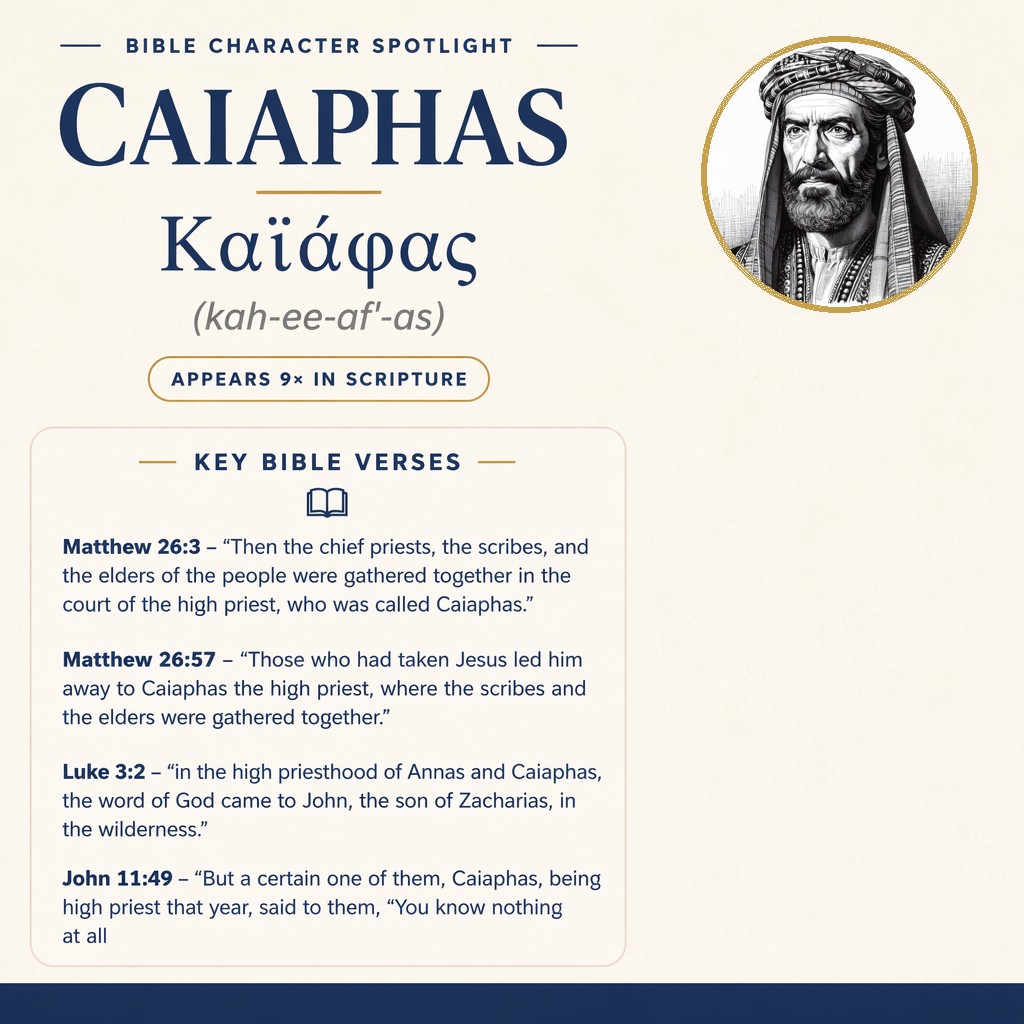
Caiaphas in Scripture
In Matthew, Caiaphas is named as the high priest whose court becomes a gathering place for Jewish leadership:
“Then the chief priests, the scribes, and the elders of the people were gathered together in the court of the high priest, who was called Caiaphas.” (Matthew 26:3, WEB)
Later in the same chapter, Jesus is brought to him, and the same kinds of groups are again present:
“Those who had taken Jesus led him away to Caiaphas the high priest, where the scribes and the elders were gathered together.” (Matthew 26:57, WEB)
Luke places Caiaphas within a wider setting of recognized high-priestly authority at the time when John begins to receive God’s word:
“in the high priesthood of Annas and Caiaphas, the word of God came to John, the son of Zacharias, in the wilderness.” (Luke 3:2, WEB)
John’s Gospel also identifies Caiaphas as high priest, and records him speaking within a deliberative group. John introduces him as one among “them,” explicitly stating his office for that time:
“But a certain one of them, Caiaphas, being high priest that year, said to them, “You know nothing at all,”” (John 11:49, WEB)
Later John summarizes a specific counsel attributed to him:
“Now it was Caiaphas who advised the Jews that it was expedient that one man should perish for the people.” (John 18:14, WEB)
In John 18, Caiaphas is woven into the account of Jesus’ arrest and movement through custody. After Jesus goes with his disciples “over the brook Kidron” into a garden (John 18:1), Judas arrives “having taken a detachment of soldiers and officers from the chief priests and the Pharisees” (John 18:3). Jesus identifies himself with the words “I am he,” after which the arresting party “went backward, and fell to the ground” (John 18:6). He is then seized and bound:
“So the detachment, the commanding officer, and the officers of the Jews seized Jesus and bound him,” (John 18:12, WEB)
Jesus is first taken to Annas, and Caiaphas is introduced through that relationship and office:
“and led him to Annas first, for he was father-in-law to Caiaphas, who was high priest that year.” (John 18:13, WEB)
John immediately adds the earlier-described advice associated with Caiaphas:
“Now it was Caiaphas who advised the Jews that it was expedient that one man should perish for the people.” (John 18:14, WEB)
While Jesus is in the high priestly court, the narrative emphasizes access to “the court of the high priest” and the questioning of Jesus. One disciple “was known to the high priest, and entered in with Jesus into the court of the high priest,” while Peter remains outside until brought in (John 18:15-16). As Peter enters, he is challenged about being a disciple and denies it: “I am not” (John 18:17). The setting is described as cold, with servants and officers warming themselves, and Peter among them (John 18:18).
The high priest questions Jesus “about his disciples and about his teaching,” and Jesus answers by appealing to the public nature of his words:
“The high priest therefore asked Jesus about his disciples and about his teaching.
Jesus answered him, “I spoke openly to the world. I always taught in synagogues, and in the temple, where the Jews always meet. I said nothing in secret.”” (John 18:19-20, WEB)
When an officer strikes Jesus, Jesus responds by calling for testimony if he has spoken wrongly (John 18:22-23). The narrative then marks a transfer explicitly involving Caiaphas:
“Annas sent him bound to Caiaphas, the high priest.” (John 18:24, WEB)
As the scene continues, Peter is again confronted and again denies knowing Jesus: “I am not” (John 18:25). A servant, described as “a relative of him whose ear Peter had cut off,” challenges him with having seen him “in the garden,” and Peter denies it once more; “immediately the rooster crowed” (John 18:26-27).
Afterward, Jesus is moved onward from Caiaphas to the next setting before Pilate:
“They led Jesus therefore from Caiaphas into the Praetorium. It was early, and they themselves didn’t enter into the Praetorium, that they might not be defiled, but might eat the Passover.” (John 18:28, WEB)
Pilate comes out and questions the accusers, who answer that they have delivered Jesus up as an “evildoer” (John 18:29-30). Pilate tells them to judge him by their law, and they reply, “It is illegal for us to put anyone to death,” (John 18:31), after which Pilate questions Jesus about being “the King of the Jews” (John 18:33). Jesus speaks of a kingdom “not of this world” (John 18:36). Pilate says, “What is truth?” and then declares, “I find no basis for a charge against him.” (John 18:38). The chapter closes with the crowd choosing Barabbas instead of Jesus: “Not this man, but Barabbas!” (John 18:40).
In Acts, Caiaphas is named among a group present with Annas in a high-priestly circle:
“Annas the high priest was there, with Caiaphas, John, Alexander, and as many as were relatives of the high priest.” (Acts 4:6, WEB)
Name and Meaning
The name is written in Greek as Καϊάφας, transliterated Kaiaphas, and pronounced kah-ee-af’-as. The lexicon notes that the name is of Chaldee origin.
Observation
Across these passages, Caiaphas is consistently identified by office—“the high priest”—and is linked to pivotal moments of counsel and custody, including the statement that “it was expedient that one man should perish for the people” (John 18:14, WEB) and the movement “from Caiaphas into the Praetorium” (John 18:28, WEB).
Frequently Asked Questions
What does the name Caiaphas mean?
Caiaphas is a Greek form of a name of Chaldee origin, used as the name “Caiaphas.”
How many times does Caiaphas appear in the Bible?
Caiaphas occurs 9 times.
Who was Caiaphas?
Caiaphas is identified as the high priest (Matthew 26:3; Matthew 26:57). Luke mentions “the high priesthood of Annas and Caiaphas” (Luke 3:2).
What did Caiaphas advise about one man perishing for the people?
John states that Caiaphas “advised the Jews that it was expedient that one man should perish for the people” (John 18:14).
Explore Further
If you found this page about Caiaphas interesting and would like to discover more about other biblical characters, explore our comprehensive Encyclopedia of Biblical Characters. For those looking to delve deeper into the Greek origins of these names and terms, our Greek Lexicon is an invaluable resource.
Sources: Name and occurrence data from Strong’s Exhaustive Concordance and STEPBible reference data (CC BY). Scripture quotations from the World English Bible (public domain).