
Who was Ahab in the bible?
Ahab was the son of Omri who reigned over Israel in Samaria, appearing in 1 Kings 16:28–33 and 1 Kings 18.

Rule and Character
“Ahab the son of Omri did that which was evil in Yahweh’s sight above all that were before him” (1 Kings 16:30). “Ahab did more yet to provoke Yahweh, the God of Israel, to anger than all the kings of Israel who were before him” (1 Kings 16:33).
Learn More →Elijah and Famine
“Elijah went to show himself to Ahab. The famine was severe in Samaria” (1 Kings 18:2). When Ahab saw Elijah, he said, “Is that you, you troubler of Israel?” (1 Kings 18:17).
Learn More →Ahab (Hebrew אַחְאָב, ’Ach’ab) is presented in Scripture as “Ahab the son of Omri,” who “reigned over Israel in Samaria twenty-two years,” and as a king judged for doing evil in Yahweh’s sight. A lexicon gloss also identifies the name Ahab as borne by “a king of Israel and… a prophet at Babylon,” though only the king is shown in the verses given here.
Ahab in Scripture
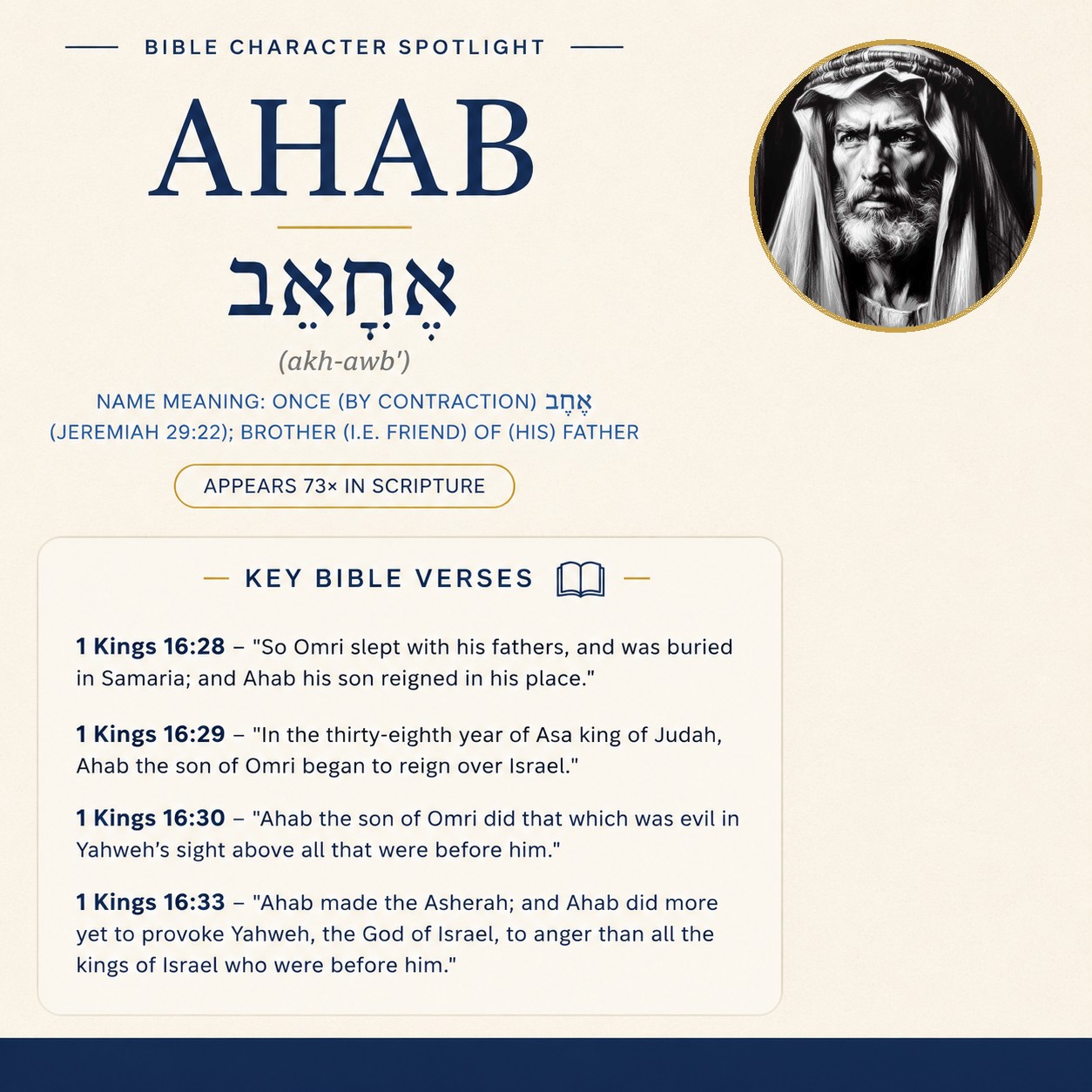
“So Omri slept with his fathers, and was buried in Samaria; and Ahab his son reigned in his place.” (1 Kings 16:28, WEB)
Ahab appears first as the successor of Omri, reigning in Samaria.
“In the thirty-eighth year of Asa king of Judah, Ahab the son of Omri began to reign over Israel. Ahab the son of Omri reigned over Israel in Samaria twenty-two years.” (1 Kings 16:29, WEB)
The text identifies him repeatedly as “the son of Omri,” gives a synchronism for the beginning of his reign, and states its length and location (“in Samaria”). His character is summarized in the assessment that follows.
“Ahab the son of Omri did that which was evil in Yahweh’s sight above all that were before him.” (1 Kings 16:30, WEB)
The narrative attributes to Ahab an exceptional degree of wrongdoing “in Yahweh’s sight,” compared to prior kings. Another statement links his actions directly with provoking Yahweh.
“Ahab made the Asherah; and Ahab did more yet to provoke Yahweh, the God of Israel, to anger than all the kings of Israel who were before him.” (1 Kings 16:33, WEB)
Within the same overall presentation, Ahab is said to have made “the Asherah” and to have provoked “Yahweh, the God of Israel” beyond his predecessors.
The extended narrative in 1 Kings 18 places Ahab in the midst of a severe famine and alongside key figures in his court and in Israel’s prophetic conflict. It begins by reporting Yahweh’s word to Elijah about meeting Ahab and the sending of rain.
“After many days, Yahweh’s word came to Elijah, in the third year, saying, ‘Go, show yourself to Ahab; and I will send rain on the earth.’ ” (1 Kings 18:1, WEB)
“Elijah went to show himself to Ahab. The famine was severe in Samaria.” (1 Kings 18:2, WEB)
Against the setting of “severe” famine “in Samaria,” Ahab is shown acting as a king managing resources and directing his household officials. He summons Obadiah, identified as “over the household,” and Obadiah is described as one who “feared Yahweh greatly.”
“Ahab called Obadiah, who was over the household. (Now Obadiah feared Yahweh greatly;” (1 Kings 18:3, WEB)
The account briefly explains the perilous climate for Yahweh’s prophets at the time, mentioning Jezebel’s action and Obadiah’s concealment and provision for prophets.
“for when Jezebel cut off Yahweh’s prophets, Obadiah took one hundred prophets, and hid them by fifty in a cave, and fed them with bread and water.)” (1 Kings 18:4, WEB)
Ahab’s immediate concern in the famine is the survival of livestock. He instructs Obadiah to search broadly for water sources, expressing a hope to preserve animals.
“Ahab said to Obadiah, ‘Go through the land, to all the springs of water, and to all the brooks. Perhaps we may find grass and save the horses and mules alive, that we not lose all the animals.’ ” (1 Kings 18:5, WEB)
They split the search, each traveling separately.
“So they divided the land between them to pass throughout it. Ahab went one way by himself, and Obadiah went another way by himself.” (1 Kings 18:6, WEB)
Obadiah meets Elijah and recognizes him, but he fears being sent to announce Elijah’s presence to Ahab. His fear is explicit: he anticipates that Ahab would kill him if Elijah cannot then be found.
“He said, ‘How have I sinned, that you would deliver your servant into the hand of Ahab, to kill me?’ ” (1 Kings 18:9, WEB)
“It will happen, as soon as I leave you, that Yahweh’s Spirit will carry you I don’t know where; and so when I come and tell Ahab, and he can’t find you, he will kill me. But I, your servant, have feared Yahweh from my youth.” (1 Kings 18:12, WEB)
Obadiah also refers to Ahab’s efforts to find Elijah across nations and kingdoms.
“As Yahweh your God lives, there is no nation or kingdom where my lord has not sent to seek you. When they said, ‘He is not here,’ he took an oath of the kingdom and nation, that they didn’t find you.” (1 Kings 18:10, WEB)
Elijah insists he will present himself. Obadiah then reports to Ahab, and Ahab goes out to meet Elijah.
“So Obadiah went to meet Ahab, and told him; and Ahab went to meet Elijah.” (1 Kings 18:16, WEB)
When they meet, Ahab addresses Elijah with accusation, calling him the “troubler of Israel.”
“When Ahab saw Elijah, Ahab said to him, ‘Is that you, you troubler of Israel?’ ” (1 Kings 18:17, WEB)
Elijah denies the charge and places blame on Ahab and his father’s house, describing Ahab’s conduct in terms of forsaking Yahweh’s commandments and following the Baals. This direct confrontation supplies the narrative’s interpretation of Ahab’s religious policy and its consequences.
“He answered, ‘I have not troubled Israel; but you, and your father’s house, in that you have forsaken Yahweh’s commandments, and you have followed the Baals.’ ” (1 Kings 18:18, WEB)
Elijah then commands Ahab to gather Israel and a large company of prophets associated with Baal and the Asherah at Mount Carmel, including those who “eat at Jezebel’s table.”
“Now therefore send, and gather to me all Israel to Mount Carmel, and four hundred fifty of the prophets of Baal, and four hundred of the prophets of the Asherah, who eat at Jezebel’s table.” (1 Kings 18:19, WEB)
Ahab complies by sending to Israel and assembling the prophets at Carmel.
“So Ahab sent to all the children of Israel, and gathered the prophets together to Mount Carmel.” (1 Kings 18:20, WEB)
The ensuing contest centers on whether Yahweh or Baal is God, and Elijah proposes a test by fire: “The God who answers by fire, let him be God.” The people agree, and the prophets of Baal call on Baal all day but receive no answer. Elijah repairs Yahweh’s altar, prepares a sacrifice, and prays that Yahweh would be known as God in Israel. The account then describes Yahweh’s decisive response.
“Then Yahweh’s fire fell, and consumed the burnt offering, the wood, the stones, and the dust, and licked up the water that was in the trench.” (1 Kings 18:38, WEB)
Seeing this, the people confess Yahweh as God. Elijah orders the prophets of Baal seized and kills them at the brook Kishon. Immediately afterward Elijah speaks to Ahab with the expectation of coming rain.
“Elijah said to Ahab, ‘Get up, eat and drink; for there is the sound of abundance of rain.’ ” (1 Kings 18:41, WEB)
Ahab goes up “to eat and to drink,” while Elijah prays and instructs his servant to look toward the sea. On the seventh report, a small cloud appears, and Elijah warns Ahab to depart quickly so the rain does not hinder him.
“On the seventh time, he said, ‘Behold, a small cloud, like a man’s hand, is rising out of the sea.’ He said, ‘Go up, tell Ahab, “Get ready and go down, so that the rain doesn’t stop you.” ’ ” (1 Kings 18:44, WEB)
The rain arrives, and Ahab rides to Jezreel. The narrative closes by describing Yahweh’s strengthening of Elijah, who runs ahead of Ahab to Jezreel’s entrance.
“In a little while, the sky grew black with clouds and wind, and there was a great rain. Ahab rode, and went to Jezreel.” (1 Kings 18:45, WEB)
“Yahweh’s hand was on Elijah; and he tucked his cloak into his belt and ran before Ahab to the entrance of Jezreel.” (1 Kings 18:46, WEB)
Multiple bearers
A lexicon gloss attached to this name states that Ahab is “the name of a king of Israel and of a prophet at Babylon.” In the passages cited above, Ahab is consistently “the son of Omri” who “reigned over Israel in Samaria,” and he is the king whom Elijah confronts in 1 Kings 18.
Name and Meaning
The name is written אַחְאָב and transliterated ’Ach’ab (pronounced akh-awb’). A lexicon derivation connects it with Hebrew terms for “brother” (’ach) and “father” (’ab), yielding the sense “brother (i.e. friend) of (his) father,” and notes a contracted form אֶחָב.
Observation
Within the quoted narrative, Ahab is portrayed both as a reigning administrator during famine (“Go through the land… Perhaps we may find grass,” 1 Kings 18:5) and as a king indicted for religious unfaithfulness (“you have forsaken Yahweh’s commandments, and you have followed the Baals,” 1 Kings 18:18).
Frequently Asked Questions
What does the name Ahab mean?
Ahab means “brother (i.e. friend) of (his) father.”
How many times does Ahab appear in the Bible?
Ahab appears 73 times.
Who was Ahab?
Ahab is the name of a king of Israel and of a prophet at Babylon. In 1 Kings 16:28–29, Ahab is identified as Omri’s son who reigned over Israel in Samaria.
What is one thing Ahab is said to have done?
1 Kings 16:30 says Ahab “did that which was evil in Yahweh’s sight above all that were before him.”
Explore Further
If you found this page about Ahab interesting and would like to discover more about other biblical characters, explore our comprehensive Encyclopedia of Biblical Characters. For those looking to delve deeper into the Greek origins of these names and terms, our Greek Lexicon is an invaluable resource.
Sources: Name and occurrence data from Strong’s Exhaustive Concordance and STEPBible reference data (CC BY). Scripture quotations from the World English Bible (public domain).




