
Exploring the Meaning of Katagnumi in Greek
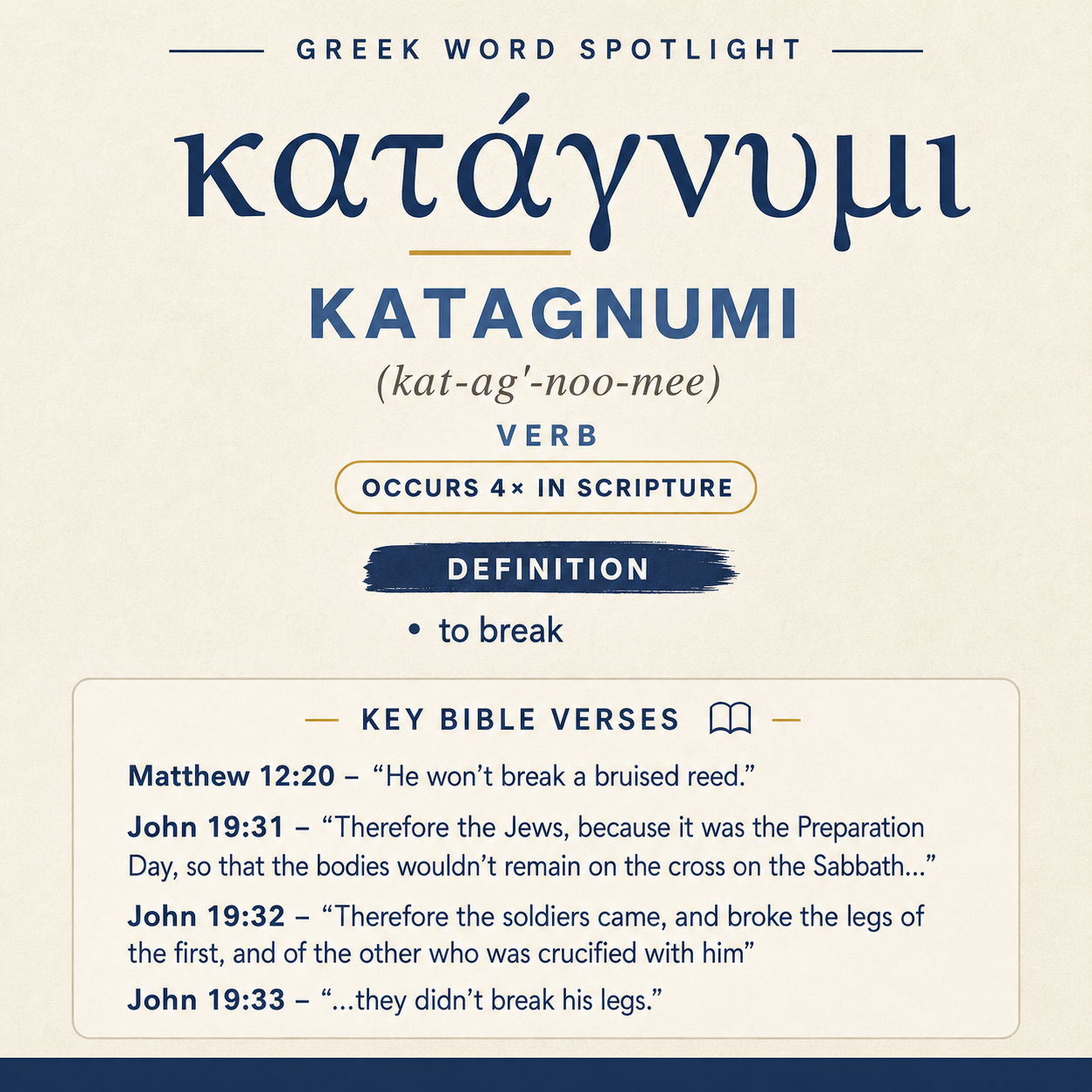
κατάγνυμι means “to break” and appears four times in Matthew 12:20 and John 19:31–33.
Context In Use
In Matthew 12:20 it describes not breaking a bruised reed. In John 19:32–33 it describes soldiers breaking, or not breaking, legs at the crucifixion.
Learn More →κατάγνυμι means “to break,” appearing once in a prophetic description of gentle restraint and three times in the crucifixion narrative where leg-breaking is requested, carried out, and withheld.
Root and Related Words
Strong’s connects κατάγνυμι with κατά (kata, “according to”; Strong’s G2596) and ῥήγνυμι (rhegnymi, “to throw violently”; Strong’s G4486). These related terms place κατάγνυμι within a family of vocabulary that can describe forceful action, while the New Testament contexts here show that the breaking itself can be either refused or performed depending on the situation.

Occurrences
“He won’t break a bruised reed. He won’t quench a smoking flax, until he leads justice to victory.” (Matthew 12:20)
Here the act of breaking is presented as something deliberately not done. The object is “a bruised reed,” already damaged and easily snapped; the line’s force lies in the restraint: even what is vulnerable and near failure is not brought to the point of being broken. Within the parallel phrasing (“won’t break … won’t quench”), κατάγνυμι contributes a vivid physical image—an already-weakened plant stalk that could be finished off by a small pressure—used to communicate measured gentleness. The clause that follows (“until he leads justice to victory”) keeps the emphasis on purposeful control: strength is present, but it is exercised without crushing what is fragile.
“Therefore the Jews, because it was the Preparation Day, so that the bodies wouldn’t remain on the cross on the Sabbath (for that Sabbath was a special one), asked of Pilate that their legs might be broken, and that they might be taken away.” (John 19:31)
In this scene the breaking is requested as an action done to crucified men: “that their legs might be broken.” The stated aim in the verse is practical and time-bound—“so that the bodies wouldn’t remain on the cross on the Sabbath”—and the request is paired with removal: “and that they might be taken away.” κατάγνυμι thus enters as a procedural act associated with ending the crucifixion situation so the bodies can be removed. The word’s contribution is concrete: it names a targeted, bodily breaking (“their legs”), not general damage. The narrative also frames the breaking as something needing official permission (“asked of Pilate”), showing it as a controlled act carried out under authority rather than spontaneous violence.
“Therefore the soldiers came, and broke the legs of the first, and of the other who was crucified with him;” (John 19:32)
This verse records the request being executed. The subject is explicit—“the soldiers”—and the action is repeated across two victims: “broke the legs of the first, and of the other who was crucified with him.” κατάγνυμι here has an unmistakably physical and forceful setting, describing what happens at the cross to those still being treated as living bodies subject to further harm. The verse’s structure emphasizes sequence and thoroughness: they come, and they break; then they do the same to the other. The breaking is not an accident but a deliberate step applied to each person in turn, reinforcing the word’s sense as a decisive act that changes the condition of the body.
“but when they came to Jesus, and saw that he was already dead, they didn’t break his legs.” (John 19:33)
Here κατάγνυμι appears in the negative again: “they didn’t break his legs.” The reason is tied directly to observation—“saw that he was already dead.” In contrast to the previous verse’s repeated action on the two others, this line marks a halt: the soldiers “came,” assessed the situation, and withheld the breaking. The word therefore functions as a point of narrative distinction: the same expected procedure is explicitly named and then explicitly not carried out. By specifying “his legs,” the verse keeps the focus on the same bodily target mentioned in the request and performed on the others, but now as an action intentionally omitted because the intended purpose has already been met by death.
Sense and Usage
Across these four occurrences, “to break” moves between two kinds of contexts: figurative restraint and literal bodily force. In Matthew 12:20 the imagery is ordinary and delicate—a “bruised reed”—and the significance lies in refusing to complete the damage. The verb’s force is felt through contrast: breaking is what could easily happen, and the line gains meaning because it does not happen.
John 19:31–33 uses the same basic notion of breaking but anchors it in a specific, grim action connected with crucifixion: legs being broken to enable removal from the cross. Within this narrative, κατάγνυμι serves as a procedural marker: it is requested, then carried out on two men, then withheld from Jesus due to his already being dead. The repeated mention of “legs” gives the verb a consistent object, which makes the final negation (“didn’t break his legs”) function as a sharp point of difference inside the same operational setting.
Notably, the word’s impact in both passages depends on control—either moral restraint (not breaking what is already bruised) or situational judgment (breaking when needed, not breaking when not needed). The same act can be the finishing touch of harm against something fragile, or it can be a sanctioned measure at the end of a public execution; in each case the verb names a decisive transition from damaged or suffering to fully “broken,” whether that transition is prevented or imposed.
Imagery
The passages place “breaking” before the reader’s eyes in two stark pictures: a reed that could be snapped, and legs that could be fractured. Matthew 12:20 uses the image to communicate gentleness toward what is already weakened, while John 19:31–33 uses it to trace a chain of actions at the cross—request, execution, and omission—so that one figure is singled out by the fact that his legs are not broken.
Sources: Lexical data from Strong’s Exhaustive Concordance and the Translators Brief Lexicon of Extended Strongs for Greek (STEPBible, CC BY). Occurrence data from the Translators Amalgamated Greek New Testament (STEPBible, CC BY). Scripture quotations from the World English Bible (public domain).




