
Exploring the Meaning of Ischuo in Greek
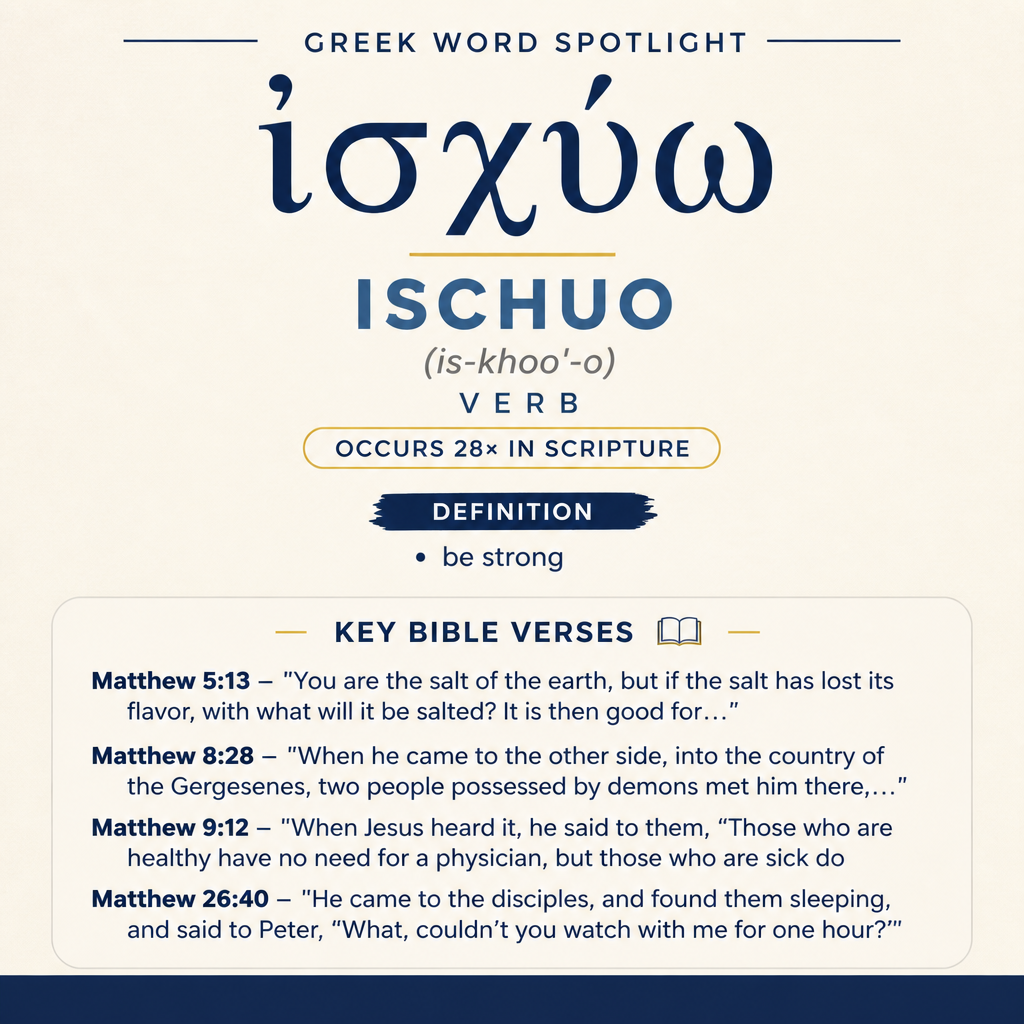
ἰσχύω (Ischuo) means “be strong” and occurs 28 times in Scripture, including Matthew and Mark.
Scripture Footprint
This word occurs 28 times in Scripture. Listed occurrences include several verses in Matthew and Mark.
Learn More →Sample Contexts
In Matthew 5:13 and Mark 5:4, it appears within teachings and narrative descriptions. It also occurs in Matthew 26:40 and Mark 14:37.
Learn More →ἰσχύω expresses the idea of being strong, whether in literal strength, practical capacity, or the inability to do what is desired. In the passages quoted below, it appears in settings ranging from everyday images (salt, building) to encounters with illness, demons, and moral challenge.
Occurrences
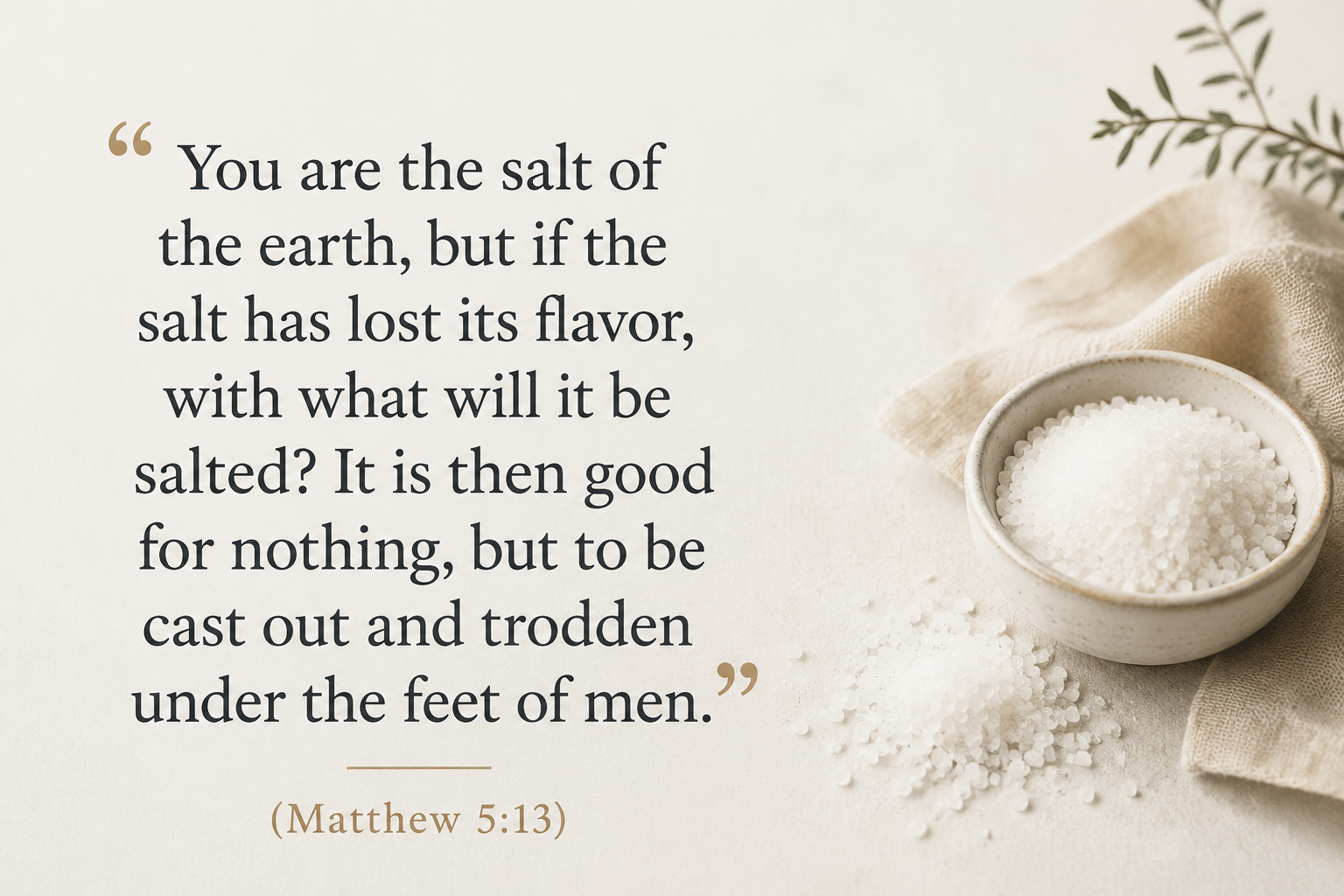
“You are the salt of the earth, but if the salt has lost its flavor, with what will it be salted? It is then good for nothing, but to be cast out and trodden under the feet of men.” (Matthew 5:13)
In this saying, ἰσχύω frames a question about whether anything has the strength to restore what has become ineffective: “with what will it be salted?” The force of the verb lies in the search for an adequate means—something “strong” enough, in effect, to accomplish the salting once the salt itself has failed.
“When he came to the other side, into the country of the Gergesenes, two people possessed by demons met him there, coming out of the tombs, exceedingly fierce, so that nobody could pass that way.” (Matthew 8:28)
Here the verb’s strength idea is expressed as practical inability: the people are “exceedingly fierce,” and as a result “nobody could pass that way.” The scene highlights a situation where ordinary human strength is insufficient to carry out something as basic as traveling a road.
“When Jesus heard it, he said to them, “Those who are healthy have no need for a physician, but those who are sick do.” (Matthew 9:12)
ἰσχύω contributes by drawing a contrast between the “healthy” and “the sick.” The line assumes a difference in strength or capability that determines whether one has “need” of a physician; the verb belongs to the description of how strength (or its lack) shapes what help is required.
“He came to the disciples, and found them sleeping, and said to Peter, “What, couldn’t you watch with me for one hour?” (Matthew 26:40)
The verb depicts a failure of strength in resolve and alertness: Peter “couldn’t” keep watch “for one hour.” The point is not about lack of instruction but lack of capacity to do what the moment calls for.
“When Jesus heard it, he said to them, “Those who are healthy have no need for a physician, but those who are sick. I came not to call the righteous, but sinners to repentance.”” (Mark 2:17)
As in Matthew’s parallel, ἰσχύω functions within the “healthy” versus “sick” contrast. The saying links strength to perceived need: those who are well do not seek a physician, while those who are sick do; the verb’s contribution is to keep the focus on what people can manage on their own and where they cannot.
“because he had been often bound with fetters and chains, and the chains had been torn apart by him, and the fetters broken in pieces. Nobody had the strength to tame him.” (Mark 5:4)
In this vivid account, ἰσχύω is tied to literal force. The man tears chains apart and breaks fetters; the summary is blunt: “Nobody had the strength to tame him.” The verb marks the limit of communal restraint—human strength is overmatched by the fierce power on display.
“and wherever it seizes him, it throws him down, and he foams at the mouth, and grinds his teeth, and wastes away. I asked your disciples to cast it out, and they weren’t able.” (Mark 9:18)
Here the verb expresses inability in a direct report: the disciples “weren’t able” to cast out what afflicts the boy. The description of the boy’s suffering sets the backdrop; ἰσχύω pinpoints the failure of effective strength at the crucial point—attempted deliverance does not succeed.
“He came and found them sleeping, and said to Peter, “Simon, are you sleeping? Couldn’t you watch one hour?” (Mark 14:37)
This parallel to Matthew again uses the verb for the inability to remain watchful: “Couldn’t you watch one hour?” The question presumes that watchfulness requires strength—stamina of attention and will—and exposes its absence in the disciples’ sleep.
“He is like a man building a house, who dug and went deep, and laid a foundation on the rock. When a flood arose, the stream broke against that house, and could not shake it, because it was founded on the rock.” (Luke 6:48)
In this parable image, ἰσχύω describes the flood’s incapacity: the stream “could not shake” the house. The verb shifts from human ability to the exertion of natural forces; even under pressure, the force of the flood is not strong enough to achieve its intended effect because of the rock foundation.
“A woman who had a flow of blood for twelve years, who had spent all her living on physicians and could not be healed by any” (Luke 8:43)
ἰσχύω is applied to the limits of medical help: she “could not be healed by any.” The narrative stresses duration (“twelve years”) and costly effort (“spent all her living”); the verb captures the outcome—despite all attempts, the ability to bring healing is not found in the physicians she sought.
“Strive to enter in by the narrow door, for many, I tell you, will seek to enter in and will not be able.” (Luke 13:24)
Here the verb speaks to the failure of would-be entrants: many “will seek to enter in and will not be able.” The command “Strive” sets the theme of exertion; ἰσχύω then marks the sobering reality that desire and effort do not always amount to sufficient strength to attain the goal.
“They couldn’t answer him regarding these things.” (Luke 14:6)
In this brief note, ἰσχύω expresses inability in speech: “They couldn’t answer him.” Strength here is not physical; it is the capacity to respond—whether because they lack an argument, courage, or clarity in the moment, the result is the same: they do not have what it takes to give an answer.

Sense and Usage
Across these passages, ἰσχύω consistently operates as a verb of strength measured by outcome: whether something can be done, whether a force can prevail, whether a person can sustain a demanded action. The contexts show that “being strong” is not limited to muscular power. In Mark 5:4, strength is unmistakably physical: chains are “torn apart,” and taming fails because nobody has sufficient strength. Yet in Matthew 26:40 and Mark 14:37, the same verbal idea is applied to wakeful perseverance—remaining alert for “one hour” exposes a weakness that sleep makes visible.
The verb also covers the strength of forces and systems. Luke 6:48 describes the stream’s inability to destabilize a well-founded house; the flood exerts real pressure (“the stream broke against that house”), but it “could not shake it.” Strength is portrayed as effectiveness under stress, and the verb draws attention to the mismatch between exerted force and achieved result. In Luke 8:43 the sphere is healing: despite time and expense, the woman “could not be healed by any,” so the ability to bring about change is absent where it was expected.
Several occurrences focus on human inability in the face of moral, spiritual, or social challenge. Matthew 8:28 portrays a road blocked by ferocity: “nobody could pass that way.” Mark 9:18 records a failed attempt to help a suffering child: the disciples “weren’t able” to cast out what afflicts him. Luke 13:24 connects the verb to eschatological urgency expressed in everyday terms—entering by a “narrow door”—and ἰσχύω sharpens the warning that many who “seek” will still lack the effective strength to enter. Luke 14:6 applies the same concept to argument and reply: “They couldn’t answer him,” revealing that strength can be tested in discourse as well as in action.
Finally, in Matthew 5:13 ἰσχύω frames the question of what can restore salt that has become unfit for its purpose. The concern is practical effectiveness: if the agent meant to act (salt) no longer functions, what is strong enough to accomplish the intended salting? The verb thus supports a larger contrast found throughout these texts: strength that accomplishes and weakness that leaves an intention unrealized.
Imagery and Force
The images surrounding ἰσχύω are concrete and varied: feet trampling something “good for nothing” (Matthew 5:13), an impassable path by the tombs (Matthew 8:28), chains torn apart (Mark 5:4), a house absorbing the blow of floodwater without being shaken (Luke 6:48), and a long illness resisting every attempted remedy (Luke 8:43). Together they portray strength as something that shows itself under pressure—when a road must be crossed, a watch must be kept, a force must be resisted, an answer must be given, or healing must actually occur.
Sources: Lexical data from Strong’s Exhaustive Concordance and the Translators Brief Lexicon of Extended Strongs for Greek (STEPBible, CC BY). Occurrence data from the Translators Amalgamated Greek New Testament (STEPBible, CC BY). Scripture quotations from the World English Bible (public domain).





