
Exploring the Meaning of Iounias in Greek
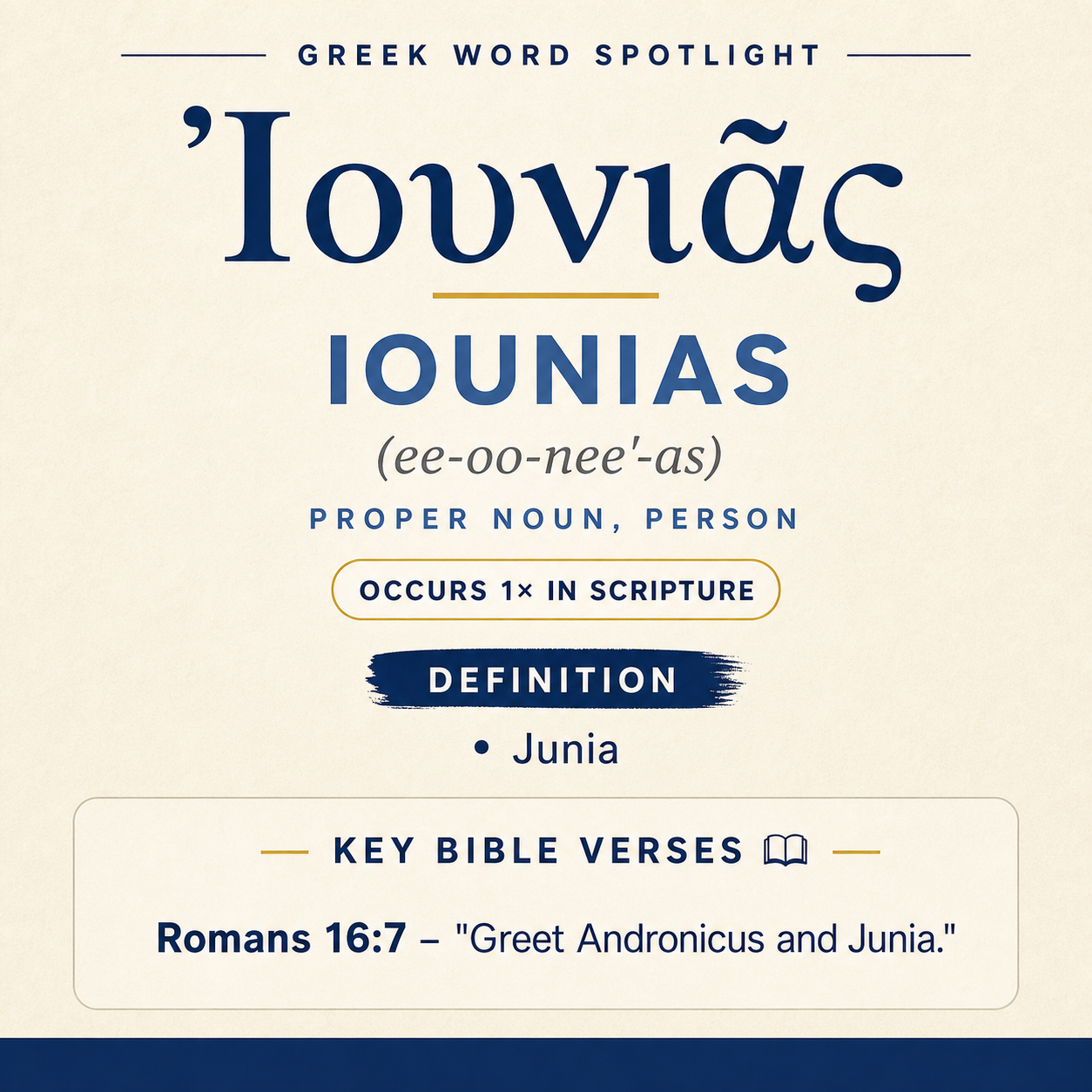
Ἰουνιᾶς means “Junia” and appears once in Scripture, in Romans 16:7.
Verse Context
In Romans 16:7, Paul sends greetings to Andronicus and Junia. He calls them his relatives and fellow prisoners.
Learn More →Ἰουνιᾶς means “Junia” and appears once in the New Testament, in Paul’s greetings at the close of Romans. In that single occurrence, the name is set within a brief but densely descriptive portrait that ties Junia to kinship, suffering, reputation, and early belonging to Christ.
Occurrences
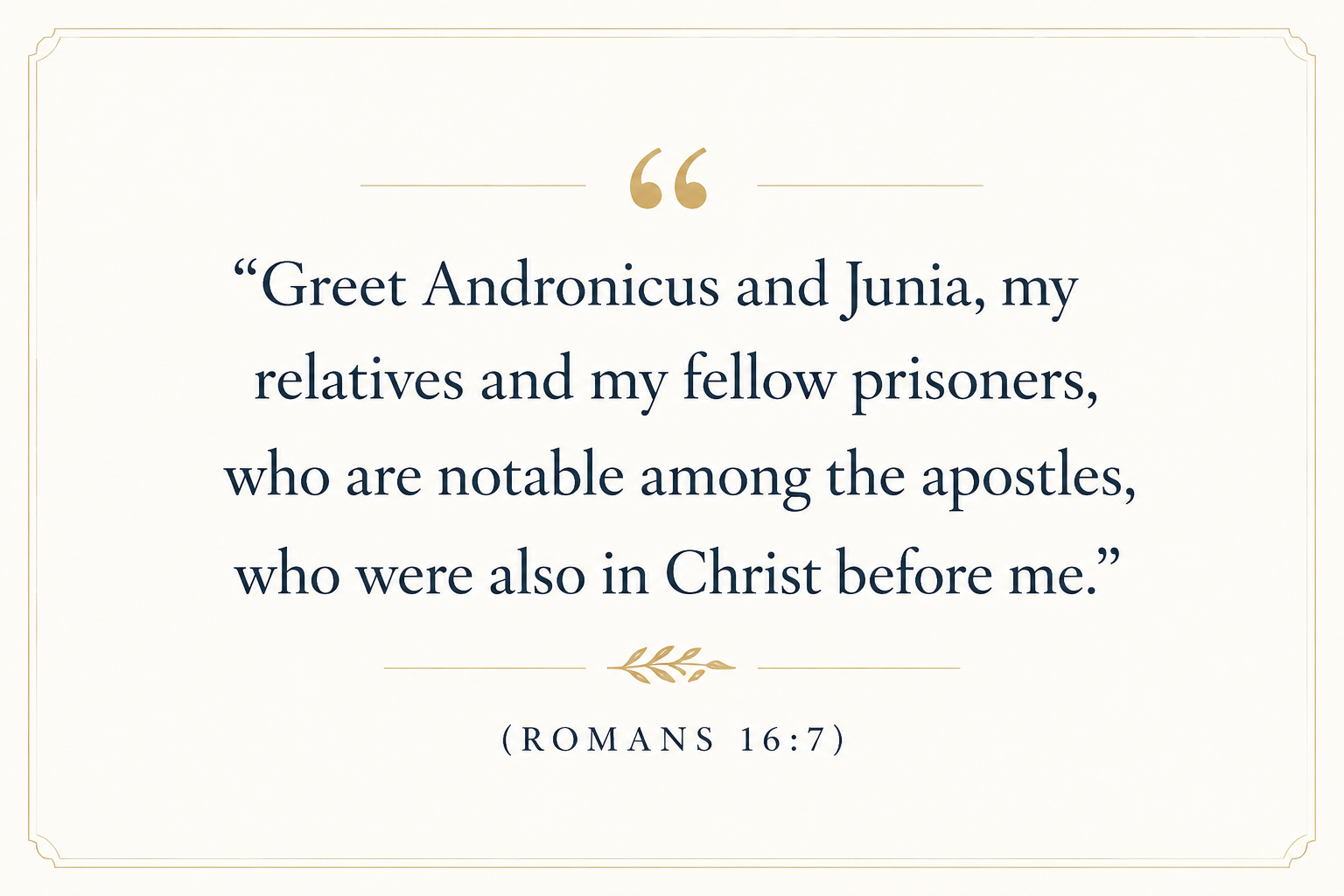
“Greet Andronicus and Junia, my relatives and my fellow prisoners, who are notable among the apostles, who were also in Christ before me.” (Romans 16:7)
In Romans 16:7, Ἰουνιᾶς functions as a personal name within a paired greeting: “Andronicus and Junia.” The naming is not bare identification; it anchors a chain of relational and descriptive phrases that fill out who Junia is in relation to Paul and to a wider circle. First, Junia is included among those Paul calls “my relatives,” placing the name inside Paul’s own network of kinship or familial connection as Paul understands it. Second, Junia is counted among “my fellow prisoners,” language that situates this person’s story alongside Paul’s experiences of confinement and suffering, and marks the relationship as one forged through shared hardship rather than casual acquaintance.
The verse then adds a public dimension: Andronicus and Junia are described as people “who are notable among the apostles.” The name Ἰουνιᾶς therefore appears in a context where reputation and recognition matter; Junia is not merely greeted privately but is presented as known within an identified group. The greeting closes by locating Junia in time relative to Paul: “who were also in Christ before me.” In the flow of the sentence, Ἰουνιᾶς is inseparable from this chronological note, portraying Junia as an earlier participant in life “in Christ” than Paul himself—an affirmation that gives weight to the greeting and helps explain why Paul can speak of Junia in terms of both closeness (“my relatives,” “my fellow prisoners”) and esteem (“notable”).

Sense and Usage
As a proper name, Ἰουνιᾶς identifies a specific person, but Romans 16:7 shows how a name in a greeting list can carry more than identification. The single use is framed by four linked descriptors: kinship (“my relatives”), shared suffering (“my fellow prisoners”), recognized standing (“notable among the apostles”), and early belonging (“in Christ before me”). These phrases turn the name into a compact testimony about relationships and community memory. Paul does not greet Junia in isolation; he pairs Junia with Andronicus and speaks of them together, suggesting that the two are associated in Paul’s mind and in the Roman community’s awareness. The pairing also means that the qualities attributed to the pair shape how the reader hears the name: Junia is remembered as part of a partnership that was close to Paul and respected more broadly.
The placement of Ἰουνιᾶς in Romans’ closing greetings highlights how personal names can serve as anchors for social bonds in the letter. Paul’s command “Greet” addresses the recipients, but the content of the greeting supplies reasons that make the greeting meaningful: Junia is someone the community should recognize and receive warmly because Paul claims this person as “my” relative and “my” fellow prisoner. The possessive language binds Paul to Junia; the name is introduced through Paul’s voice and personal stake. Yet the greeting also reaches beyond Paul’s private connection by speaking of what is publicly perceived—Junia and Andronicus are “notable,” implying that the people who hear the letter can understand this honor and share in it.
The phrase “in Christ before me” deepens the way the name works. It positions Junia’s identity not only socially (related to Paul; imprisoned with Paul; notable among a group) but also temporally in relation to Paul’s own story. Within the sentence, Paul measures his own timeline of being “in Christ” against theirs, effectively acknowledging Junia’s prior standing. The name thus appears in a setting where seniority in faith is acknowledged without rivalry: Paul, the writer, can honor another person’s earlier entry into the life he now shares. In this one occurrence, Ἰουνιᾶς is therefore associated with honor that is relational (rooted in shared bonds) and communal (recognized “among the apostles”), and with a history that predates Paul’s own experience “in Christ.”
The greeting also shows how a personal name can gather multiple forms of belonging into a single line. Junia belongs with Andronicus as a pair; belongs to Paul as relative and fellow prisoner; belongs among a named circle (“the apostles”) where the pair is notable; and belongs to Christ in a way that predates Paul’s. Even though the definition of the word is simply the name “Junia,” the verse gives that name narrative density. It suggests a life marked by connection and endurance, and it gives the recipients of Romans a reason to treat Junia not as an unknown addressee but as a person of established standing and shared history within the Christian movement Paul addresses.
Imagery
Romans 16:7 places Junia’s name against the imagery of greeting and remembrance: a community hearing a letter and being instructed to extend welcome. Alongside that is the stark image carried by “my fellow prisoners,” evoking confinement as part of Junia’s story, and the social image of a wider circle—“among the apostles”—in which Junia’s reputation is known. The verse closes with the quiet, personal comparison “before me,” leaving the impression of a life whose faith-story began earlier than Paul’s and is honored openly in a single line of greeting.
Sources: Lexical data from Strong’s Exhaustive Concordance and the Translators Brief Lexicon of Extended Strongs for Greek (STEPBible, CC BY). Occurrence data from the Translators Amalgamated Greek New Testament (STEPBible, CC BY). Scripture quotations from the World English Bible (public domain).




