
Exploring the Meaning of Hileos in Greek
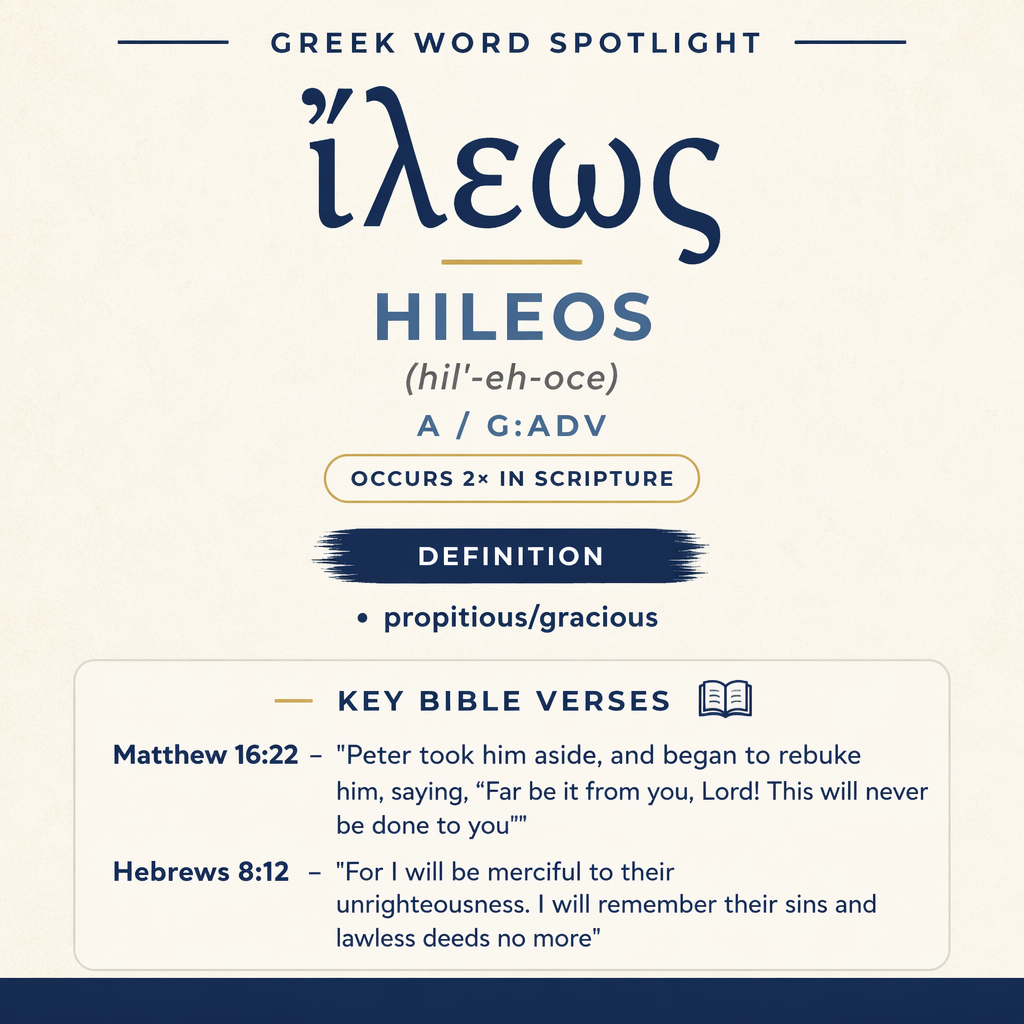
ἵλεως means “propitious/gracious” and occurs twice in Scripture: Matthew 16:22 and Hebrews 8:12.
Biblical Occurrences
It appears in Matthew 16:22 and Hebrews 8:12, for a total of two occurrences.
Learn More →Context Snapshot
In Matthew 16:22 it appears in Peter’s rebuke: “Far be it from you, Lord!” In Hebrews 8:12 it appears in God’s promise to be merciful and remember sins no more.
Learn More →ἵλεως expresses the idea of being propitious or gracious, appearing in a plea placed on Peter’s lips and in a divine promise of mercy in Hebrews. In both settings it frames an appeal for favorable regard, either toward a threatened suffering or toward wrongdoing that calls for mercy.
Root and Related Words
Strong’s connects ἵλεως with the verb haireomai (αἱρέω), “to choose” (Strong’s G138). The relationship places ἵλεως within a network of language concerned with volition and disposition, fitting its use where a speaker seeks a favorable, gracious stance rather than an adverse one.
Occurrences
“Peter took him aside, and began to rebuke him, saying, “Far be it from you, Lord! This will never be done to you.”” (Matthew 16:22)
In Matthew 16:22 the word functions inside Peter’s forceful objection. The scene is personal and urgent: “Peter took him aside,” then “began to rebuke him,” and his rebuke is expressed as a two-part protest—first an emphatic disavowal (“Far be it from you, Lord!”), then a categorical denial of outcome (“This will never be done to you.”). Within that utterance, ἵλεως gives Peter a way to voice more than disagreement; it is a plea that events turn out favorably for Jesus. The expression is directed toward what Peter fears will happen (“This will never be done to you”), and it pushes against that feared future by calling for a gracious, favorable turn—an outcome in which the threatened suffering is averted. The word’s contribution is therefore not merely emotional intensity but a stance: it casts the impending matter as something that ought not to be allowed, as though a gracious order of things should prevent it.

The address “Lord” further sharpens the force of the plea. Peter is not speaking neutrally about possibilities; he is invoking reverence while insisting on a certain kind of outcome. ἵλεως in this context underscores that Peter’s rebuke is framed as a protective appeal—an insistence that what is envisioned should meet with propitious favor instead of being permitted to come to pass.
“For I will be merciful to their unrighteousness. I will remember their sins and lawless deeds no more.” (Hebrews 8:12)
In Hebrews 8:12 ἵλεως belongs to a divine first-person promise. The verse is structured as a declaration of what God will do: “I will be merciful,” paired with a second promise describing the effect of that mercy, “I will remember their sins and lawless deeds no more.” Here ἵλεως expresses graciousness not toward a threatened circumstance but toward people marked by moral failure: “their unrighteousness,” “their sins,” and “lawless deeds.” The word gives the line its positive resolution: the promised response to wrongdoing is not retaliation or continued accounting but merciful regard.
The second sentence (“I will remember… no more”) shows how this graciousness is portrayed in the verse itself: mercy is linked to a decisive shift in how past offenses are held. ἵλεως thus carries a relational weight—wrong is real and named in multiple terms, yet the divine posture promised toward it is merciful. In this setting the word anchors assurance: despite the reality of “unrighteousness,” the commitment is to act graciously, with the remembered record of “sins and lawless deeds” brought to an end.
Sense and Usage
Across its two New Testament appearances, ἵλεως operates as a word of favorable disposition in moments where the stakes are high. In Matthew it is voiced from within a tense exchange as an urgent attempt to prevent an outcome; in Hebrews it is spoken as a settled promise that addresses moral guilt. These contexts show two distinct pressures under which “propitious/gracious” language becomes meaningful: impending suffering and established wrongdoing.
In Matthew 16:22, the propitious aspect is felt as a wish that the future be turned away from harm—an appeal that what is looming should not be allowed to occur. The word’s force is heightened by the immediacy of Peter’s action (“took him aside”) and the boldness of his speech (“began to rebuke him”). A gracious outcome, in that moment, is imagined as a spared path: “This will never be done to you.” The language does not merely express fear; it presses for a favorable decision about what will be permitted to happen.
In Hebrews 8:12, the gracious aspect is directed not to circumstances but to persons described by their wrongdoing. The verse piles up terms for moral failure—“unrighteousness,” “sins,” “lawless deeds”—and then sets over them a twofold gracious response: mercy and the cessation of remembering. Here, to be gracious is to respond in a way that changes the standing of those failures. The propitious element is therefore covenantal in tone within the verse itself: it is not a temporary mood but an announced commitment expressed in the repeated “I will.”
Taken together, these uses show ἵλεως as suitable for both plea and promise. It can be put into a human mouth as a protest that presses for favorable regard, and it can stand in divine speech as the ground of reassurance that wrongdoing will not be held in enduring remembrance. The word thus carries a strong interpersonal orientation: it is about how one party is disposed toward another party or toward an event affecting another, whether that disposition is being requested (Matthew) or declared (Hebrews).
Imagery
The word’s imagery in these passages is concrete in its emotional texture, even when the word itself is abstract. In Matthew 16:22 it evokes the scene of someone pulling a friend aside to insist that harm must not happen—an urgent desire for a favorable turn of events. In Hebrews 8:12 it evokes a courtroom-like moral accounting reversed by mercy: wrongdoing is acknowledged in full, yet the decisive image is of it no longer being “remember[ed],” because graciousness has taken the lead.
Sources: Lexical data from Strong’s Exhaustive Concordance and the Translators Brief Lexicon of Extended Strongs for Greek (STEPBible, CC BY). Occurrence data from the Translators Amalgamated Greek New Testament (STEPBible, CC BY). Scripture quotations from the World English Bible (public domain).





