
Exploring the Meaning of Isos in Greek
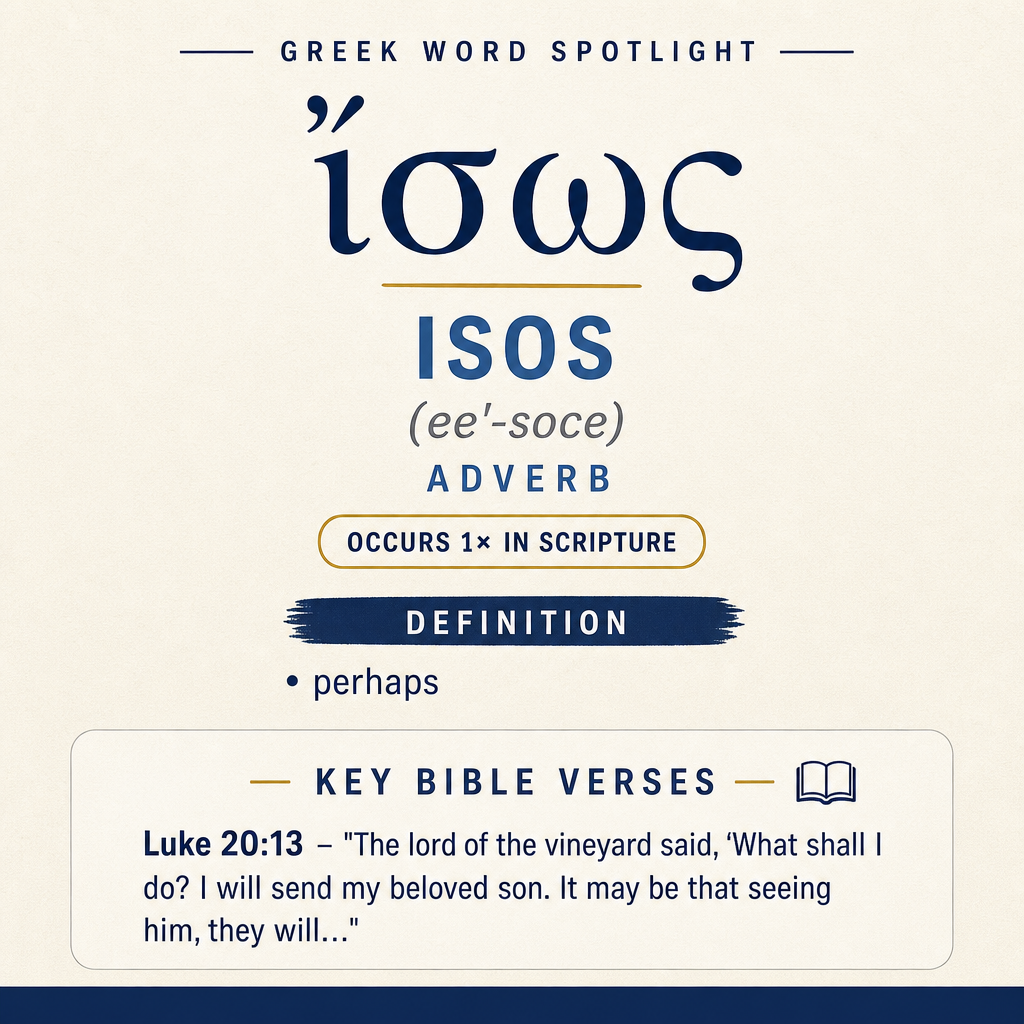
ἴσως means “perhaps” and appears once in Scripture, in Luke 20:13.
Biblical Usage
ἴσως occurs once in Scripture. It appears in Luke 20:13 within the lord of the vineyard’s decision to send his beloved son.
Learn More →Verse Context
In Luke 20:13, the lord says, “It may be that seeing him, they will respect…” The word frames the hoped-for response as uncertain.
Learn More →ἴσως expresses “perhaps,” marking a contemplated outcome as uncertain rather than assured. It appears once, in Jesus’ parable of the vineyard, where a landowner weighs what may happen if he sends his son.
Root and Related Words
ἴσως (Isos) derives from ἴσος (isos), “equal” (Strong’s G2470). The adverbial form carries this relationship in its formation, showing a link to the adjective named here.

Occurrences
“The lord of the vineyard said, ‘What shall I do? I will send my beloved son. It may be that seeing him, they will respect him.’” (Luke 20:13)
In this line the speaker is “The lord of the vineyard,” and his words unfold as a brief deliberation: “What shall I do? I will send my beloved son.” ἴσως belongs to the next sentence—“It may be that seeing him, they will respect him.”—and it places the hoped-for response (“they will respect him”) in the category of possibility rather than certainty. The statement does not describe what the tenants actually do; it voices the landowner’s reasoning as he chooses a course of action and entertains what could follow from it.

The adverb’s force is shaped by its immediate context. The landowner is not only acting; he is forecasting: he anticipates an encounter (“seeing him”) and attaches a potential result (“they will respect him”). The “perhaps” does not weaken the decision to send the son—he sends him anyway—but it frames the expectation as a calculated hope, not a guaranteed outcome. In the logic of the sentence, “seeing him” functions as the occasion that might lead to the tenants’ respect, and ἴσως makes that chain of cause and effect contingent.
The placement of ἴσως also highlights the contrast between resolve and uncertainty inside a single speech. “I will send my beloved son” is expressed as settled intent, whereas “It may be that…they will respect him” is expressed as an open question about the tenants’ response. The word therefore contributes a specific psychological texture: the landowner’s decision carries a measured optimism, but he does not speak as though he controls the outcome. His choice is firm; the tenants’ reaction remains undetermined.
Sense and Usage
As “perhaps,” ἴσως signals that what follows is possible but not assured. In Luke 20:13 it modifies an entire expectation—“they will respect him”—rather than merely adding vagueness to a single term. The speaker imagines a future reaction and marks it as uncertain. This is not uncertainty about whether the son will be sent (that is stated as a decision) but uncertainty about whether the act of sending will accomplish its desired effect.
The word’s contribution can be observed by attending to the structure of the quoted speech. The landowner asks, “What shall I do?” and then answers his own question with an action: “I will send my beloved son.” The “perhaps” introduces the motivation that accompanies this action: the landowner expects that the son’s presence—specifically the tenants “seeing him”—could elicit respect. ἴσως, therefore, marks the landowner’s expectation as a reasoned possibility. It is compatible with hope, and it is compatible with risk; it leaves room for the event to unfold in more than one way.
Within the parable’s imagery, the adverb also underscores a relational dynamic. The landowner appeals, in effect, to what the tenants might do upon recognizing the beloved son. Yet by using “perhaps,” the landowner does not presume that recognition will necessarily produce the proper response. The sentence holds together two ideas at once: that the son’s appearance should matter (“seeing him”), and that those who see may still respond unpredictably (“It may be that…they will respect him”). ἴσως is the hinge that keeps the expectation from becoming an assertion.
Because ἴσως is attached to a prediction about another party’s reaction, it also functions as a marker of limited knowledge. The landowner speaks from his own viewpoint, deciding what he will do and conjecturing about what others may do. “Perhaps” places the future response outside his direct control and outside his certain knowledge, even as he remains committed to his chosen course. In this way the word sets an atmosphere of contingency: the next move is deliberate, but its reception is unsettled.
Imagery
Luke 20:13 ties ἴσως to the vivid picture of a vineyard owner sending “my beloved son” in the hope that the tenants, upon “seeing him,” might respond with respect. The “perhaps” belongs to that moment of sending—an act filled with intention and expectation, yet shadowed by uncertainty about how the recipients will react when the son arrives.
Sources: Lexical data from Strong’s Exhaustive Concordance and the Translators Brief Lexicon of Extended Strongs for Greek (STEPBible, CC BY). Occurrence data from the Translators Amalgamated Greek New Testament (STEPBible, CC BY). Scripture quotations from the World English Bible (public domain).





