Exploring the Meaning of Ischus in Greek
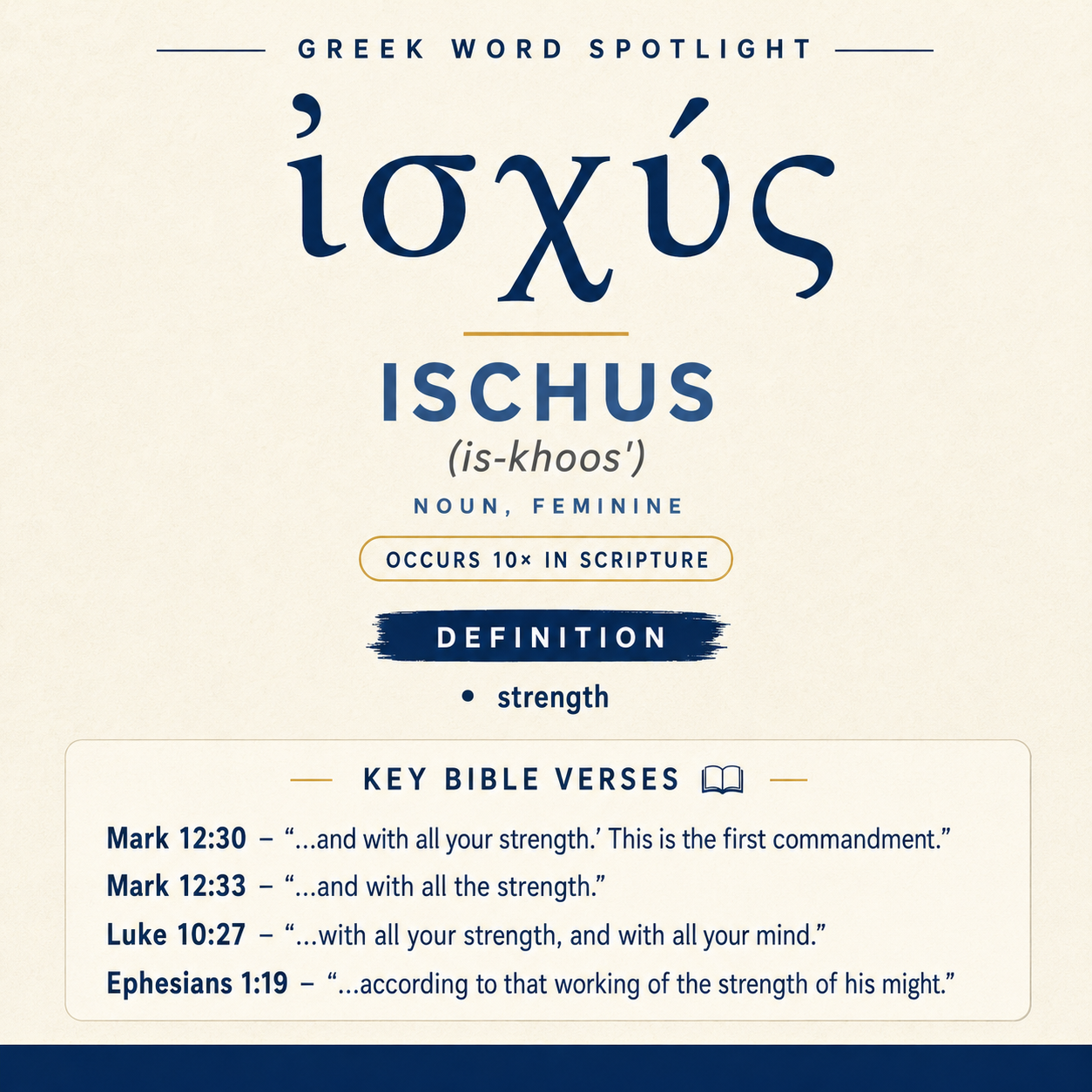
ἰσχύς (Ischus) means “strength” and appears 10 times in Scripture, including Mark 12:30; Luke 10:27; Ephesians 6:10; and 1 Peter 4:11.
Gospel Usage
In Mark 12:30, Mark 12:33, and Luke 10:27, it appears in the command to love God “with all your strength.”
Learn More →Power and Might
It is used for divine strength in Ephesians 1:19 and Ephesians 6:10. It also appears with “might” in 2 Thessalonians 1:9 and 2 Peter 2:11.
Learn More →ἰσχύς expresses “strength,” appearing in contexts of wholehearted devotion, divine empowerment, angelic comparison, and heavenly praise. Across these passages it can describe what a person brings to love and service, and what belongs supremely to God and the Lamb.
Occurrences
Mark 12:30 — “you shall love the Lord your God with all your heart, and with all your soul, and with all your mind, and with all your strength.’ This is the first commandment.”
Here ἰσχύς completes a fourfold description of total love toward God. The verse stacks inner dimensions (“heart,” “soul,” “mind”) and then adds “strength,” drawing attention to love that includes one’s full capacity for exertion and ability, not only thought and feeling.

Mark 12:33 — “and to love him with all the heart, and with all the understanding, with all the soul, and with all the strength, and to love his neighbor as himself, is more important than all whole burnt offerings and sacrifices.”
In the scribe’s restatement, ἰσχύς is kept alongside “heart,” “understanding,” and “soul,” and then paired with love of neighbor. “Strength” helps define love as something that engages a person’s full resources, and the verse sets that lived devotion above “whole burnt offerings and sacrifices,” highlighting that what is valued is not merely ritual quantity but the full-bodied reality of love.
Luke 10:27 — “He answered, “You shall love the Lord your God with all your heart, with all your soul, with all your strength, and with all your mind; and your neighbor as yourself.””
Luke places “strength” as one component in the comprehensive claim of “with all” love. In the same sentence, love for God and love for neighbor stand together; ἰσχύς therefore sits in an ethical frame, suggesting that the strength one has is not reserved for private devotion alone but belongs within a life oriented to God and others.
Ephesians 1:19 — “and what is the exceeding greatness of his power toward us who believe, according to that working of the strength of his might”
ἰσχύς is drawn into a cluster of terms that portray God’s active effectiveness. The phrase “working of the strength of his might” presents strength not as static capacity but as energy in action (“working”), directed “toward us who believe.” The verse’s concern is the scale (“exceeding greatness”) and the direction (“toward us”) of God’s effective power.
Ephesians 6:10 — “Finally, be strong in the Lord, and in the strength of his might.”
Here ἰσχύς is the sphere in which believers are to be strengthened: “in the strength of his might.” The wording locates strength in the Lord rather than in the self, and it frames strength as something one enters and relies on. The command “be strong” is thus tied to a source outside the person, specified as “his might.”
2 Thessalonians 1:9 — “who will pay the penalty: eternal destruction from the face of the Lord and from the glory of his might,”
In this solemn line, “the glory of his might” sets divine might in a radiant, manifest dimension (“glory”). Although ἰσχύς is not named in the English wording here, the verse belongs with the same conceptual field as other passages where strength and might are linked; the scene emphasizes the Lord’s overwhelming majesty as the backdrop to “the penalty: eternal destruction.”
1 Peter 4:11 — “If anyone speaks, let it be as it were the very words of God. If anyone serves, let it be as of the strength which God supplies, that in all things God may be glorified through Jesus Christ, to whom belong the glory and the dominion forever and ever. Amen.”
ἰσχύς is explicitly something “God supplies” for service. The verse distinguishes speaking and serving: speech is to align with “the very words of God,” and service is to proceed “as of the strength” God provides. Strength is therefore not merely a natural endowment but a provision enabling ministry, with a stated purpose: “that in all things God may be glorified through Jesus Christ.”
2 Peter 2:11 — “whereas angels, though greater in might and power, don’t bring a railing judgment against them before the Lord.”
This comparison uses “might and power” to mark angels as “greater,” yet it highlights their restraint: they “don’t bring a railing judgment.” Strength here is not celebrated as license for harshness; instead, superior might is placed alongside a refusal to act presumptuously “before the Lord,” implying that true strength can be expressed in controlled, accountable conduct.
Revelation 5:12 — “saying with a loud voice, “Worthy is the Lamb who has been killed to receive the power, wealth, wisdom, strength, honor, glory, and blessing!””
ἰσχύς appears as one item in a sevenfold ascription to the Lamb: “power, wealth, wisdom, strength, honor, glory, and blessing.” In this worship scene, strength is not something the Lamb needs but something he is “worthy…to receive,” language that frames strength as a rightful due within heavenly acclaim. The setting (“with a loud voice”) underscores the public, liturgical acknowledgment of his worth.
Revelation 7:12 — “saying, “Amen! Blessing, glory, wisdom, thanksgiving, honor, power, and might, be to our God forever and ever! Amen.””
Here the doxology shifts to “our God,” and the list includes “power, and might.” Although ἰσχύς is not named in the English wording, the thought-world is the same as Revelation 5: strength/might is part of what belongs to God, and it is affirmed “forever and ever.” The framing with “Amen!” at both ends gives the ascription a solemn, communal finality.

Sense and Usage
In the Synoptic command to love God “with all,” ἰσχύς sits at the point where devotion becomes embodied and enacted. “Heart,” “soul,” and “mind/understanding” can be heard as inward faculties; “strength” broadens the claim so that love includes what a person can do and sustain. The repeated “with all” presses against partial devotion: strength is not a leftover category but one of the totalizing terms that demand undivided allegiance.
In the letters, ἰσχύς is repeatedly aligned with God’s own effective action. Ephesians speaks of “the working of the strength of his might” and instructs believers to be strong “in the strength of his might,” joining strength to the idea of divine efficacy and to the believer’s dependence. Strength is portrayed as something operative (“working”), communicable (“toward us who believe”), and inhabitable (“in the strength”), not merely as an abstract attribute.
First Peter sharpens this by connecting strength directly to service: the one who serves is to do so “as of the strength which God supplies.” Strength is thus a gifted enablement with a theological aim—God’s glory “through Jesus Christ.” This establishes a pattern in which strength is not self-referential; it is given so that action results in worship, and the closing ascription (“to whom belong the glory and the dominion forever and ever”) keeps the focus on God’s rightful rule rather than human achievement.
The comparative statement about angels in 2 Peter adds an ethical contour. Angels are “greater in might and power,” yet their greater strength is shown in restraint from “a railing judgment…before the Lord.” In this setting, might is real but bounded by reverence and propriety. Strength does not erase accountability; it operates within the presence of the Lord.
Revelation places strength within explicit worship formulas. In 5:12, “strength” is part of what the Lamb is worthy to receive; in 7:12, “power, and might” belong to “our God forever and ever.” In both, strength is doxological: it is confessed and assigned in praise. The lists connect strength with other recognized excellencies (such as honor, glory, blessing, thanksgiving), suggesting that strength, in these scenes, is not isolated force but a quality celebrated in harmony with wisdom and worship.
Imagery
The passages move from the concrete arena of human love and neighborly obligation to the liturgical arena of heaven’s acclamation. ἰσχύς can describe the full measure of human engagement (“with all your strength”), yet it also appears as something supplied by God for service and as something ultimately ascribed to God and the Lamb in worship. The word thus carries an image of capacity put into motion—love enacted, service sustained, and praise offered to the one to whom strength rightly belongs.
Sources: Lexical data from Strong’s Exhaustive Concordance and the Translators Brief Lexicon of Extended Strongs for Greek (STEPBible, CC BY). Occurrence data from the Translators Amalgamated Greek New Testament (STEPBible, CC BY). Scripture quotations from the World English Bible (public domain).