
Exploring the Meaning of Isotes in Greek
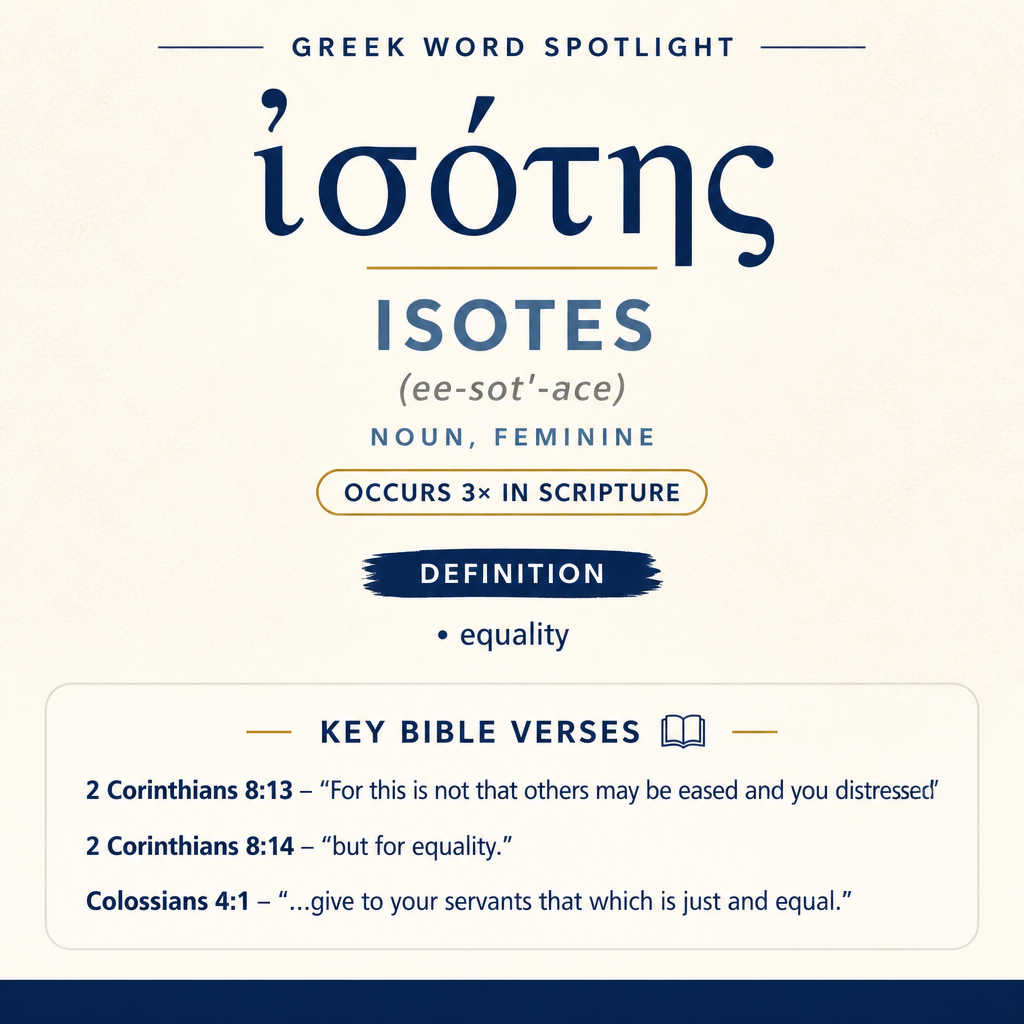
ἰσότης (Isotes) means “equality” and appears three times in Scripture: 2 Corinthians 8:13–14 and Colossians 4:1.
In 2 Corinthians
In 2 Corinthians 8:13–14, it contrasts others being eased while you are distressed, calling instead for equality.
Learn More →In Colossians
In Colossians 4:1, masters are instructed to give servants what is just and equal, remembering they also have a Master in heaven.
Learn More →ἰσότης means “equality.” It appears in Paul’s discussion of material sharing between believers (2 Corinthians 8:13–14) and in an exhortation to masters about their treatment of servants (Colossians 4:1).
Occurrences
2 Corinthians 8:13
“For this is not that others may be eased and you distressed,” (2 Corinthians 8:13)
Though ἰσότης is not stated in this line, the sentence sets the frame in which “equality” will be named: a concern that one group should not experience “ease” at the cost of another’s “distress.” The contrast between “others” and “you” presents a potential imbalance—relief for some, pressure for others—and prepares for a balancing principle that governs giving. In this immediate context, ἰσότης functions as a standard that resists a one-sided outcome; it presumes a relationship between parties in which benefits and burdens are not meant to be distributed in a way that crushes one side while relieving the other.

2 Corinthians 8:14
“but for equality. Your abundance at this present time supplies their lack, that their abundance also may become a supply for your lack; that there may be equality.” (2 Corinthians 8:14)
Here ἰσότης is explicitly stated and anchors the logic of exchange: “Your abundance” meets “their lack,” and the scenario is then reversed in possibility—“their abundance also may become a supply for your lack.” Equality is not presented as a flat sameness of condition in every moment, but as a principle that governs how abundance and lack are addressed within a shared community. The wording “at this present time” highlights that circumstances shift; what one party has now may later be what another party has. ἰσότης therefore names the goal of a reciprocal pattern of support: resources flow toward need without establishing a permanent structure of one-sided dependence or one-sided strain. The repetition—“for equality … that there may be equality”—gives the term rhetorical weight, emphasizing it as the intended outcome of the arrangement described.
Colossians 4:1
“Masters, give to your servants that which is just and equal, knowing that you also have a Master in heaven.” (Colossians 4:1)
In this instruction, ἰσότης is paired with “just” as a concrete directive about what masters are to “give” to their servants. “Equal” is not framed as an abstract ideal but as a measure of what is due in the master–servant relationship. The command is grounded in accountability: masters are reminded that they themselves “also have a Master in heaven.” That reminder places the earthly authority of masters under a higher authority, pressing them toward conduct characterized by justice and equality rather than arbitrary power. ἰσότης thus contributes the idea that fairness in treatment is not optional or merely pragmatic; it is bound up with a moral order in which those who command must recognize their own position under command.

Sense and Usage
Across these passages, ἰσότης names “equality” as a relational norm—something that governs how one party should act toward another when there is an imbalance of power or resources. In 2 Corinthians 8:13–14, the imbalance is economic: “abundance” and “lack.” Equality there is described through movement and exchange: supply flows from abundance to lack in the present, with the expectation that the direction could later reverse. The logic assumes that equality can be pursued through responsive generosity that attends to real conditions (“abundance,” “lack,” “at this present time”) rather than through an abstract leveling detached from circumstance. The term gathers up the preceding concern—“others … eased and you distressed”—and refuses a solution that merely shifts hardship from one group to another. Instead, equality is presented as the aim that shapes how relief is offered and how burdens are shared.
In Colossians 4:1, the imbalance is structural: “Masters” and “servants.” Equality here is not described in terms of shifting material conditions but in terms of what masters must actively provide: “that which is just and equal.” ἰσότης functions as a check on the asymmetry of authority. The verse does not spell out specific practices, but it does anchor equality in the obligation of masters to act with justice toward those under them. The added clause—“knowing that you also have a Master in heaven”—supplies the reason within the sentence itself: equality is compelled by the master’s own accountability. In this setting, ἰσότης is not negotiated from below; it is commanded from above, grounded in the recognition that human hierarchies exist under divine oversight.
Read together, these uses show ἰσότης operating in two distinct but related arenas. Where resources differ, equality is pursued through mutual supply that answers need without creating crushing imbalance. Where authority differs, equality is pursued through just provision and fair dealing from the one with power, shaped by awareness of a higher authority. In both arenas, ἰσότης carries a practical force: it names an intended outcome that should be visible in concrete arrangements—how aid is distributed and how people are treated. Equality is not left as a vague aspiration; it is tied to measurable contrasts (“eased” versus “distressed,” “abundance” versus “lack”) and to accountable behavior (“give … just and equal,” “knowing”).
Imagery in Context
The language surrounding ἰσότης in 2 Corinthians 8:13–14 paints a picture of balances and counterbalances: relief and distress, abundance and lack, supply moving to meet need. The repeated naming of equality frames the community as one in which present advantage becomes present responsibility, precisely because circumstances may change. In Colossians 4:1, the imagery is less about exchange and more about stewardship: a master “gives” what is just and equal while remembering he stands under a Master in heaven. In both, equality appears not as a detached concept but as a standard that shapes real transactions and real authority in daily life.
Sources: Lexical data from Strong’s Exhaustive Concordance and the Translators Brief Lexicon of Extended Strongs for Greek (STEPBible, CC BY). Occurrence data from the Translators Amalgamated Greek New Testament (STEPBible, CC BY). Scripture quotations from the World English Bible (public domain).




