Exploring the Meaning of Ioulios in Greek
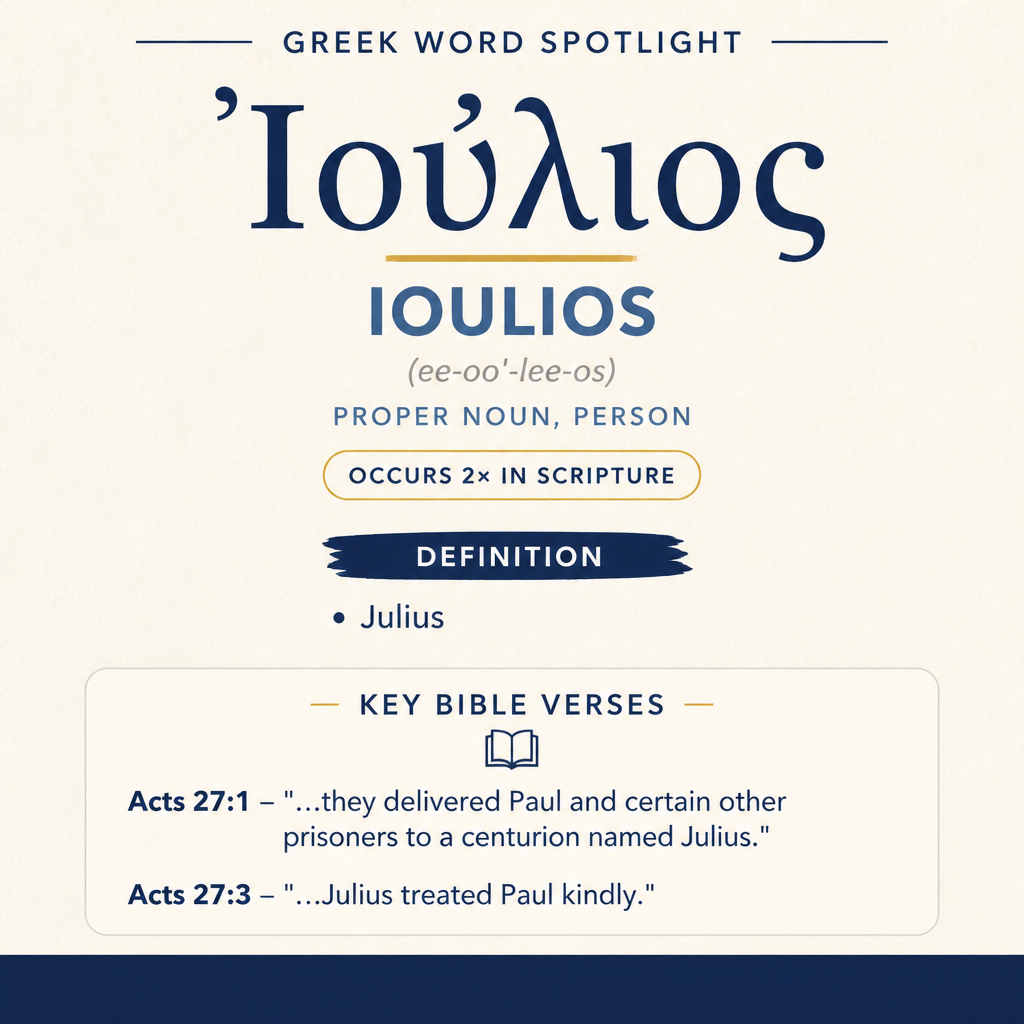
Ἰούλιος means “Julius” and appears in Acts 27:1 and Acts 27:3.
Acts 27 Context
In Acts 27:1, prisoners including Paul are delivered to a centurion named Julius. In Acts 27:3, Julius treats Paul kindly and permits him to visit friends and refresh himself.
Learn More →Ἰούλιος means “Julius,” a personal name found in the travel narrative of Acts 27. It appears in the opening movements of the voyage in which Paul is sent by sea toward Italy.
Occurrences
“When it was determined that we should sail for Italy, they delivered Paul and certain other prisoners to a centurion named Julius, of the Augustan band.” (Acts 27:1)
Here Ἰούλιος identifies the centurion who receives custody of Paul and “certain other prisoners” at the moment the voyage is set in motion. The name functions as a narrative anchor: the reader is not left with an unnamed military intermediary, but with a specific officer who stands at the junction between the decision “that we should sail for Italy” and the practical transfer of prisoners into Roman hands. The verse frames Julius by rank (“a centurion”) and by affiliation (“of the Augustan band”), placing him within an ordered structure of command. Within the immediate sentence, the name marks responsibility: Julius is the person to whom Paul is delivered, and thus the one through whom Paul’s movement as a prisoner will proceed during the early stages of the journey.
The wording also situates Julius in relation to the narrator’s “we,” since the same determination that sets “we” sailing also results in the delivery of prisoners to him. In this scene, the contribution of the name is clarity and continuity: it introduces the officer who will appear again as the voyage unfolds, making the custody relationship concrete rather than generic.
“The next day, we touched at Sidon. Julius treated Paul kindly, and gave him permission to go to his friends and refresh himself.” (Acts 27:3)
In the second occurrence, Ἰούλιος again names the centurion, now shown exercising discretion during a stopover: “we touched at Sidon.” The name links the officer introduced in the first scene to an immediately observable action, and the verse characterizes that action in two connected ways. First, Julius’s posture toward Paul is explicitly described: “Julius treated Paul kindly.” Second, that kindness takes an administrative form suited to his role over prisoners: he “gave him permission to go to his friends and refresh himself.” The name therefore marks the person with authority to grant or withhold liberty of movement, even if limited and temporary, in the context of travel under guard.
The setting (“The next day,” “Sidon”) emphasizes the early point in the itinerary: shortly after departure, the centurion is already making decisions that affect Paul’s immediate welfare. In this verse, Julius is not merely a label for an officer on board; he becomes a narrative agent whose conduct shapes what is possible for Paul within the constraints of imprisonment. Naming him keeps that agency personal and traceable: the permission comes from Julius, not from an anonymous system, and the refreshment Paul receives is tied to a particular decision made during a specific port call.

Sense and Usage
Across its two uses, Ἰούλιος functions as a straightforward personal name, and its sense is carried entirely by its referent: the centurion named Julius. The narrative employs the name to stabilize relationships of authority and care within the travel account. In Acts 27:1, Julius is introduced at the moment of formal transfer—Paul and other prisoners are “delivered” to him—so the name signals custody and the responsible officer within the chain of movement toward Italy. In Acts 27:3, the same named officer is shown acting within that custodial role, and the name becomes associated with a specific exercise of permission in a concrete location.
The way the name is deployed also highlights how a personal name can carry narrative weight without requiring additional explanation. Julius appears as the officer who both holds Paul under guard and can still “treat” him in a way described as “kindly.” The name is therefore the thread that ties together two aspects of the centurion’s presence: official control (“they delivered Paul…to a centurion named Julius”) and humane accommodation (“gave him permission to go to his friends and refresh himself”). The reader is given a consistent point of reference for the human face of custody on this voyage.
The immediate co-text reinforces this: Julius is not described in isolation but with descriptors of office and group (“centurion,” “Augustan band”), and with verbs of action (“treated,” “gave…permission”). In such a setting, a name does more than identify; it helps the narrative distribute responsibility. When Paul is delivered, Julius is the recipient; when Paul is allowed to visit friends, Julius is the grantor. The sense “Julius” remains constant, while the usage moves from introduction to characterization through action.
Even the placement of the name within the sentence structure contributes to its function. In Acts 27:1, “a centurion named Julius” apposes rank and name, presenting Julius as a public official with a personal identity. In Acts 27:3, the name stands at the head of the clause (“Julius treated Paul kindly”), emphasizing initiative. The name thus serves as a hinge between institutional reality (a centurion in a band) and personal conduct (kind treatment and permission), all within the narrated logistics of a sea journey.
Imagery in Context
Although Ἰούλιος is simply a name, it evokes a vivid slice of the voyage’s early imagery: prisoners being transferred to a centurion for a journey “for Italy,” followed by a brief landing at Sidon where the named officer allows a guarded traveler to step ashore and be “refreshed.” The passages attach the name to moments of movement and pause—sailing determination, delivery into custody, touching at port, and a short permission to visit friends—so that Julius becomes associated with the practical, on-the-ground decisions that accompany travel under Roman authority.
Sources: Lexical data from Strong’s Exhaustive Concordance and the Translators Brief Lexicon of Extended Strongs for Greek (STEPBible, CC BY). Occurrence data from the Translators Amalgamated Greek New Testament (STEPBible, CC BY). Scripture quotations from the World English Bible (public domain).