Exploring the Meaning of Threskos in Greek
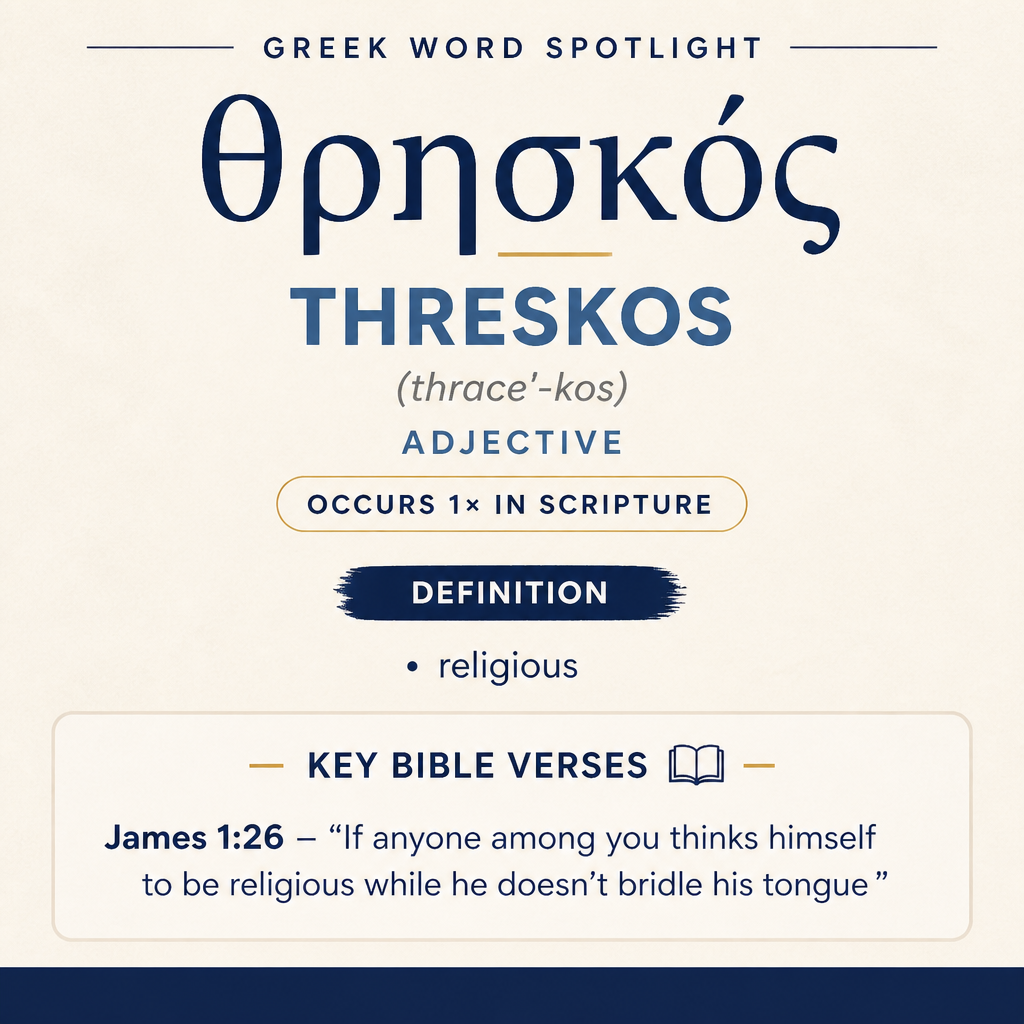
θρησκός (Threskos) means “religious” and appears once in Scripture, in James 1:26.
Context in James
James 1:26 speaks of someone who thinks himself religious but does not bridle his tongue, deceiving his heart.
Learn More →θρησκός means “religious” and appears in the New Testament in James 1:26. In that verse it describes a person’s self-assessment and gives a label to a way of life that is then tested by speech and inner integrity.
Root and Related Words
A related word is θροέω (throeo), “to alarm” (Strong’s G2360), identified as the word θρησκός derives from.

Occurrences
“If anyone among you thinks himself to be religious while he doesn’t bridle his tongue, but deceives his heart, this man’s religion is worthless.” (James 1:26)
Here θρησκός stands inside a conditional statement that begins with a person’s own opinion about himself: “If anyone among you thinks himself to be religious….” The adjective functions as a descriptor a person may apply to himself within the community (“among you”), so the word is framed as something that can be claimed, assumed, or adopted as an identity. James immediately places that claimed identity under pressure by pairing it with observable conduct: “while he doesn’t bridle his tongue.” The imagery of bridling draws attention to control and restraint in speech, so θρησκός in this scene is not treated as a private label detached from what a person says. The verse then moves from the tongue to the inner person: “but deceives his heart.” In this construction, the self-description “religious” is set alongside an internal misdirection, as though the person’s inner judgment about himself is not reliable when his speech is unrestrained. The sentence culminates with an evaluative verdict: “this man’s religion is worthless.” Within the same verse, the adjective describing the person (“religious”) is linked to the noun describing the person’s religious life (“religion”), and the claim to be θρησκός is shown to be empty when the tongue is not bridled and the heart is self-deceived.
Sense and Usage
In James 1:26, “religious” is used in a way that highlights the difference between self-perception and what is actually shown in life. The verse does not attack the category itself; rather, it examines the claim “thinks himself to be religious” by exposing a contradiction between outward speech and inward honesty. The person is described as failing to “bridle his tongue,” indicating that verbal behavior is treated as a decisive arena where one’s religious claim is proved or disproved. At the same time, James does not reduce the issue to public speech alone; he includes the heart: “deceives his heart.” In this single sentence, θρησκός belongs to a web of self-assessment, moral restraint, and inner truthfulness.
The placement of θρησκός at the front end of the conditional (“If anyone…thinks himself to be religious”) makes the word function as a starting point for evaluation rather than a conclusion reached after evaluation. A person may begin with the conviction that he is religious; James then challenges whether that conviction corresponds to a disciplined tongue and an undeceived heart. Thus the adjective becomes a test case for sincerity: it marks a person who regards himself as belonging to the religious sphere, yet the verse insists that the reality of that sphere is not secured by the claim itself.
The verse also draws a close connection between the descriptor and the resulting appraisal of “this man’s religion.” The flow from “religious” to “religion” makes the claim personal (“thinks himself”) and then renders a judgment on the whole religious stance of the individual (“this man’s religion is worthless”). In that way, θρησκός in James 1:26 is not merely a social tag; it is a term that can be weighed and found wanting when it is paired with unrestrained speech and self-deception.
Finally, the community setting (“among you”) implies that the self-description has a relational context. The person’s religion is not evaluated in isolation from life among others, because the tongue is the instrument most directly involved in human relations. In James 1:26, then, θρησκός is located where a person’s claim about his religious standing meets daily communication and the honesty of the heart.
Imagery
James 1:26 gives θρησκός concrete force by pairing it with the image of a bridled mouth: “he doesn’t bridle his tongue.” The picture is of religious identity being checked at the point of speech-control, with the heart’s self-deception portrayed as the inner counterpart to an unrestrained tongue.
Sources: Lexical data from Strong’s Exhaustive Concordance and the Translators Brief Lexicon of Extended Strongs for Greek (STEPBible, CC BY). Occurrence data from the Translators Amalgamated Greek New Testament (STEPBible, CC BY). Scripture quotations from the World English Bible (public domain).