
Exploring the Meaning of Theosebes in Greek
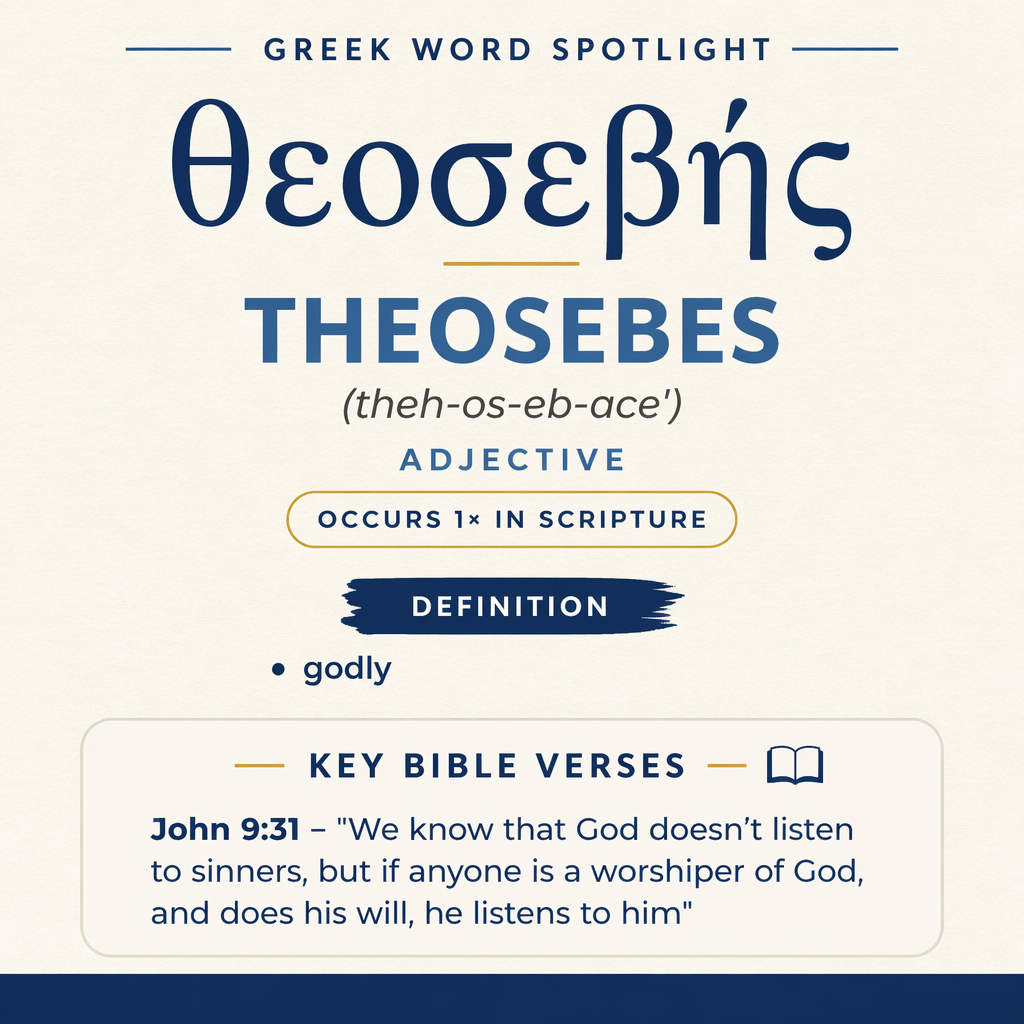
θεοσεβής (Theosebes) means “godly” and appears once in Scripture, in John 9:31.
John 9:31 Context
In John 9:31, it describes “a worshiper of God” who does God’s will, and whom God listens to.
Learn More →θεοσεβής means “godly.” It appears once, in John 9:31, where it helps frame a contrast between “sinners” and a person whose life is oriented toward God and God’s will.
Root and Related Words
θεοσεβής is associated with theos (θεός), “God” (Strong’s G2316), and sebomai (σέβομαι), “be devout” (Strong’s G4576). These related words place the adjective in the sphere of reverence directed toward God and a posture of devotion expressed in conduct.

Occurrences
“We know that God doesn’t listen to sinners, but if anyone is a worshiper of God, and does his will, he listens to him.” (John 9:31)
In this statement, θεοσεβής describes the kind of person set in contrast to “sinners.” The speaker presents a shared conviction (“We know…”) about how God responds: God “doesn’t listen to sinners,” but does listen to a person characterized as “a worshiper of God” and further marked by doing “his will.” Within the sentence, the word functions as a defining label for that worshiper—someone whose posture toward God is not merely verbal but aligned with obedience. The effect is to portray “godly” as a recognizable moral and religious profile: reverence toward God coupled with active conformity to what God wants (“does his will”).
The clause structure makes the adjective serve a practical point in argumentation. The difference between the two groups is not presented as a bare status distinction; it is tied to God’s responsiveness (“he listens to him”). θεοσεβής therefore contributes to the logic of the scene by naming the sort of person whose prayers or appeals belong to the category God “listens” to, as opposed to those classified as “sinners.” The verse’s own terms link the “godly” person with two features: worship directed to God and conduct that matches God’s will.
Sense and Usage
Because θεοσεβής occurs in a sentence that defines its own contrast and rationale, its sense is sharpened by the immediate context. “Godly” is not left as an abstract compliment; it is embedded in a description of lived religion. The verse pairs the label with two concrete indicators: being “a worshiper of God” and doing “his will.” In this way, θεοσεβής carries a sense that is both relational and ethical within the verse itself—relational in that it is oriented toward God as its object (“worshiper of God”), and ethical in that it expresses itself through compliance with divine intention (“does his will”).
The verse also places the word inside a claim about divine hearing. The speaker’s point is about whether God “listens,” and the description of the godly person is given as the condition under which listening occurs (“but if anyone…”). That positioning gives θεοσεβής a practical weight: it marks the person whose standing in the argument is that of someone heard by God. The usage is therefore evaluative, not merely descriptive. It sorts people into meaningful categories for the claim being made, contrasting the “sinners” with a “godly” worshiper whose will and conduct align with God’s will.
Finally, the wording suggests that θεοσεβής is recognizable in outward and inward orientation: “worshiper of God” speaks to a reverent stance, while “does his will” speaks to sustained action. Taken together, the verse depicts godliness as a whole-person orientation expressed in devotion and obedience, and it is this integrated profile that is tied to God’s attentive response (“he listens to him”).
Imagery
The verse’s imagery is auditory and relational: God “doesn’t listen” to one group but “listens” to another. Within that picture, θεοσεβής belongs to the scene of a person approaching God as a worshiper and being heard. The word thus carries the implied setting of prayerful appeal and divine attention, with godliness portrayed as the kind of life that matches worship with the doing of God’s will.
Sources: Lexical data from Strong’s Exhaustive Concordance and the Translators Brief Lexicon of Extended Strongs for Greek (STEPBible, CC BY). Occurrence data from the Translators Amalgamated Greek New Testament (STEPBible, CC BY). Scripture quotations from the World English Bible (public domain).




