Exploring the Meaning of Thalassa in Greek
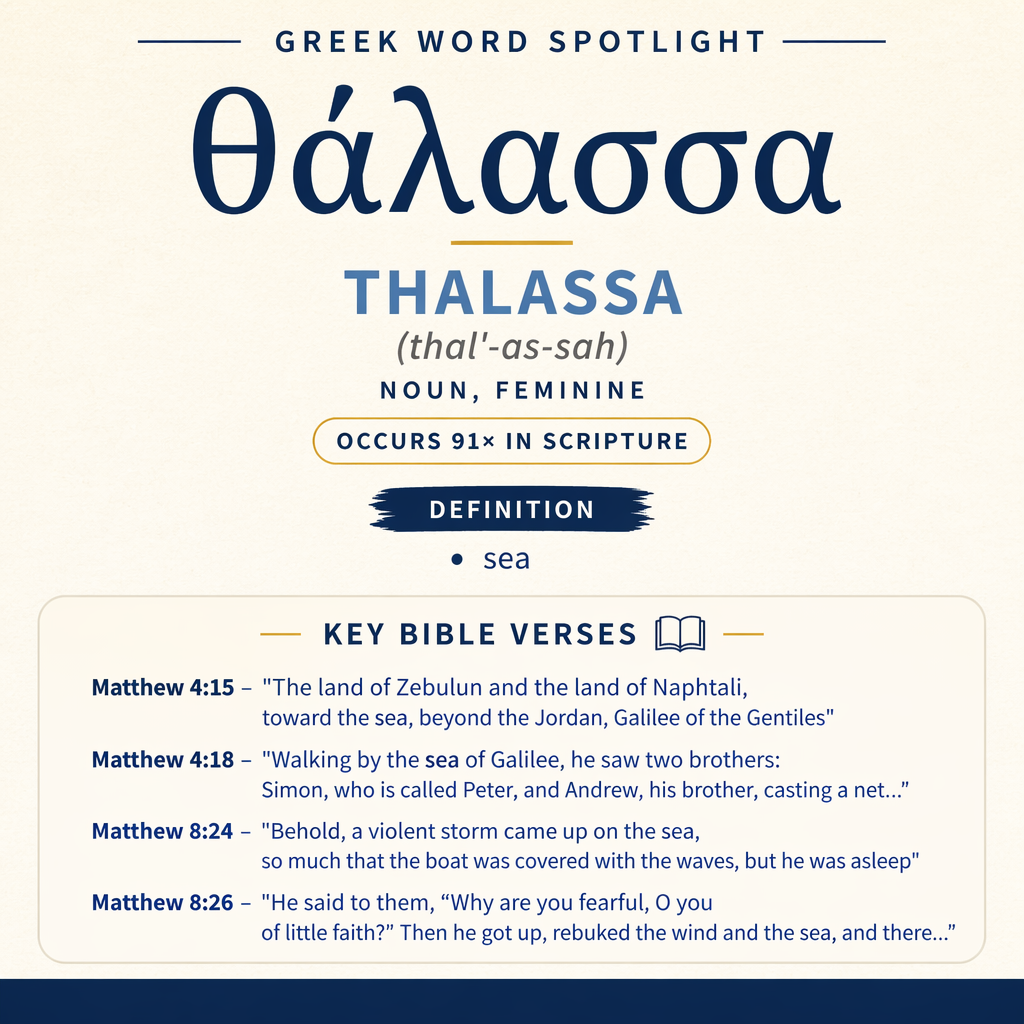
θάλασσα (Thalassa) means “sea” and appears 91 times in Scripture, including Matthew’s references to the sea of Galilee and the seaside.
Matthew Examples
Matthew uses θάλασσα for the sea of Galilee (Matthew 4:18) and for a storm on the sea (Matthew 8:24).
Learn More →Teaching Imagery
Jesus speaks of the sea in parables, including a dragnet cast into the sea (Matthew 13:47).
Learn More →θάλασσα refers to the “sea,” a setting that frames travel, work, teaching, danger, and wonder in the Gospel scenes quoted below. In these passages it can name a geographic boundary (“toward the sea”), a particular body of water (“the sea of Galilee”), and the sea as an element whose power is felt in storm and calm.
Occurrences
“The land of Zebulun and the land of Naphtali, toward the sea, beyond the Jordan, Galilee of the Gentiles, (Matthew 4:15)
Here θάλασσα functions as a point of orientation. “Toward the sea” helps locate the region being described, setting a coastal-facing direction within a larger geographical description that also includes “beyond the Jordan” and “Galilee of the Gentiles.” The sea is not a scene of action in this line; it is a landmark that helps define where the land lies.
Walking by the sea of Galilee, he saw two brothers: Simon, who is called Peter, and Andrew, his brother, casting a net into the sea; for they were fishermen. (Matthew 4:18)
θάλασσα appears twice, first as the shoreline Jesus walks beside (“by the sea of Galilee”), then as the water receiving the fishermen’s net (“into the sea”). The sea is both place and workplace: it provides the immediate environment in which the brothers are encountered, and it is the medium in which their labor happens. The wording “casting a net into the sea” presents the sea as a space that can be entered by tools and that yields fish, fitting the explicit reason given—“for they were fishermen.”
Behold, a violent storm came up on the sea, so much that the boat was covered with the waves, but he was asleep. (Matthew 8:24)
In this scene θάλασσα is the surface on which the storm breaks. The sea is not merely background; it is the arena where the “violent storm” manifests its force, producing waves that “covered” the boat. The clause ties the sea to instability and danger: the sea becomes the setting where human vulnerability is exposed, while Jesus’ sleep heightens the contrast between the threatening waters and his composure.
He said to them, “Why are you fearful, O you of little faith?” Then he got up, rebuked the wind and the sea, and there was a great calm. (Matthew 8:26)
θάλασσα here stands alongside “the wind” as something addressed and controlled. The sea is treated as a force that can be rebuked, and the result is immediate environmental change: “a great calm.” In the narrative flow, the sea moves from the storm-tossed condition implied by the prior verse to calmness at Jesus’ action, so the sea becomes a visible measure of danger removed.
The men marveled, saying, “What kind of man is this, that even the wind and the sea obey him?” (Matthew 8:27)
θάλασσα is again paired with “the wind,” but now it is placed in the disciples’ reflection. The sea is depicted as something that can “obey,” and its obedience becomes part of the question that astonishes them: the sea, known in their experience as unruly in storm, is now included among things responsive to Jesus. The word thus carries the weight of what seems beyond ordinary human command.
He said to them, “Go!” They came out, and went into the herd of pigs: and behold, the whole herd of pigs rushed down the cliff into the sea, and died in the water. (Matthew 8:32)
In this account θάλασσα marks the endpoint of a headlong rush: the herd goes “down the cliff into the sea.” The sea functions as a receiving space that leads to death (“and died in the water”), so it is portrayed as a place where life is extinguished once the animals enter it in this way. The sea is not threatening by weather here; rather, it is dangerous because of the uncontrolled plunge into it.
On that day Jesus went out of the house, and sat by the seaside. (Matthew 13:1)
θάλασσα appears in the compound idea “seaside,” presenting the sea as a boundary where land meets water and where one may sit. The move “out of the house” to “by the seaside” gives the sea a role in framing a teaching setting: it is part of the open-air environment that replaces the interior space, suggesting accessibility and public visibility without describing any motion on the water itself.
“Again, the Kingdom of Heaven is like a dragnet, that was cast into the sea, and gathered some fish of every kind, (Matthew 13:47)
In this parable θάλασσα is the sphere into which the net is thrown. The sea is imagined as containing “fish of every kind,” and it is the place from which a gathering is made. The concrete action “cast into the sea” uses the sea as a familiar environment for net-fishing, so θάλασσα supplies the physical realism of the comparison: a net entering the sea and bringing back a mixed catch.
In the fourth watch of the night, Jesus came to them, walking on the sea. (Matthew 14:25)
θάλασσα is presented as the surface under Jesus’ feet: he comes “walking on the sea.” The time reference (“in the fourth watch of the night”) intensifies the scene’s starkness: the sea is not only a location but a dark, nocturnal expanse. The sea remains “sea”—the ordinary body of water—but the action described upon it is extraordinary within the story’s world, making the sea a stage for a striking approach.
When the disciples saw him walking on the sea, they were troubled, saying, “It’s a ghost!” and they cried out for fear. (Matthew 14:26)
θάλασσα here is the visual context that triggers alarm. The disciples’ reaction hinges on what they “saw”—a figure “walking on the sea”—and the sea functions as the unsettling medium that makes the sight hard to categorize. The sea, at night, becomes a place where perception and fear interact; the word anchors the scene in an environment associated with depth and unpredictability, even though no storm is mentioned.
Jesus departed from there, and came near to the sea of Galilee; and he went up into the mountain, and sat there. (Matthew 15:29)
θάλασσα again appears with the specific designation “the sea of Galilee,” serving as a geographic marker in Jesus’ movement. He “came near” it, then “went up into the mountain,” so the sea helps set the topography: proximity to the water followed by ascent. The sea here contributes place and orientation, situating the subsequent sitting and activity in a landscape where water and high ground are both present.
But, lest we cause them to stumble, go to the sea, cast a hook, and take up the first fish that comes up. When you have opened its mouth, you will find a stater coin. Take that, and give it to them for me and you.” (Matthew 17:27)
In this instruction θάλασσα is the location of a specific task. “Go to the sea” introduces a practical fishing action—“cast a hook”—and the sea is assumed to be a place where a fish can be taken “first” and brought up. The sea is thus portrayed as accessible and responsive to purposeful action, and it becomes the setting in which an ordinary fishing act leads to an unexpected provision (“you will find a stater coin”).
Sense and Usage
Across these passages θάλασσα consistently names a real sea as a physical environment, but the narratives draw on different aspects of what a sea is for human life. It can function as a directional landmark (“toward the sea,” Matthew 4:15) and as a boundary space where one can walk or sit (“Walking by the sea of Galilee,” Matthew 4:18; “sat by the seaside,” Matthew 13:1). It is also a working environment that assumes fishing practices: nets are cast “into the sea” (Matthew 4:18; Matthew 13:47) and a hook is cast there for a fish to be taken (Matthew 17:27). In these scenes the sea is neither abstract nor distant; it is near enough to be used and depended upon.
At the same time, θάλασσα carries the sea’s capacity for peril. The “violent storm” that comes “up on the sea” (Matthew 8:24) makes the boat’s vulnerability tangible through “waves,” while the herd’s plunge “into the sea” ends in death “in the water” (Matthew 8:32). The word therefore names the same created environment that sustains livelihoods and also threatens life, depending on circumstances—storm, cliff, darkness, or control lost.
Several occurrences link the sea with awe through the contrast between its familiar force and its submission. Jesus “rebuked the wind and the sea, and there was a great calm” (Matthew 8:26), leading to the disciples’ astonished question about one whom “even the wind and the sea obey” (Matthew 8:27). Later, the sea becomes the surface on which Jesus approaches them at night, “walking on the sea” (Matthew 14:25–26). In these episodes, θάλασσα remains the ordinary referent—an actual sea—yet the narratives use it to highlight the boundary between what is normally expected from the sea and what occurs in Jesus’ presence.
Imagery
The quoted scenes repeatedly place θάλασσα at an edge: beside it one can walk and sit; into it one can cast nets and hooks; upon it storms rise; and into it living creatures can plunge. Because the sea can be calm or violent and can serve both work and danger, it becomes a vivid backdrop for human fear (“they cried out for fear,” Matthew 14:26) and human marvel (“The men marveled,” Matthew 8:27), with the sea’s changing surface—covered with waves, stilled to calm, or walked upon—providing the visible texture of each moment.
Sources: Lexical data from Strong’s Exhaustive Concordance and the Translators Brief Lexicon of Extended Strongs for Greek (STEPBible, CC BY). Occurrence data from the Translators Amalgamated Greek New Testament (STEPBible, CC BY). Scripture quotations from the World English Bible (public domain).