Exploring the Meaning of Helikos in Greek
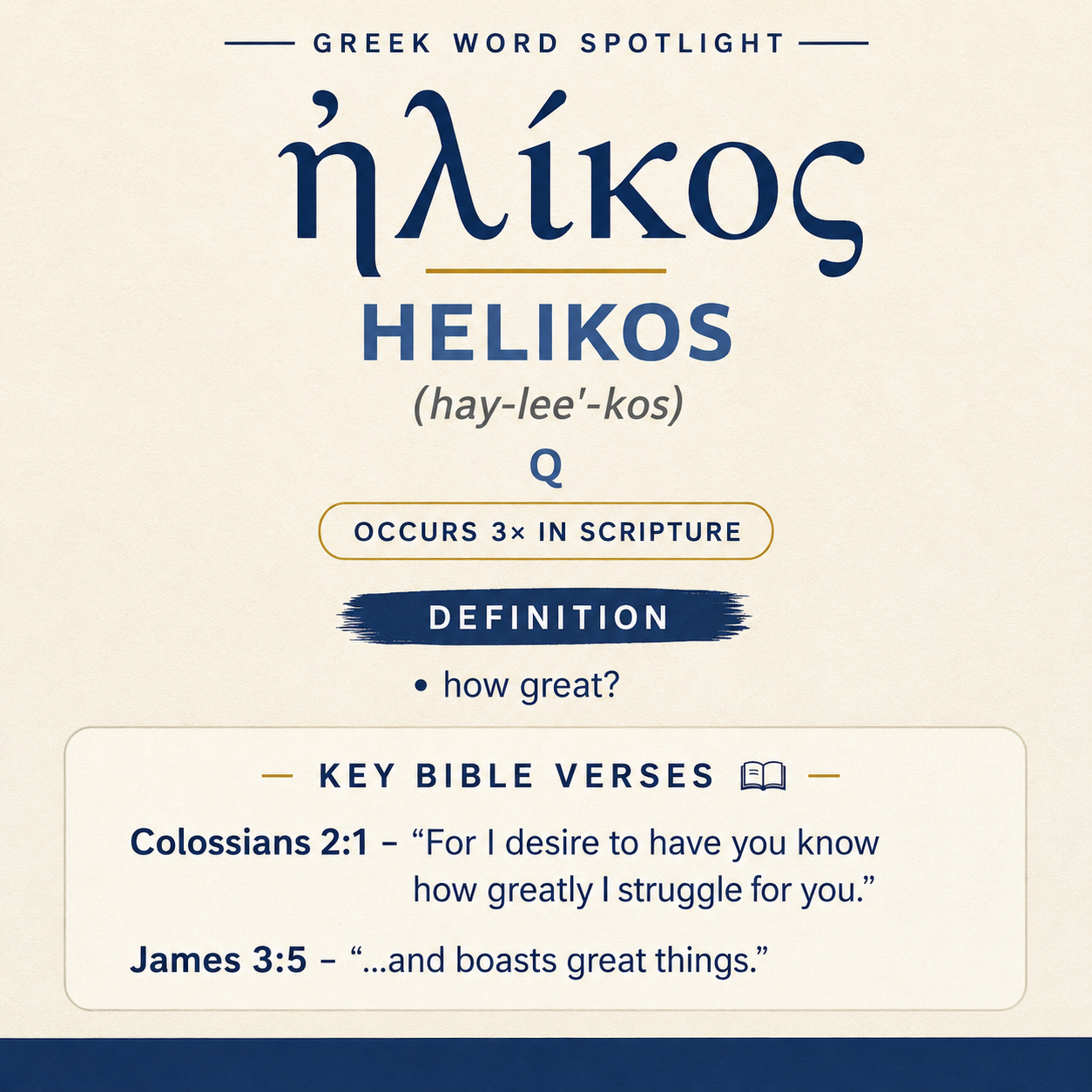
ἡλίκος means “how great?” and occurs three times in Scripture, including Colossians 2:1 and James 3:5.
Scripture Occurrences
This word occurs three times in Scripture. It appears in Colossians 2:1 and James 3:5.
Learn More →Context Examples
In Colossians 2:1 it is used in “how greatly I struggle.” In James 3:5 it highlights how a small fire can spread to a large forest.
Learn More →ἡλίκος poses a question of magnitude: “how great?” It appears in contexts where intensity and scale are being assessed—Paul’s strenuous concern for believers he has not met, and James’s warning about the tongue’s outsized effects.
Occurrences
“For I desire to have you know how greatly I struggle for you, and for those at Laodicea, and for as many as have not seen my face in the flesh;” (Colossians 2:1)
Here ἡλίκος functions within Paul’s effort to make his readers grasp the magnitude of his struggle. The sentence is framed as disclosure—“I desire to have you know”—and the question of scale pushes beyond a bare statement that he struggles. It presses the reader to reckon with the extent of that labor as something measurable in degree, not merely a fact. The verse also specifies the beneficiaries: “for you,” “for those at Laodicea,” and “as many as have not seen my face in the flesh.” Within that widening circle, ἡλίκος heightens the sense that Paul’s struggle is not confined to a single relationship or a small set of people; it is portrayed as a struggle whose greatness corresponds to the breadth of those for whom he labors, including those outside his direct personal acquaintance.

Because the verse pairs the magnitude-question with “I struggle,” ἡλίκος focuses attention on intensity and cost. The word draws the reader into evaluating the scale of Paul’s exertion as part of his pastoral concern, emphasizing that his relationship to them is not casual or distant even though many have not “seen my face in the flesh.” In the flow of the sentence, the magnitude implied by ἡλίκος supports Paul’s purpose: he wants them not simply to know that he struggles, but to understand how great that struggle is.
“So the tongue is also a little member, and boasts great things. See how a small fire can spread to a large forest!” (James 3:5)
James uses ἡλίκος to draw the eye to disproportion: a “little member” that “boasts great things,” and a “small fire” that spreads to “a large forest.” The wording sets up a contrast between what is small in size and what becomes great in outcome. In that setting, ἡλίκος serves as an exclamatory prompt—“See how…”—calling the reader to perceive the scale of the effect. The question of greatness is not abstract; it is illustrated by a vivid cause-and-effect image in which a small ignition becomes something large and far-reaching.
Within the verse, the tongue’s self-presentation (“boasts great things”) is immediately matched with an external analogy that shows how greatness can proceed from small beginnings. ἡλίκος helps the analogy do its work by making the point of comparison explicitly about magnitude: the forest is not merely affected; the spread is large enough to be described in terms of greatness. The reader is guided to attend to the scale of harm or impact that can proceed from something that initially seems minor.

Sense and Usage
Across these passages, ἡλίκος functions as a magnitude-question that intensifies what follows. Its force is not simply to ask whether something exists, but to press the reader to consider its degree—its greatness on a scale. In Colossians 2:1 the magnitude concerns an inward and sustained exertion: Paul’s struggle is presented as something the audience needs to comprehend as “how great,” especially given the range of people he includes (“for you,” “for those at Laodicea,” and those who have not seen him). The word helps convey that the struggle is significant enough to warrant special notice and understanding, not a passing difficulty.
In James 3:5 the magnitude concerns outward effect and spread. The verse is built on a small-to-great contrast, and ἡλίκος highlights the large scale of the result. The rhetorical direction “See how…” makes the magnitude perceptible by pointing to a concrete scenario: a small fire producing a large forest-wide spread. The tongue, though small, is framed as having a reach or consequence that must be evaluated in terms of greatness.
In both uses, ἡλίκος draws readers into an assessment of scale that reshapes how the subject is viewed. Paul’s struggle is not evaluated by proximity (“seen my face in the flesh”) but by the greatness of his labor for them. James’s warning is not limited to the tongue’s smallness but is driven by the greatness of what it can set in motion. The word therefore operates as a lens: it makes “greatness” the relevant category for understanding what is being described, whether the greatness is in effort or in outcome.
Imagery
James 3:5 anchors the magnitude-question in a picture: a “small fire” that spreads “to a large forest.” That image supplies an immediate sense of scale—something easily overlooked becoming something extensive and consuming. Colossians 2:1, though not pictorial in the same way, still evokes magnitude through scope: Paul’s struggle reaches beyond the people who know him personally to include many he has never met face-to-face. Together the passages show ἡλίκος at work where the reader must be prompted to recognize greatness—either in the hidden weight of a struggle or in the widening reach of a small beginning.
Sources: Lexical data from Strong’s Exhaustive Concordance and the Translators Brief Lexicon of Extended Strongs for Greek (STEPBible, CC BY). Occurrence data from the Translators Amalgamated Greek New Testament (STEPBible, CC BY). Scripture quotations from the World English Bible (public domain).