
Exploring the Meaning of Zetema in Greek
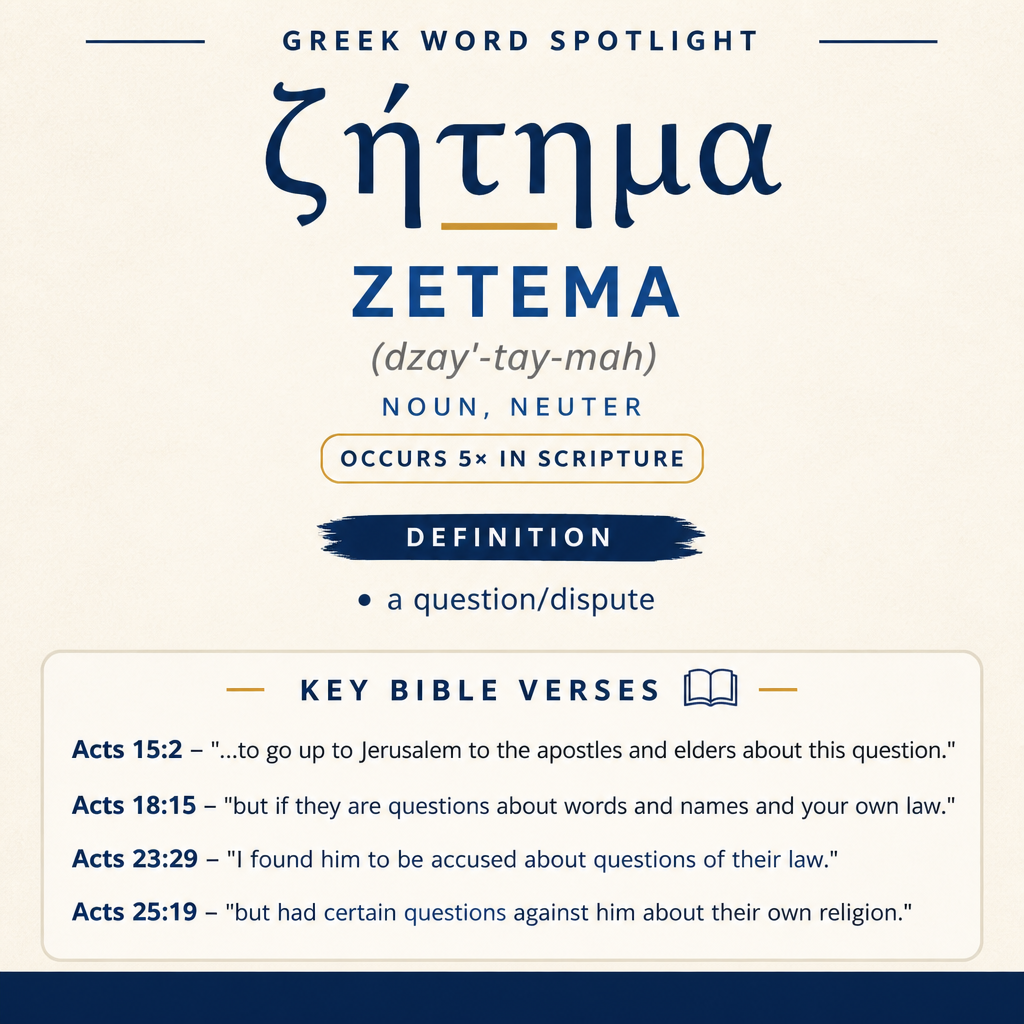
ζήτημα means a question/dispute and appears five times in Scripture: Acts 15:2; 18:15; 23:29; 25:19; 26:3.
Acts Occurrences
It occurs five times, all in Acts (15:2; 18:15; 23:29; 25:19; 26:3).
Learn More →Context In Acts
In Acts, it is used for questions tied to words, names, and the Jews’ law or religion (Acts 18:15; 25:19).
Learn More →ζήτημα refers to a question or dispute, especially one that calls for decision, judgment, or careful handling. In the New Testament it appears in Acts in settings where authorities, communities, and leaders must reckon with contested issues.
Root and Related Words
ζήτημα is derived from zeteo (ζητέω), “to seek” (Strong’s G2212). In Acts, the noun regularly marks what people are seeking to resolve—an issue brought forward for consideration, debate, or adjudication.

Occurrences
“Therefore when Paul and Barnabas had no small discord and discussion with them, they appointed Paul and Barnabas, and some others of them, to go up to Jerusalem to the apostles and elders about this question.” (Acts 15:2)
Here ζήτημα names the contested issue that has escalated beyond local “discord and discussion.” The word gathers the disagreement into a single matter that can be carried to Jerusalem and placed before “the apostles and elders.” In this scene, ζήτημα is not a casual inquiry; it is the focal point of a communal conflict significant enough to require recognized leadership and a formal hearing.
“but if they are questions about words and names and your own law, look to it yourselves. For I don’t want to be a judge of these matters.” (Acts 18:15)
In the mouth of a civil official, ζήτημα falls within a set of concerns defined as “about words and names and your own law.” The term is plural (“questions”), portraying multiple disputed points rather than a single issue. The speaker refuses the role of adjudicator: ζήτημα here is the kind of internal controversy that one forum declines to take up, insisting that the parties themselves should handle it.
“I found him to be accused about questions of their law, but not to be charged with anything worthy of death or of imprisonment.” (Acts 23:29)
ζήτημα again appears in the plural and is explicitly tied to “their law.” The contrast in the verse is sharp: accusations exist, but they pertain to questions rather than to crimes “worthy of death or of imprisonment.” In this report, ζήτημα functions as a category that reclassifies the conflict: it is a matter of dispute within a legal-religious framework, not an offense that merits severe penalty.
“but had certain questions against him about their own religion, and about one Jesus, who was dead, whom Paul affirmed to be alive.” (Acts 25:19)
In this hearing, ζήτημα describes “certain questions against him,” framing the opposition to Paul as a set of disputed points. The verse anchors these questions in “their own religion” and in a specific contested claim involving “one Jesus,” described as “dead,” while Paul “affirmed” him “to be alive.” ζήτημα thus marks a dispute where competing affirmations are at stake and where the disagreement concerns the content of religious belief and proclamation.
“especially because you are expert in all customs and questions which are among the Jews. Therefore I beg you to hear me patiently.” (Acts 26:3)
Here ζήτημα appears alongside “customs” as an area of recognized expertise. The speaker appeals to an audience competent to understand “questions which are among the Jews,” implying that these disputes require informed judgment and cultural-legal literacy. In this context, ζήτημα signals issues that are familiar within a community and that can be weighed by someone trained to discern them.
Sense and Usage
Across these passages ζήτημα consistently points to contested matters—issues raised in conflict, argued in public, and evaluated by those asked to decide what to do with them. The word readily fits both a single focal controversy (“this question,” Acts 15:2) and multiple disputed points (“questions,” Acts 18:15; 23:29; 25:19; 26:3). In Acts 15:2, the term sits within a process of escalation and referral: a dispute becomes a defined question that can be taken to a higher council. In Acts 18:15, it is used dismissively to set boundaries: some “questions” are treated as internal and therefore outside a particular judge’s concern. In Acts 23:29, ζήτημα serves as a legal classification that distinguishes disputation from criminal liability. In Acts 25:19, the disputes are described as being “against” a person and are attached to religion and to a pivotal affirming/denying claim, showing that ζήτημα can carry personal and public consequences even when framed as “questions.” Finally, Acts 26:3 uses the term in an appeal to competence: certain listeners can evaluate the questions because they know the customs and the points of dispute circulating within the community.
The passages also show how ζήτημα often lives at the boundary between forums: local discussion gives way to Jerusalem deliberation (Acts 15:2); a judge declines involvement (Acts 18:15); a report reduces charges to internal legal questions (Acts 23:29); a hearing identifies disputes as religious questions (Acts 25:19); and a speaker seeks a patient hearing from someone expert in these questions (Acts 26:3). The term therefore regularly indicates not only that an issue is disputed, but that it must be situated—handled by the right people, in the right setting, with the right kind of understanding.
Imagery and Setting
In Acts, ζήτημα evokes the scene of a matter placed on the table for resolution: messengers sent to elders (Acts 15:2), a magistrate drawing a line around his jurisdiction (Acts 18:15), an official report distinguishing disputes from punishable crimes (Acts 23:29), and hearings where “questions” are articulated as accusations and evaluated by those regarded as “expert” (Acts 25:19; 26:3). The word’s repeated association with law, religion, and expertise gives it the feel of a live controversy—an issue under dispute that demands careful hearing rather than mere curiosity.
Sources: Lexical data from Strong’s Exhaustive Concordance and the Translators Brief Lexicon of Extended Strongs for Greek (STEPBible, CC BY). Occurrence data from the Translators Amalgamated Greek New Testament (STEPBible, CC BY). Scripture quotations from the World English Bible (public domain).





