Exploring the Meaning of Zenas in Greek
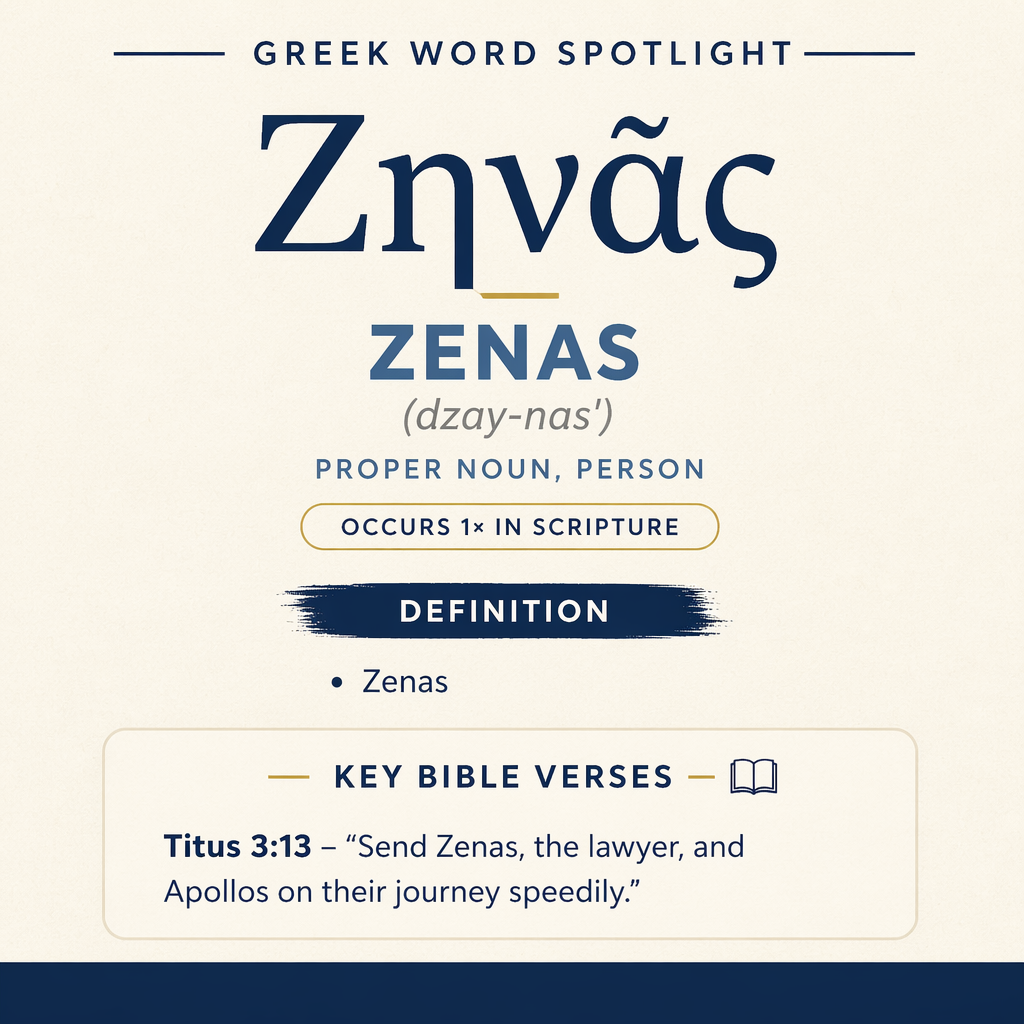
Ζηνᾶς (Zenas) is the personal name “Zenas,” appearing once in Scripture in Titus 3:13.
Verse Context
Titus 3:13 mentions sending Zenas, the lawyer, and Apollos on their journey speedily.
Learn More →Ζηνᾶς refers to Zenas and appears in Paul’s closing instructions in Titus. The single mention places him alongside Apollos and connects him with travel, practical support, and the work of a local church community.
Root and Related Words
Ζηνᾶς is connected, per Strong’s, with Ζεύς (transliteration: Zeus, “Zeus,” Strong’s G2203) and with δῶρον (transliteration: doron, “gift,” Strong’s G1435).

Occurrences
“Send Zenas, the lawyer, and Apollos on their journey speedily, that nothing may be lacking for them.” (Titus 3:13)
Here Ζηνᾶς functions as a named individual whose immediate situation is movement: he is to be “send[ed] … on [his] journey.” The instruction is not merely to acknowledge him but to take responsibility for his departure—arranging it “speedily” and with adequate provision. Zenas is further identified in the sentence as “the lawyer,” a descriptive tag that distinguishes him from Apollos and signals why the recipients would recognize him and understand his standing. Within the short line, the name anchors a concrete task: the church is to see that the travelers are outfitted so “nothing may be lacking for them,” implying that Zenas’s journey is to be supplied in a thorough, practical way rather than treated as an afterthought.

Sense and Usage
Because Ζηνᾶς appears only as a personal designation, its force in context is referential: it points to a specific co-worker known to the letter’s recipients and worthy of deliberate attention. The verse frames the name within a brief but complete set of community obligations—recognize the person, respond promptly, and ensure material sufficiency for the road. The appositive “the lawyer” shapes how the reader hears the name: Ζηνᾶς is not introduced as a stranger, but as someone with an identifiable role, and the letter treats that role as compatible with Christian travel and ministry partnership.
The wording also binds Ζηνᾶς closely to Apollos (“Send Zenas … and Apollos”), so the name participates in a paired mission. Paul’s instruction does not separate their needs or give two different standards of care; the plural “them” gathers both under one expectation of provision. In this way the name Ζηνᾶς contributes to the verse’s emphasis on shared support: assistance is rendered to real individuals with real itineraries, and the adequacy of that support is measured by the simple test that “nothing may be lacking.”
Imagery
Within Titus 3:13, Ζηνᾶς carries the everyday imagery of travel supported by a community: a person setting out on a journey, and fellow believers making sure the traveler leaves without unmet needs. The name makes the instruction concrete and personal, tying the letter’s closing counsel to an actual departure that is meant to be prompt and fully supplied.
Sources: Lexical data from Strong’s Exhaustive Concordance and the Translators Brief Lexicon of Extended Strongs for Greek (STEPBible, CC BY). Occurrence data from the Translators Amalgamated Greek New Testament (STEPBible, CC BY). Scripture quotations from the World English Bible (public domain).