Exploring the Meaning of Euprosedros in Greek
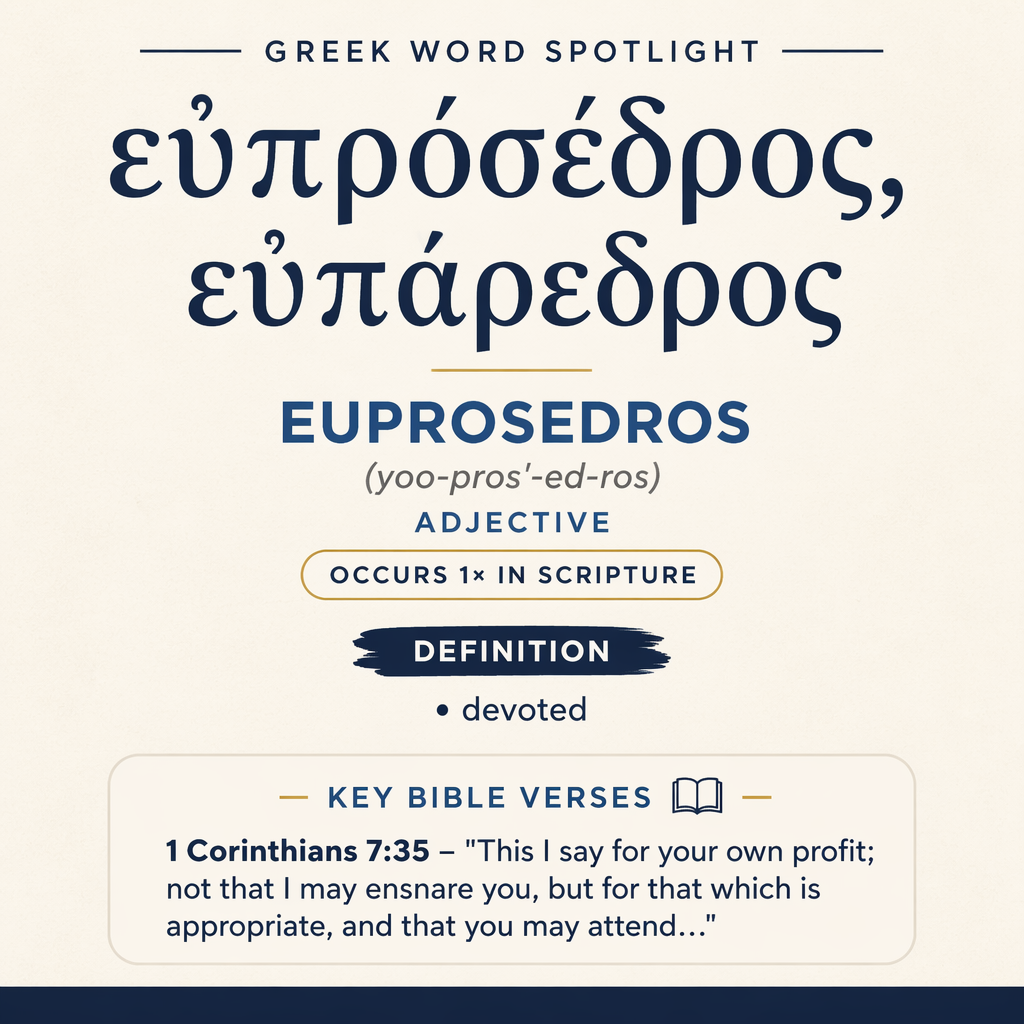
εὐπρόσεδρος (εὐπάρεδρος), “devoted,” appears once in Scripture in 1 Corinthians 7:35.
Verse Context
In 1 Corinthians 7:35, Paul speaks about what is appropriate so believers may attend to it.
Learn More →Euprosedros means “devoted” and appears once in the New Testament, in Paul’s counsel on marriage and singleness in 1 Corinthians 7:35. In that setting it is tied to a mode of life aimed at steady attention to the Lord.
Root and Related Words
Euprosedros is formed from eu (εὖ), “well/well done!” (Strong’s G2095), and prosedreuo (προσεδρεύω), “to sit near/serve” (Strong’s G4332). The combination evokes the idea of a “well-” or fitting kind of nearness and service, which frames the way the word is used in its lone occurrence.

Occurrences
“This I say for your own profit; not that I may ensnare you, but for that which is appropriate, and that you may attend to the Lord without distraction.” (1 Corinthians 7:35)
In this sentence Paul explains his pastoral aim: “for your own profit,” yet “not that I may ensnare you.” The contrast sets the tone for the word’s contribution. What he urges is not a constraint laid on the hearer, but “that which is appropriate,” with a particular goal: “that you may attend to the Lord without distraction.” Euprosedros functions here as a quality of attention and posture—devotion expressed as steadiness and freedom from competing pulls.
The verse places this devotion in a concrete, lived arena. The surrounding phrases show that the issue is not merely inner feeling but practical orientation: an undivided capacity to “attend” to the Lord. Paul’s careful negation (“not that I may ensnare you”) also colors the word: devotion is presented as fitting and beneficial, not as an imposed trap. In other words, the devotion in view is chosen and directed, the kind that fits the believer’s situation and supports sustained focus.
The wording “without distraction” sharpens the picture by naming devotion’s opposite—not lack of sincerity, but a life pulled apart. Within the logic of the verse, euprosedros points to a pattern of life where attention is gathered rather than scattered. The goal is not merely increased religious activity, but a settled ability to “attend to the Lord,” a phrase that suggests ongoing orientation rather than a single act.
Sense and Usage
Because euprosedros occurs only in 1 Corinthians 7:35, its sense is best read through the immediate purpose statement: it serves Paul’s aim that the Corinthians “may attend to the Lord without distraction.” Devotion here is not defined abstractly but located in conduct that is “appropriate” and in a stance that remains available for the Lord.
The verse’s structure shows how the term operates rhetorically. Paul stacks three motivations: benefit (“for your own profit”), freedom (“not…ensnare”), and fittingness (“that which is appropriate”), culminating in the intended outcome—undistracted attentiveness to the Lord. Euprosedros belongs to this final outcome. It names the quality of life that results when what is “appropriate” is embraced: a devoted posture characterized by sustained attendance.
The related word prosedreuo (“to sit near/serve”) helps the reader hear the texture of the devotion described. Paul is not speaking of devotion as a private claim but as a kind of abiding proximity and service—being near enough, and steady enough, to remain in attendance. When paired with eu (“well”), the idea points toward devotion that is fittingly ordered: a “well-”directed attendance that is not constantly interrupted.
At the same time, the caution “not that I may ensnare you” guards against a misreading. Devotion is not cast as a net that removes legitimate freedom; it is presented as something “for your own profit,” an aim aligned with the believer’s good. The devotion euprosedros describes therefore carries an ethical and pastoral nuance in this context: it is commended as an appropriate way to live before the Lord, not as a coercive standard. The verse itself holds together both the seriousness of attending to the Lord and the refusal to bind the conscience with a snare.
In its lone New Testament use, then, euprosedros depicts devotion as undistracted attendance—steadiness that serves, nearness that endures, and an ordering of life that supports continued focus on the Lord. The verse does not develop multiple senses, but it does give a clear profile: devotion expressed as freedom from distraction for the sake of consistent attention.
Imagery
The verse paints devotion with the imagery of attention and distraction. To “attend to the Lord” suggests a person who remains near and ready, while “without distraction” implies competing claims that would tug the mind and schedule away. Euprosedros gathers these contrasts into a single idea: a devoted life marked by fitting, unencumbered attentiveness.
Sources: Lexical data from Strong’s Exhaustive Concordance and the Translators Brief Lexicon of Extended Strongs for Greek (STEPBible, CC BY). Occurrence data from the Translators Amalgamated Greek New Testament (STEPBible, CC BY). Scripture quotations from the World English Bible (public domain).