
Exploring the Meaning of Euthus in Greek
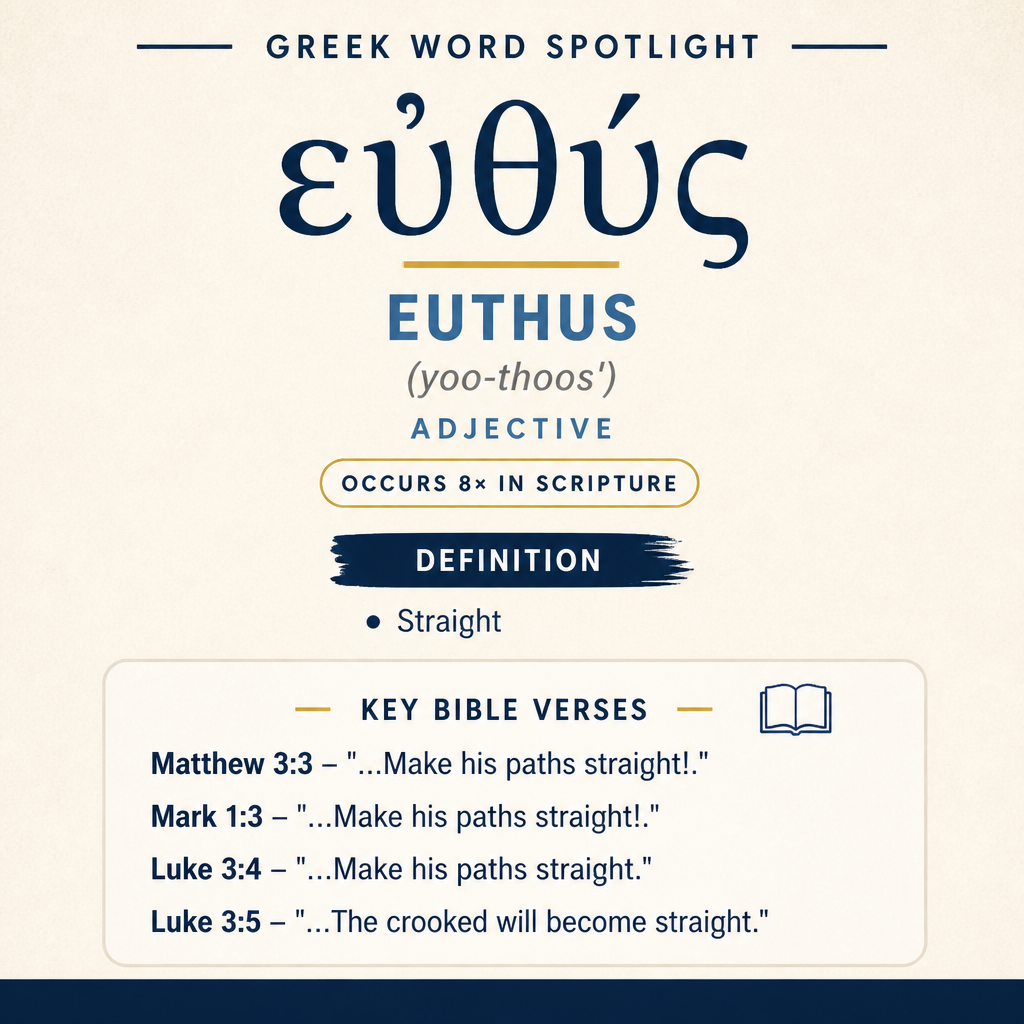
εὐθύς means “straight” and occurs 8 times in Scripture, including Matthew 3:3, Mark 1:3, Luke 3:4–5, Acts, and 2 Peter 2:15.
Core Meaning
εὐθύς is defined as “straight.” In Luke 3:5, it contrasts with what is “crooked.”
Learn More →Prophetic Citation
In Matthew 3:3, Mark 1:3, and Luke 3:4, it appears in the call to “make his paths straight.” These verses quote Isaiah’s prophecy about a voice in the wilderness.
Learn More →Acts and 2 Peter
In Acts 9:11 it names “the street which is called Straight,” and in Acts 8:21 it describes a heart not “right” before God. In 2 Peter 2:15 it appears in the phrase “the right way.”
Learn More →εὐθύς expresses the idea of what is “straight,” and the passages where it appears draw that idea into images of prepared roads and moral alignment. In the Gospels it is heard in Isaiah’s wilderness proclamation, and in Acts and 2 Peter it shapes speech about what is “right,” “Straight,” or the “right way.”
Occurrences
Matthew 3:3 — “For this is he who was spoken of by Isaiah the prophet, saying, “The voice of one crying in the wilderness, make the way of the Lord ready! Make his paths straight!””
Here εὐθύς belongs to the road imagery of “the way of the Lord.” “Make his paths straight!” speaks to paths that are not winding or bent, fitting the scene of a wilderness voice calling for a way to be made “ready.” The word’s force is concrete: the paths envisioned are to be made straight as part of preparation for the Lord’s coming.
Mark 1:3 — “the voice of one crying in the wilderness, ‘Make ready the way of the Lord! Make his paths straight!’ ”
Mark repeats the same wilderness summons with the same two-part imperative: readiness for “the way” and straightness for “his paths.” Within the quotation, εὐθύς functions as the quality that matches a properly prepared route. The pairing of “Make ready” and “Make… straight” lets “straight” describe what readiness looks like in the picture: a cleared, direct path.
Luke 3:4 — “As it is written in the book of the words of Isaiah the prophet, “The voice of one crying in the wilderness, ‘Make ready the way of the Lord. Make his paths straight.”
Luke situates the line explicitly as written Scripture and preserves the wilderness call. The “way of the Lord” is again the setting, and εὐθύς again defines the “paths” that belong to that way. The repetition across the Synoptic accounts makes “straight” a defining feature of the preparation motif: the Lord’s “paths” are not pictured as twisting, obstructed, or meandering.
Luke 3:5 — “Every valley will be filled. Every mountain and hill will be brought low. The crooked will become straight, and the rough ways smooth.”
This verse elaborates the earlier imperative with a set of landscape transformations. εὐθύς stands opposite “crooked” in the statement, “The crooked will become straight.” The image is not merely of selecting a straight route but of reshaping the terrain itself—valleys filled, heights leveled—so that what was crooked becomes straight. In this scene, “straight” is the outcome of leveling and smoothing actions that remove the causes of crookedness and roughness.
Acts 8:21 — “You have neither part nor lot in this matter, for your heart isn’t right before God.”
In Acts 8 the language shifts from road imagery to inner condition. The statement contrasts participation (“part or lot”) with a heart that “isn’t right before God.” In this setting, εὐθύς contributes the idea of straightness applied to moral-spiritual posture: the heart is evaluated as not being “right,” that is, not aligned in the straight sense before God. The word sharpens the rebuke by locating the issue not in the “matter” itself but in the state of the heart in God’s presence.
Acts 9:11 — “The Lord said to him, “Arise, and go to the street which is called Straight, and inquire in the house of Judah for one named Saul, a man of Tarsus. For behold, he is praying,”
Here εὐθύς appears as a place-name: “the street which is called Straight.” The narrative use is practical and directional—an identifiable street in the setting that guides the messenger’s movement. The word’s basic sense naturally suits a street designation, evoking a road that runs straight, and in the story it functions as a precise locator for finding Saul “in the house of Judah.” The mention “For behold, he is praying” heightens the immediacy of the instruction, but εὐθύς itself anchors the instruction in a concrete urban landmark.
Acts 13:10 — “and said, “You son of the devil, full of all deceit and all cunning, you enemy of all righteousness, will you not cease to pervert the right ways of the Lord?”
In this confrontation, “right ways of the Lord” echoes earlier “way” language but now under threat: they are being “pervert[ed].” εὐθύς supplies the “right” quality of the Lord’s ways, and “pervert” depicts an action that bends what ought to be straight. The rhetorical question—“will you not cease”—assumes that the Lord’s ways are properly straight and that deceitful activity acts like a twisting of those ways away from their straight course.
2 Peter 2:15 — “forsaking the right way, they went astray, having followed the way of Balaam the son of Beor, who loved the wages of wrongdoing;”
This verse frames moral departure as movement away from a path. εὐθύς underlies the phrase “the right way,” which is “forsak[en],” and the result is described as “they went astray.” The verse develops the straightness idea by presenting “right way” as the path that prevents straying; abandoning it produces wandering. The mention of “the wages of wrongdoing” marks the direction of the astray movement as driven by a desire that leads away from the straight path.

Sense and Usage
Across these passages, εὐθύς carries straightness into two tightly connected domains: travel-path imagery and moral alignment. The wilderness proclamation in Matthew, Mark, and Luke places straightness on “paths,” with the repeated imperative “Make his paths straight!” treating straightness as an active, preparatory shaping of the route associated with “the way of the Lord.” Luke 3:5 then thickens the picture by describing how straightness emerges: valleys filled, mountains brought low, crooked made straight, rough made smooth. Within that single verse, “straight” stands as the counterpart to “crooked,” while “smooth” stands as the counterpart to “rough,” creating a coherent portrayal of a way made fit for passage by removing distortions and obstacles.
Acts and 2 Peter show how naturally this same straightness language can move from geography into assessment of persons and conduct. In Acts 8:21 the evaluation “your heart isn’t right before God” applies straightness to the inner self: the heart is measured against what is straight in God’s sight. In Acts 13:10 “the right ways of the Lord” are not merely neutral routes but ways that can be “pervert[ed],” a verb choice that assumes a straight standard which can be bent. Finally, 2 Peter 2:15 sets “the right way” over against “went astray,” making straightness the stabilizing quality of a path and depicting deviation as wandering off course.
Acts 9:11 stands slightly apart by using εὐθύς as the proper name of a street, “Straight.” Yet even there the usage fits the larger pattern: the story’s movement depends on a way that can be followed, and the name itself draws on the basic, ordinary idea of a street characterized by straightness. Taken together, these occurrences present straightness as both a physical feature of a prepared route and a moral feature of what is “right” before God—two uses linked by the shared conceptual contrast with crookedness, perversion, and straying.
Imagery
The dominant image is the making of a direct route: a “way” made “ready” and “paths” made straight in a wilderness setting (Matthew 3:3; Mark 1:3; Luke 3:4). Luke 3:5 makes the image vivid by picturing the world reshaped so that crookedness gives way to straightness. Acts and 2 Peter preserve the same spatial feel even when speaking of the heart or of conduct: what is “right” is what is straight, and what opposes it bends, perverts, or wanders from the way (Acts 8:21; Acts 13:10; 2 Peter 2:15).
Sources: Lexical data from Strong’s Exhaustive Concordance and the Translators Brief Lexicon of Extended Strongs for Greek (STEPBible, CC BY). Occurrence data from the Translators Amalgamated Greek New Testament (STEPBible, CC BY). Scripture quotations from the World English Bible (public domain).





