Exploring the Meaning of Euthuno in Greek
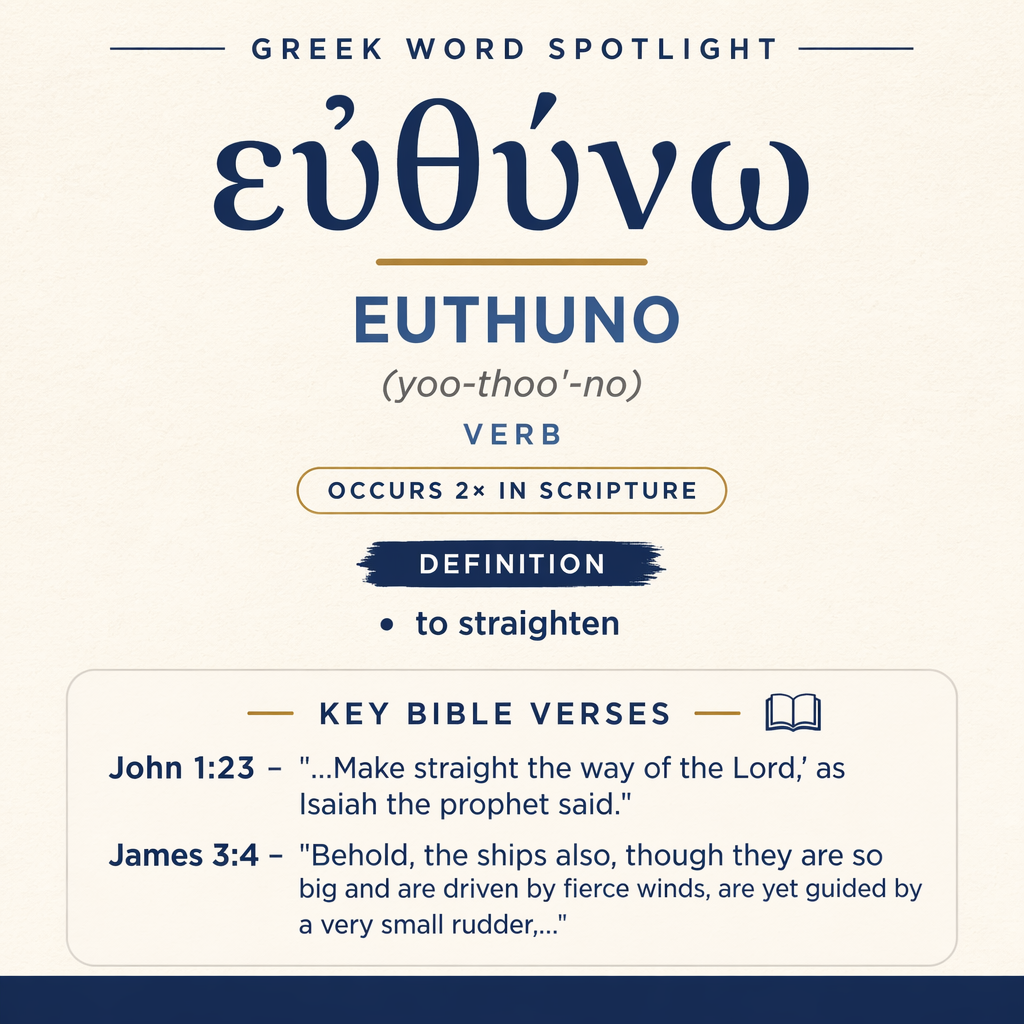
εὐθύνω means “to straighten” and occurs twice in Scripture: John 1:23 and James 3:4.
Scripture Occurrences
This word occurs 2 times in Scripture. It appears in John 1:23 and James 3:4.
Learn More →Usage in Context
In John 1:23 it is used in the call, “Make straight the way of the Lord.” In James 3:4 it is used of guiding large ships with a small rudder.
Learn More →εὐθύνω means “to straighten.” It appears in the call to prepare “the way of the Lord” and in a picture of how a ship is guided toward a chosen course.
Root and Related Words
εὐθύνω is related to euthys (εὐθύς), meaning “Straight” (Strong’s G2117).

Occurrences
“He said, “I am the voice of one crying in the wilderness, ‘Make straight the way of the Lord,’ as Isaiah the prophet said.”” (John 1:23)
Here εὐθύνω supplies the imperative force of a public summons: “Make straight.” The quoted line presents “the way of the Lord” as something that can be acted upon—addressed, prepared, and set into a condition described as straight. In the immediate wording, the action is directed toward a “way,” not toward a person, so the verb frames the response to the “voice” as practical preparation rather than mere announcement. The setting “in the wilderness” sharpens the imagery: a “way” in such a place would call for intentional clearing and alignment, and the command “Make straight” expresses the goal for that preparation in a single, pointed instruction.
The verse also places the verb within a chain of testimony: the speaker identifies himself as “the voice,” and the command is anchored by the clause “as Isaiah the prophet said.” In that scene, εὐθύνω does not stand alone as a generic instruction; it functions as the central verbal demand that the “voice” is commissioned to cry out. The straightening is what the proclamation aims to produce in relation to the Lord’s way.
“Behold, the ships also, though they are so big and are driven by fierce winds, are yet guided by a very small rudder, wherever the pilot desires.” (James 3:4)
In this illustration, εὐθύνω belongs to the description of directional control. The verse contrasts the size and vulnerability of ships (“so big,” “driven by fierce winds”) with the surprising effectiveness of a “very small rudder.” The guiding described is not aimless drift; it is movement that can be set in line with intention: “wherever the pilot desires.” In that context, εὐθύνω contributes the idea of bringing the ship’s course into a straightened, directed path under governance, despite external pressures that would push it off course.
The image is dynamic. The ship is already in motion, winds are already active, and yet the rudder’s action results in guidance that corresponds to the pilot’s will. εὐθύνω therefore fits a scene where straightening is not merely initial preparation but ongoing steering—keeping a moving object aligned toward a chosen direction as conditions buffet it. The verse highlights how small means can effect decisive directional outcome.
Sense and Usage
Across these two passages, “to straighten” is applied to two different but related domains: a “way” that is to be made straight, and a course that is kept straight through guidance. In John 1:23, the straightening is presented as preparatory work on a “way.” The verb targets the condition of that way—its readiness and alignment for the Lord—so that what lies ahead is approached on a straight path rather than a crooked or obstructed one. The command form (“Make straight”) compresses the whole response into a single directive: the appropriate posture toward the Lord’s coming is expressed as straightening the route associated with him.
In James 3:4, straightening is expressed through the idea of guidance. The ship is large and subject to “fierce winds,” but the rudder enables it to be directed in accordance with the pilot’s desire. The concept of straightening here is not static but corrective and continuous: the ship’s movement can be brought into line—straightened toward a destination or intention—through a controlling instrument. The verse makes the straightening vivid by contrasting the magnitude of the vessel and the strength of the winds with the smallness of the rudder. The action implied is precise: a small adjustment at the rudder results in a decisive alignment of the ship’s path.
These two uses together show that εὐθύνω can speak both to the shaping of a route ahead (a “way” prepared to be straight) and to the directing of movement along a route (a ship guided in the line the pilot wants). The shared feature is an orientation toward a definite direction: straightening is purposive, aiming at an ordered path rather than random motion. John’s setting emphasizes readiness for the Lord; James’s setting emphasizes control amid opposing forces. In each case, the verb portrays straightness as something brought about—whether by preparing a way or by steering a course.
Imagery
The imagery carried by εὐθύνω in these texts is strongly spatial. John 1:23 places the word in the open landscape of “the wilderness,” where a “way” becomes the central object of attention and straightening names the work that makes the way fit for the Lord. James 3:4 places the word on open waters, where the ship’s path must be held true despite “fierce winds,” and straightening is pictured as guidance accomplished by a small rudder toward the pilot’s chosen direction.
Sources: Lexical data from Strong’s Exhaustive Concordance and the Translators Brief Lexicon of Extended Strongs for Greek (STEPBible, CC BY). Occurrence data from the Translators Amalgamated Greek New Testament (STEPBible, CC BY). Scripture quotations from the World English Bible (public domain).