Exploring the Meaning of Ereo in Greek
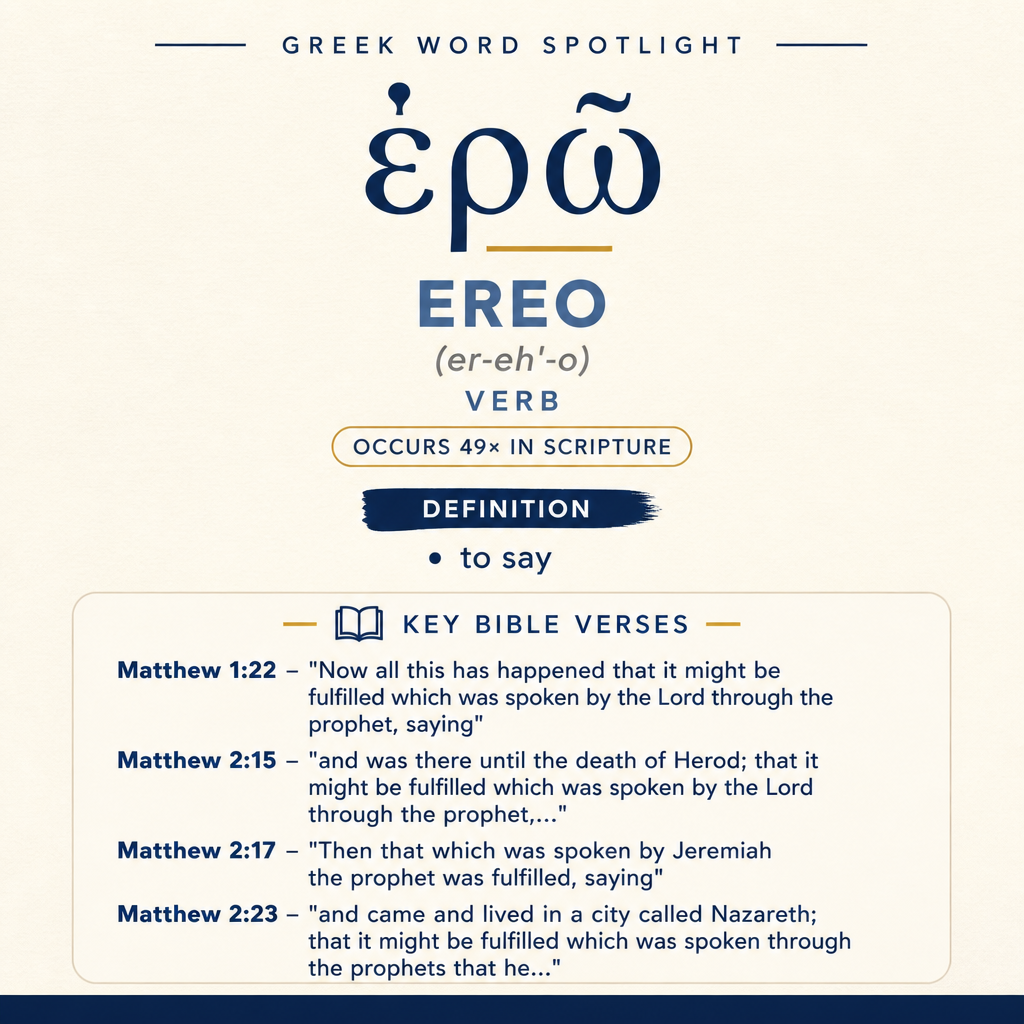
ἐρῶ means “to say” and occurs 49 times in Scripture, including Matthew 1:22; 2:15,17,23; 3:3; 4:14; 5:21,27.
Matthew Examples
It appears in fulfillment and quotation contexts in Matthew 1:22; 2:15,17,23; 3:3; 4:14; 5:21,27.
Learn More →ἐρῶ means “to say.” In the passages quoted here it functions as a speech-introducing verb, linking events and teachings to what is spoken—whether by “the Lord through the prophet,” by named prophets, or in remembered formulations such as “You have heard that it was said.”
Occurrences
Matthew 1:22 — “Now all this has happened that it might be fulfilled which was spoken by the Lord through the prophet, saying,”
Here ἐρῶ frames the fulfillment claim by introducing what is “spoken.” The verse presents the narrated events (“all this has happened”) as corresponding to prior divine speech mediated “through the prophet,” and “saying” signals that a specific utterance is about to be quoted as the content that fulfillment answers.
Matthew 2:15 — “and was there until the death of Herod; that it might be fulfilled which was spoken by the Lord through the prophet, saying, “Out of Egypt I called my son.””
In this setting ἐρῶ again introduces a quoted utterance, but now the content is supplied within the same verse. The narrative (“was there until the death of Herod”) is presented as matching what was “spoken by the Lord through the prophet,” and “saying” marks the quoted line as the speech whose wording is treated as fulfilled by the child’s location and return.
Matthew 2:17 — “Then that which was spoken by Jeremiah the prophet was fulfilled, saying,”
ἐρῶ functions as the hinge between fulfillment and quotation. The verse specifies the human messenger (“Jeremiah the prophet”) and asserts that what he “spoke” has come to fulfillment; “saying” indicates that the narrative is about to reproduce the particular words whose “saying” is now realized in the present circumstances.
Matthew 2:23 — “and came and lived in a city called Nazareth; that it might be fulfilled which was spoken through the prophets that he will be called a Nazarene.”
Although “saying” is not printed here, the same speech function is present in the clause “which was spoken through the prophets.” ἐρῶ contributes the idea of voiced or articulated proclamation as the basis for the fulfillment claim: the move to “a city called Nazareth” is narrated as corresponding to what was “spoken,” with the reported speech-content given as “that he will be called a Nazarene.”
Matthew 3:3 — “For this is he who was spoken of by Isaiah the prophet, saying, “The voice of one crying in the wilderness, make the way of the Lord ready! Make his paths straight!””
In Matthew 3:3 ἐρῶ introduces a prophetic description tied to a present person (“this is he”). “Was spoken of by Isaiah the prophet” places the emphasis on prior speech about someone, and “saying” opens the direct quotation. The quoted cry and commands (“make the way… Make his paths straight!”) are presented as the content of that saying, now identified with the figure in view.
Matthew 4:14 — “that it might be fulfilled which was spoken through Isaiah the prophet, saying,”
Here ἐρῶ serves the familiar fulfillment-and-quotation structure. The verse points forward to a prophetic utterance (mediated “through Isaiah the prophet”), and “saying” signals that the narrative will provide the verbal content. The verb keeps the emphasis on spoken formulation: fulfillment is anchored in what has been said.
Matthew 5:21 — ““You have heard that it was said to the ancient ones, ‘You shall not murder;’ and ‘Whoever murders will be in danger of the judgment.’”
In this teaching context, ἐρῶ appears in the passive pattern “it was said,” with the audience addressed as those who “have heard.” The verb connects present hearing to a prior act of saying directed “to the ancient ones,” and it introduces the specific prohibitions and warning that follow. The force of the line depends on speech as transmission: what is heard is what was said.
Matthew 5:27 — ““You have heard that it was said, ‘You shall not commit adultery;’”
Again ἐρῶ functions in “it was said,” introducing a remembered formulation. The emphasis is on the audience’s reception (“You have heard”) of an earlier saying; the content introduced by the verb is the command itself. The scene treats the command as a fixed saying that can be cited as a known point of reference.
Matthew 5:31 — ““It was also said, ‘Whoever shall put away his wife, let him give her a writing of divorce,’”
Here ἐρῶ introduces an additional cited statement (“also said”), keeping the discussion in the realm of what has been verbally formulated and handed down. The saying’s content is a conditional instruction about divorcing and documentation, and the verb presents it as an established utterance being brought into the conversation.
Matthew 5:33 — ““Again you have heard that it was said to the ancient ones, ‘You shall not make false vows, but shall perform to the Lord your vows,’”
In Matthew 5:33, ἐρῶ anchors the teaching in heard tradition: “you have heard that it was said.” The inclusion of “to the ancient ones” again highlights an earlier audience for the speech, and the content of the saying concerns vows—both prohibition (“shall not make false vows”) and obligation (“shall perform to the Lord your vows”). The verb sets the command in the category of articulated instruction.
Matthew 5:38 — ““You have heard that it was said, ‘An eye for an eye, and a tooth for a tooth.’”
Here ἐρῶ introduces a succinct, proverbial-sounding formulation. “You have heard” places it in the realm of received instruction, and “it was said” emphasizes that it circulates as a statement whose authority and meaning are connected to its being spoken. The saying’s compact parallelism is presented as something known by hearing.
Matthew 5:43 — ““You have heard that it was said, ‘You shall love your neighbor and hate your enemy.’”
In Matthew 5:43, ἐρῶ again introduces a heard saying, presented as a two-part directive. The verb highlights the form of the material as a spoken or quotable statement: it is something that “was said” and therefore something that can be appealed to as familiar. The pairing of commands is carried into the present discussion through the act of citing what was said.

Sense and Usage
Across these passages ἐρῶ consistently carries the basic function of introducing speech, whether as direct quotation (“saying, ‘Out of Egypt I called my son.’”) or as a reported description (“which was spoken through the prophets that he will be called a Nazarene”). Two main discourse settings appear.
First, in the fulfillment formulas (Matthew 1:22; 2:15; 2:17; 2:23; 3:3; 4:14), ἐρῶ ties narrated events to prior utterance. The repeated pattern “that it might be fulfilled which was spoken…” makes speech the vehicle of prophetic expectation: fulfillment is not merely correspondence to an idea, but correspondence to something articulated. Even when the messenger varies (“the Lord through the prophet,” “Jeremiah the prophet,” “Isaiah the prophet,” “through the prophets”), the verb keeps the focus on the act of saying as the decisive link between earlier proclamation and later events.
Second, in the Sermon on the Mount citations (Matthew 5:21; 5:27; 5:31; 5:33; 5:38; 5:43), ἐρῶ appears in the passive (“it was said”), joined to verbs of hearing (“You have heard”). This pairing underscores the oral/aural pathway by which authoritative instruction is known: what is “said” becomes what is “heard.” The passive construction also leaves the speaker in the background and foregrounds the sayings as received formulations, introduced as discrete units of speech that can be quoted and weighed in instruction.
In both settings, ἐρῶ does more than signal that words exist; it places weight on the communicative act itself. The fulfillment statements lean on the reliability and specificity of what has been spoken, while the teaching statements treat what was said as publicly circulating and recognizable. The verb thus serves as a bridge: from divine or prophetic speech to narrative fulfillment, and from inherited sayings to present moral and communal instruction.
Imagery
The repeated “saying” formulas create a picture of words that travel across time: uttered through prophets, heard by audiences, and then encountered again as quotations in new moments. In these verses, spoken words are not fleeting; they stand ready to be cited (“it was said”) and to find their matching reality (“that it might be fulfilled which was spoken…”).
Sources: Lexical data from Strong’s Exhaustive Concordance and the Translators Brief Lexicon of Extended Strongs for Greek (STEPBible, CC BY). Occurrence data from the Translators Amalgamated Greek New Testament (STEPBible, CC BY). Scripture quotations from the World English Bible (public domain).