
Exploring the Meaning of Epipothia in Greek
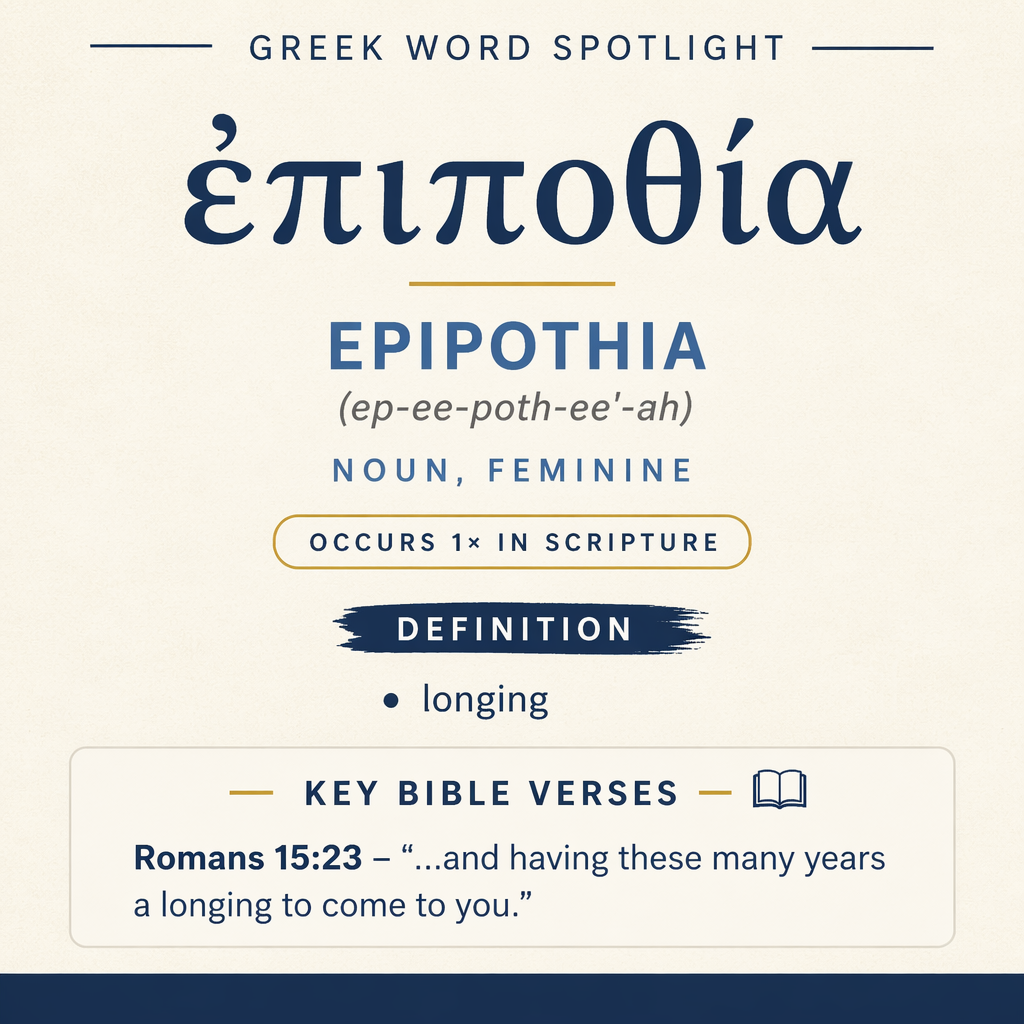
ἐπιποθία means “longing” and appears once in Scripture, in Romans 15:23.
Biblical Occurrence
It occurs 1 time in Scripture. The occurrence is in Romans 15:23.
Learn More →ἐπιποθία names a “longing,” and it appears once, in Paul’s letter to the Romans. In that single use it expresses a sustained inner desire that has endured over many years and is now poised to be acted upon.
Root and Related Words
ἐπιποθία is related to the verb epipotheō (ἐπιποθέω), “to long for” (Strong’s G1971). The noun presents the desire as a thing possessed (“a longing”), while the related verb expresses the act of longing.

Occurrences
Romans 15:23 — “but now, no longer having any place in these regions, and having these many years a longing to come to you,”
Here ἐπιποθία is embedded in Paul’s explanation of changed circumstances and long-standing intent. The sentence begins with “but now,” setting a contrast between the past and the present moment. Paul describes a shift in his situation: “no longer having any place in these regions.” Within this frame, ἐπιποθία is not a fleeting wish but something carried “these many years.” The word gives weight to the duration of the desire and ties it to a concrete object: “to come to you.” In context, the longing is relational and directional—aimed toward the Roman believers—and it functions as part of a larger rationale: with his work in those regions no longer requiring his presence, the long-held desire can move toward fulfillment. The noun phrasing “having … a longing” portrays the desire as an enduring inner reality that has accompanied him over time, now surfacing explicitly as he speaks of travel and opportunity.

Sense and Usage
In Romans 15:23, “longing” is portrayed as both persistent and purpose-oriented. It is persistent because it is measured in years: Paul has “these many years” carried this desire, suggesting a steady, continuing pull rather than a momentary impulse. It is purpose-oriented because it is attached to a specific action—“to come to you.” The longing is therefore not mere sentiment; it is an inward drive with a defined endpoint. The surrounding clauses sharpen its shape: the longing is voiced at the moment when obstacles or competing obligations have shifted (“no longer having any place in these regions”). This places the noun in the sphere of intention and planning as well as affection: the desire is personal, yet expressed in the language of movement and availability.
The construction also highlights how ἐπιποθία can function rhetorically. By locating the longing “these many years” in the past while speaking from a “but now” present, Paul uses the word to connect history with immediacy. It gives the reader a sense of continuity—this is not a new idea introduced for convenience, but a longstanding desire that predates the current opening. In that way, ἐπιποθία serves to establish sincerity and constancy: it anchors Paul’s proposed coming in a desire that has been present across time, not created on the spot by changed circumstances.
Within the single attestation, the noun also carries an interpersonal tone. The object of the longing is not an abstract goal but “you,” addressed directly. The word thus participates in the relational fabric of the passage: it expresses inward yearning toward a community, stated in a way that invites the audience to perceive themselves as desired and remembered over time. Even though the sentence is brief, ἐπιποθία contributes a strong personal motive alongside the practical note of geography and ministry scope (“these regions”).
Imagery
The imagery evoked by ἐπιποθία in Romans 15:23 is the pull of distance closing into approach. “These many years” suggests time stretched out like a road not yet traveled, while “to come to you” sets a destination. Against the backdrop of “no longer having any place in these regions,” the longing reads like a long-held intention finally meeting an open path—an inward desire aligned with an outward opportunity to move toward the people addressed.
Sources: Lexical data from Strong’s Exhaustive Concordance and the Translators Brief Lexicon of Extended Strongs for Greek (STEPBible, CC BY). Occurrence data from the Translators Amalgamated Greek New Testament (STEPBible, CC BY). Scripture quotations from the World English Bible (public domain).





