Exploring the Meaning of Exoudenoo in Greek
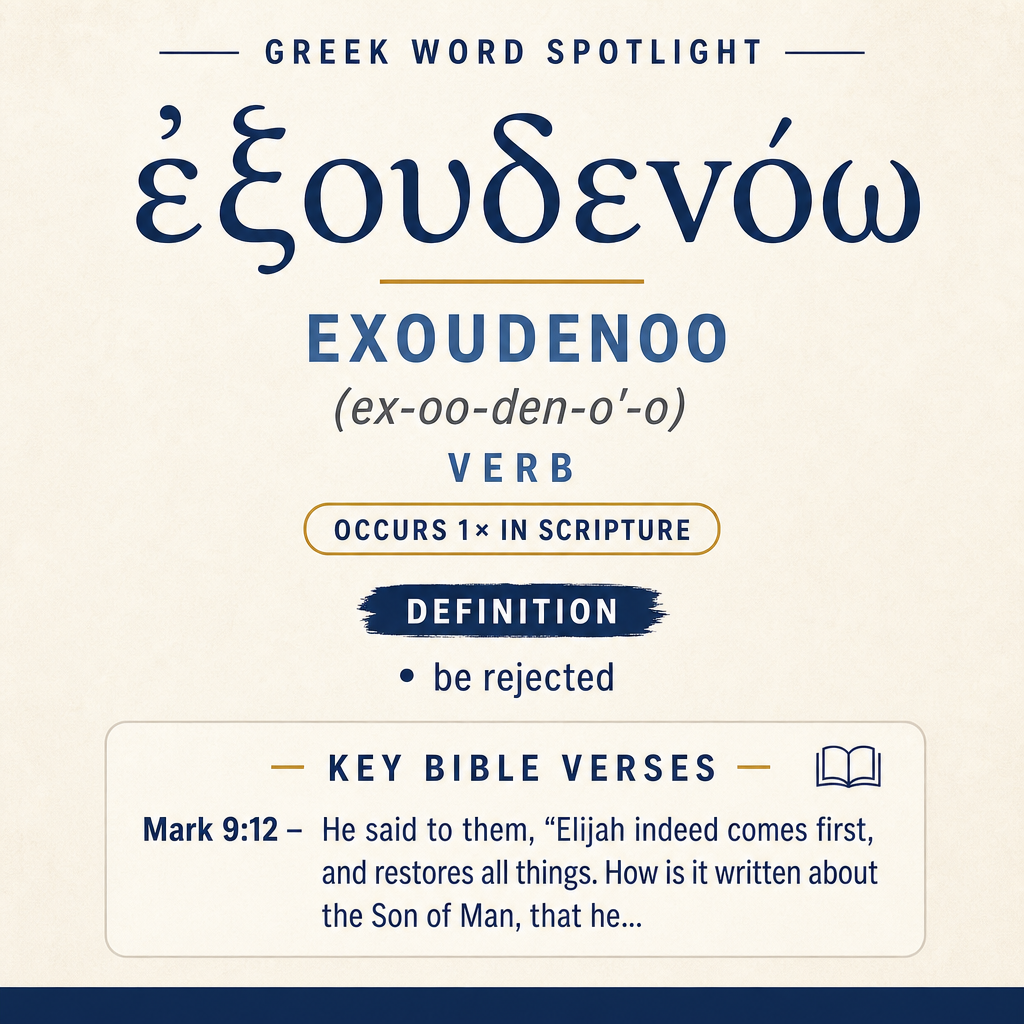
ἐξουδενόω means “be rejected” and appears once in Scripture, in Mark 9:12.
Mark Context
Its single occurrence is in Mark 9:12, within Jesus’ statement about Elijah and what is written about the Son of Man.
Learn More →ἐξουδενόω means “be rejected,” and it appears in the saying of Jesus about the Son of Man in Mark 9:12. In that setting it belongs to a cluster of expectations: restoration, suffering, and rejection.
Root and Related Words
ἐξουδενόω is linked with ἐκ (ek), “out from” (Strong’s G1537), and οὐδείς (oudeis), “none” (Strong’s G3762). Read together, these related elements point to a way of speaking in which someone is treated as if counted “out” or as “none,” which coheres with the idea of rejection.

Occurrences
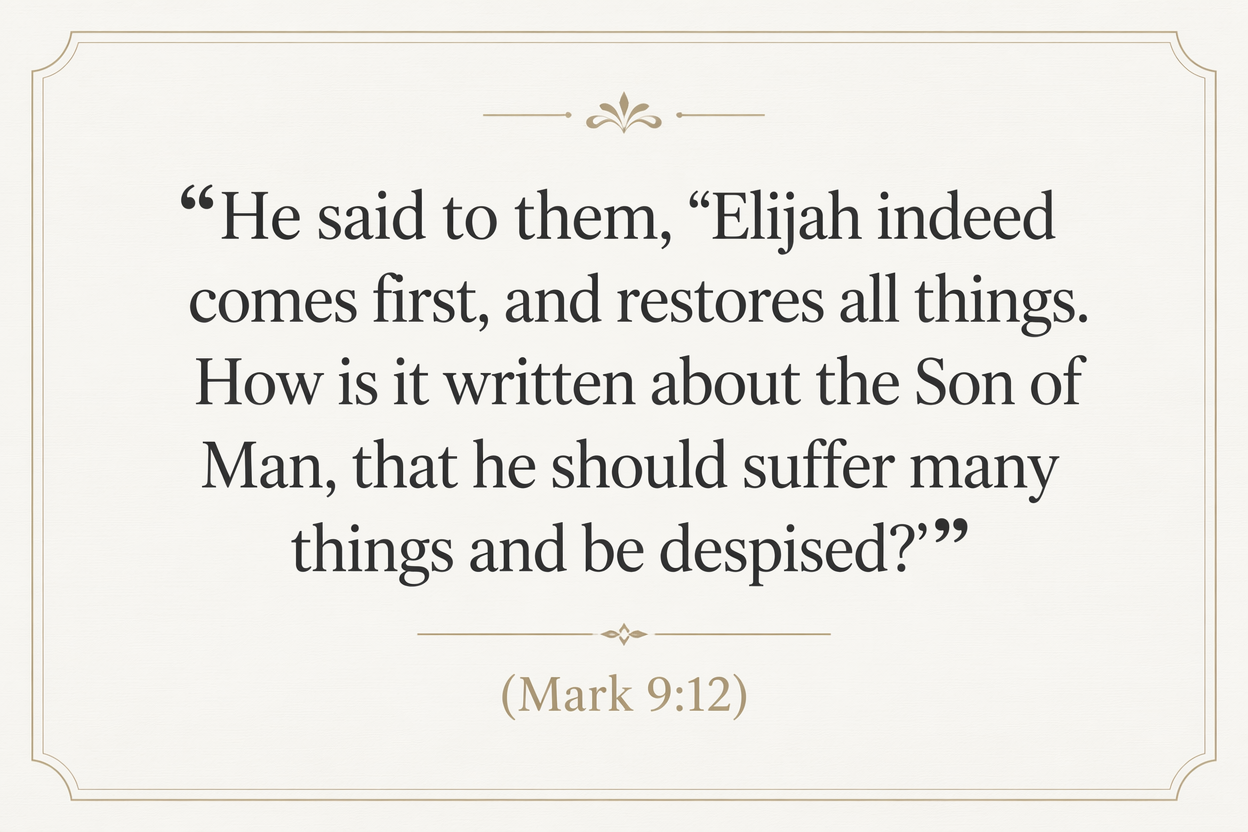
“He said to them, “Elijah indeed comes first, and restores all things. How is it written about the Son of Man, that he should suffer many things and be despised?”” (Mark 9:12)
Here ἐξουδενόω (rendered “be despised” in the quotation) functions as the social counterpart to the physical and experiential weight of “suffer many things.” Jesus frames the point as something already “written about the Son of Man,” placing rejection alongside suffering as part of a recognized script rather than a surprise turn in the story. The verb presents rejection as something that happens to the Son of Man—an act imposed from outside rather than a choice arising from him.
The immediate context within the sentence pairs two questions: one about Elijah’s coming and restoring, and another about what is written regarding the Son of Man. Within that parallel, rejection is not presented as a mere emotional reaction (“people felt negatively”), but as an identifiable outcome that stands in tension with “restores all things.” In other words, the statement holds together two threads: an expectation of restoration and an expectation that the Son of Man will meet rejection even while the broader hope of restoration is in view.
The verb’s placement at the end of the clause gives it rhetorical punch. After “suffer many things,” the added “and be despised” intensifies the portrayal: the Son of Man is not only afflicted but also treated in a way that excludes honor and acceptance. Within the line of thought, rejection becomes part of the “written” description of his path, anchoring the disciples’ discussion in what is portrayed as a settled pattern rather than an improvisation.
Sense and Usage
In Mark 9:12, “be rejected” describes an experience of being treated as unacceptable—an action directed toward the Son of Man. The saying does not isolate rejection as the only feature of his mission; it is joined to “suffer many things,” so the reader is invited to hear rejection as a concrete feature of his ordeal rather than a minor side detail. Because the statement is cast in the passive (“that he should…be despised”), it foregrounds the reality that rejection is something done to him, situating the Son of Man under the pressure of others’ judgment and response.
The verse also sets rejection within an interpretive frame: “How is it written…?” Rejection is not introduced as a random social misfortune but as something the disciples are meant to recognize as fitting within what is “written about the Son of Man.” In this way, ἐξουδενόω contributes to the logic of the conversation: restoration is affirmed, yet the path toward what is written includes suffering and rejection. The verb helps express the contradiction the disciples must face—anticipated restoration does not eliminate the reality that the Son of Man is met with rejection.
Because the same clause contains both suffering and rejection, the sense carries a public dimension. Suffering can occur in many forms, but rejection—especially when it is highlighted as a predicted feature—implies a relational and communal response: the Son of Man is not received on his own terms. The verb therefore describes more than inner discouragement; it marks the Son of Man as one who is pushed aside in the eyes of those around him, treated as unworthy of the reception his identity might otherwise suggest.
Imagery
The imagery of ἐξουδενόω in Mark 9:12 is the image of a figure moving toward a course that includes both pain (“suffer many things”) and social dismissal (“be despised”). In a single sentence, the Son of Man is portrayed as one whose suffering is compounded by rejection, making the coming ordeal not only hard but also isolating in the way it is received by others.
Sources: Lexical data from Strong’s Exhaustive Concordance and the Translators Brief Lexicon of Extended Strongs for Greek (STEPBible, CC BY). Occurrence data from the Translators Amalgamated Greek New Testament (STEPBible, CC BY). Scripture quotations from the World English Bible (public domain).