
Exploring the Meaning of Hexis in Greek
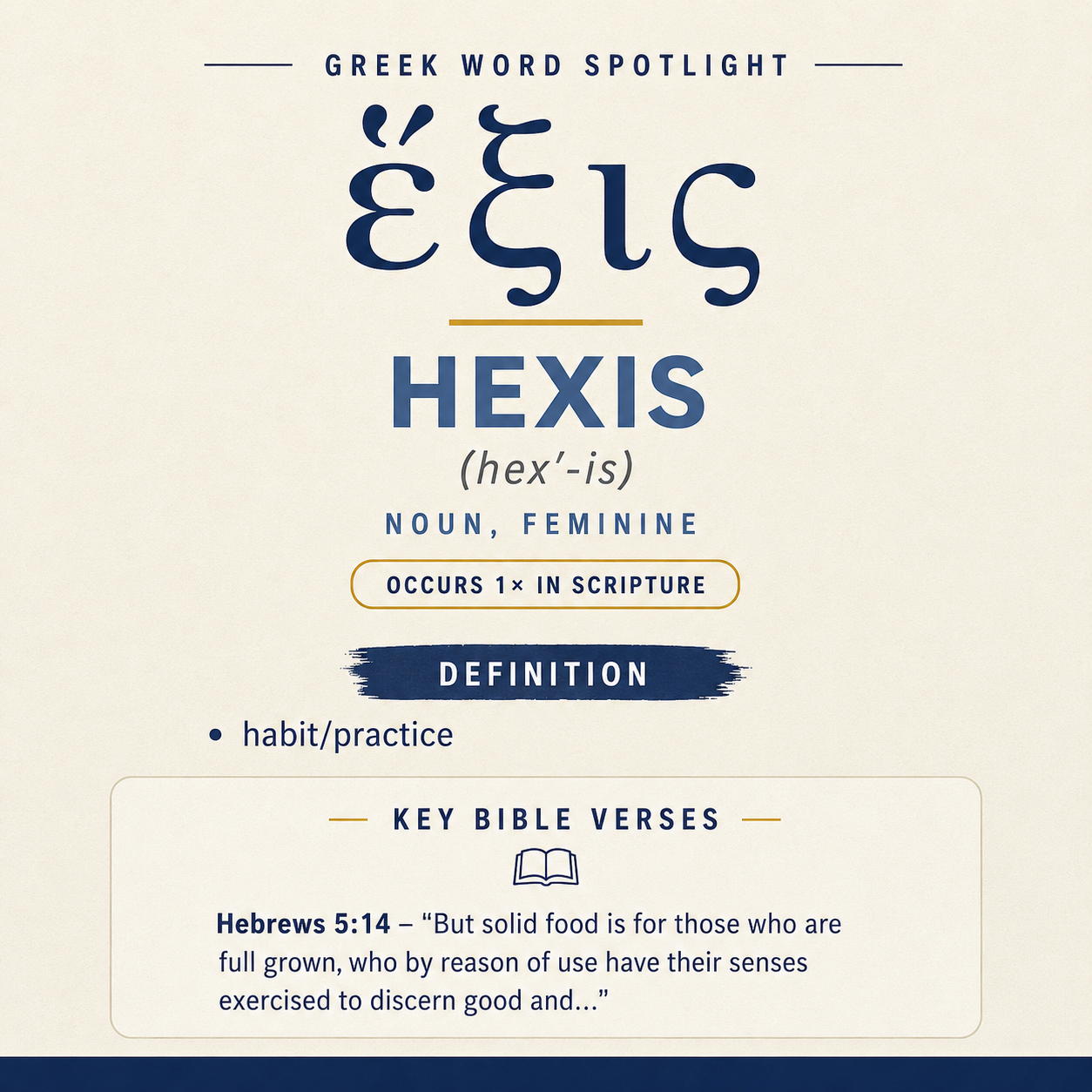
ἕξις means habit/practice and appears once in Scripture, in Hebrews 5:14.
Scripture Occurrence
ἕξις occurs 1 time in Scripture. Its occurrence is in Hebrews 5:14.
Learn More →Verse Context
In Hebrews 5:14, it is connected with being "full grown" and "by reason of use" having senses exercised to discern good and evil.
Learn More →ἕξις means “habit/practice” and appears in the New Testament in Hebrews 5:14. In that setting it describes a settled pattern formed through repeated use, the kind of practice that trains perception.
Root and Related Words
ἕξις (Hexis) derives from echo (ἔχω), “to have/be” (Strong’s G2192). The relationship suggests a term that speaks of something possessed or held as an established condition rather than a momentary impulse.

Occurrences
“But solid food is for those who are full grown, who by reason of use have their senses exercised to discern good and evil.” (Hebrews 5:14)
In Hebrews 5:14, the author contrasts “solid food” with what precedes it in the sentence: maturity (“those who are full grown”) and trained perception (“have their senses exercised”). Within this description, ἕξις functions with the phrase “by reason of use” to explain how such maturity develops. It is not presented as an innate trait that simply arrives with time; rather, it is framed as the outcome of practice—use that is repeated enough to become habitual.

The immediate result of this habitual practice is that “their senses” are “exercised.” The imagery is concrete: the senses are treated as faculties that can be trained. In this verse, ἕξις anchors that training in ongoing action. The phrase “by reason of use” points to a pattern of engagement—consistent practice—that produces an exercised condition. The goal of this exercise is stated explicitly: “to discern good and evil.” Thus ἕξις contributes the idea that discernment is sharpened through habitual practice; it is tied to repeated use that disciplines the perceptive powers.
The verse also places this practice within the broader metaphor of eating. “Solid food” belongs to the mature, and maturity is connected to trained discernment. In that flow of thought, ἕξις helps explain why “solid food” fits the mature: their habitual practice has produced an exercised capacity to recognize and distinguish. The word therefore supports a movement from repeated “use” to an “exercised” condition, and from that condition to the ability “to discern good and evil.”
Sense and Usage
The definition “habit/practice” fits Hebrews 5:14 as a description of an established, repeated pattern that shapes capability. The verse does not depict practice as a single act of “use,” but as use that becomes characteristic—use with staying power. In ordinary terms, a habit is not merely something done once; it is something done often enough that it marks a person’s customary way of acting. Hebrews 5:14 places that habitual element at the center of growth: mature people are recognizable not only by what they can receive (“solid food”) but by what has been formed in them through sustained practice.
Within the sentence, the logic moves from identity (“those who are full grown”) to means (“by reason of use”) to effect (“have their senses exercised”) to purpose (“to discern good and evil”). ἕξις belongs to the “means” portion of the chain. The word supports the idea that discernment is not disconnected from regular conduct; rather, it is cultivated through practice. The verse’s language of “senses” and “exercised” implies a process of training that requires repetition, and ἕξις supplies the habitual aspect of that repetition.
Because the verse ties this habitual practice directly to discernment, ἕξις here has an evaluative context: the practice is oriented toward distinguishing “good and evil.” The word itself denotes “habit/practice,” but in this setting the practice is not vague or undefined. It is linked to the exercising of perception in a moral arena—discernment that distinguishes between two opposed categories named in the verse. That connection shows how “habit/practice” can function as a formative force: repeated use does not merely produce familiarity; it produces trained judgment.
The metaphor of food also shapes how the sense is heard. “Solid food” implies something requiring developed capacity to take in and handle. In the verse, the capacity is the ability to discern, and the path to that capacity is habitual practice. ἕξις thus carries an implied durability: it suggests a stable pattern that has been “had” over time, consistent with its derivation from ἔχω (“to have/be”). The practice is something held as part of one’s condition, resulting in senses that are not raw or untrained but “exercised.”
In Hebrews 5:14, then, ἕξις is not an abstract statement about practice in general; it is practice as a repeated course of action that produces an exercised state. The verse presents maturity as a lived outcome: those who are full grown are those whose habitual use has trained their perceptive faculties. The definition “habit/practice” captures the key force of the word in this verse—an ongoing pattern of use that forms discernment.
Imagery
The verse’s imagery is bodily and experiential: “solid food,” “senses,” and “exercised.” In that picture, ἕξις adds the feel of repetition—practice that becomes customary—so that discernment is portrayed less like a sudden insight and more like a trained capacity built by continual use.
Sources: Lexical data from Strong’s Exhaustive Concordance and the Translators Brief Lexicon of Extended Strongs for Greek (STEPBible, CC BY). Occurrence data from the Translators Amalgamated Greek New Testament (STEPBible, CC BY). Scripture quotations from the World English Bible (public domain).





