Exploring the Meaning of Exaggello in Greek
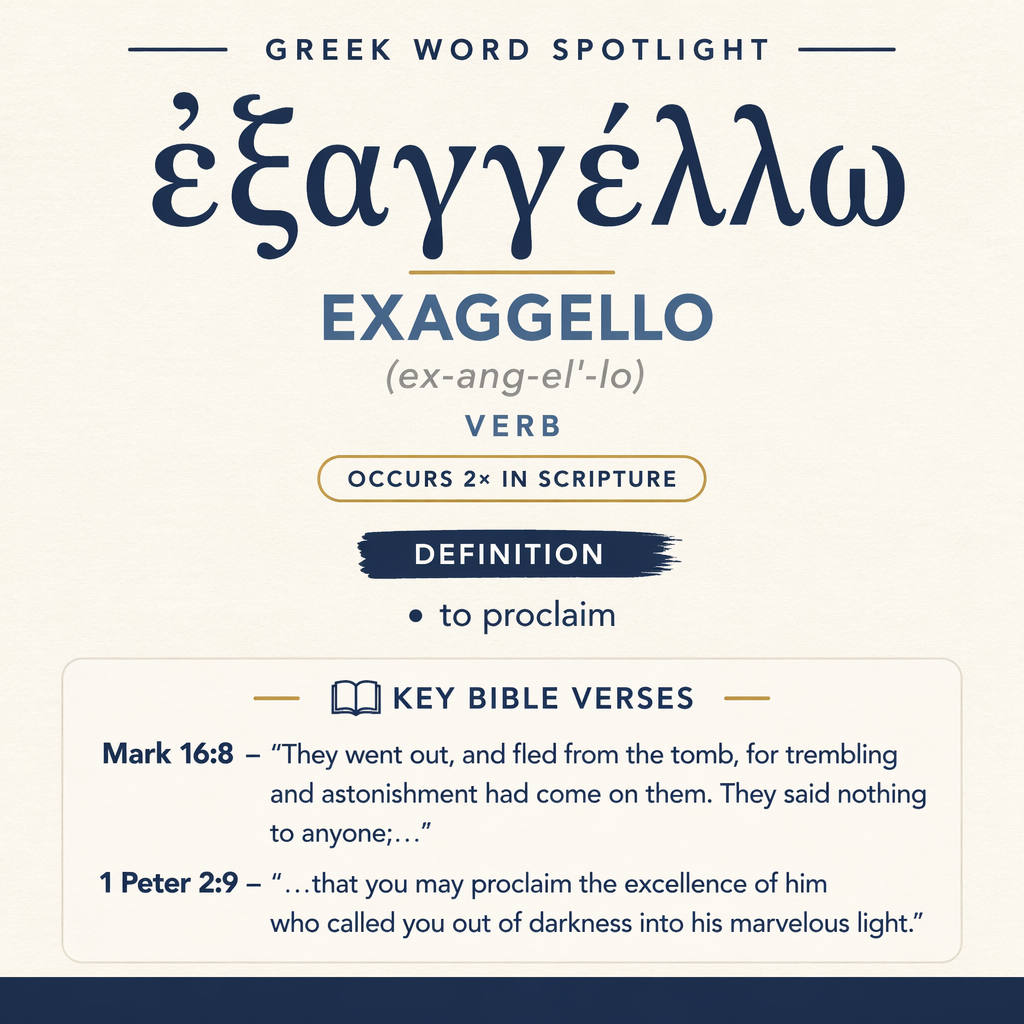
ἐξαγγέλλω means “to proclaim” and occurs twice in Scripture, in Mark 16:8 and 1 Peter 2:9.
Scripture Occurrences
It occurs 2 times in Scripture. The references given are Mark 16:8 and 1 Peter 2:9.
Learn More →Verse Context
In 1 Peter 2:9 it appears in the phrase “that you may proclaim.” Mark 16:8 is listed among its occurrences.
Learn More →ἐξαγγέλλω means “to proclaim” and appears in two New Testament passages: Mark 16:8 and 1 Peter 2:9. In both settings, the word belongs to the public voicing of a message, whether withheld in fear or urged as a fitting response to God’s calling.
Root and Related Words
ἐξαγγέλλω is connected with ek (ἐκ), “out from” (Strong’s G1537), and angelos (ἄγγελος), “angel” (Strong’s G32). The first element contributes the directional idea “out from,” and the second names a “messenger,” situating the verb in the sphere of outward communication.

Occurrences
“They went out, and fled from the tomb, for trembling and astonishment had come on them. They said nothing to anyone; for they were afraid.” (Mark 16:8)
This scene is dominated by movement and emotion: the women “went out” and “fled,” overwhelmed by “trembling and astonishment.” The narrative then places speech in stark negative terms—“They said nothing to anyone”—and gives the reason: “for they were afraid.” In this context, ἐξαγγέλλω functions in the space of what could have been spoken publicly but was not. The emphasis falls on a message that remains unvoiced, not because of a lack of content, but because fear closes the mouth. The verse presents the tomb as the setting from which news might naturally be carried outward, yet the immediate human reaction is silence; proclamation is the unrealized outcome against which the women’s fear is measured.
The wording also intensifies the social direction of speech. “Nothing to anyone” frames communication as something that moves from speaker to audience, from the witnesses to the wider circle beyond them. The verb’s idea of proclamation suits a setting where the very point of speaking would be to make what has happened known beyond the immediate witnesses. Mark 16:8 therefore portrays proclamation as vulnerable: it can be interrupted by dread, even when the event behind it is momentous and the witnesses have physically “gone out” from the place where the message originates.
“But you are a chosen race, a royal priesthood, a holy nation, a people for God’s own possession, that you may proclaim the excellence of him who called you out of darkness into his marvelous light.” (1 Peter 2:9)
Here ἐξαγγέλλω stands at the center of the clause of purpose: “that you may proclaim.” Proclamation is not presented as incidental speech but as the stated aim tied to identity. A chain of descriptions—“a chosen race, a royal priesthood, a holy nation, a people for God’s own possession”—builds toward an outward task. The community’s status is described in collective, public terms, and proclamation is the verbal expression that corresponds to that public identity.
The content of what is proclaimed is specified: “the excellence of him who called you out of darkness into his marvelous light.” The verb therefore carries a sense of directed speech that gives voice to the character and action of the one who calls. The surrounding imagery is spatial and perceptual: a call “out of darkness” and into “marvelous light.” Against that backdrop, proclamation becomes a kind of verbal stepping-into-the-light: speech that belongs to the new realm the call has opened. The verse’s structure ties the act of proclaiming to the transition it names—called “out of” one sphere and “into” another—so that proclamation fits as an outward, audible consequence of an inwardly experienced calling.
Unlike Mark 16:8, where fear results in silence, 1 Peter 2:9 describes proclamation as a fitting, expected activity. The subject is plural (“you”), and the aim is communal: proclamation is a shared duty and a shared voice. The verse also suggests an audience beyond the community itself, since “proclaim” naturally implies hearers; the people who have been called are to speak in a way that makes God’s excellence known outwardly.
Sense and Usage
Across these passages, “to proclaim” is shown as a public-facing kind of speech, oriented from witnesses to others. Mark 16:8 places the idea under the shadow of fear: the moment is charged with trembling, and the result is the opposite of proclamation—silence. The verse implies that proclamation would have been the normal outward movement of speech following what occurred at the tomb, yet the human response stalls that movement. In narrative terms, ἐξαγγέλλω is associated with the expected transmission of news from a decisive place and moment to a wider circle, making the silence more striking.
In 1 Peter 2:9, by contrast, proclamation is anchored in identity and purpose. The people described are not merely permitted to speak; their corporate calling is framed so that proclamation is what their new status is for: “that you may proclaim.” The act of proclaiming is not left vague; it is tethered to definite content (“the excellence of him”) and to a definite experience (“called you out of darkness into his marvelous light”). The verb, therefore, is not simply about speaking words but about voicing a message that corresponds to God’s action and character, and about doing so as the fitting expression of a community marked out as God’s possession.
Taken together, the two occurrences show proclamation as something with both an inner and an outer dimension. It arises from encountering something that evokes strong response—astonishment at the tomb, a call from darkness to light—and it moves outward toward others in speech. Yet the passages also portray how proclamation is conditioned by the speaker’s state: fear can suppress it (Mark), while a settled communal identity and calling can frame it as a defining activity (1 Peter). In both, the idea of proclamation carries an outward trajectory: it is not mere private reflection but speech meant to go beyond the speaker.
Imagery
The two texts surround proclamation with vivid contrasts. Mark 16:8 pairs the tomb and flight with silence—speech that does not emerge because fear dominates the moment. 1 Peter 2:9 pairs proclamation with a movement from “darkness” to “marvelous light,” setting speech in the brightness of what God has done and calling the community’s voice to match that transition. Together they picture proclamation as the outward sound of what has been seen and received, whether delayed by fear or urged forward by a calling into light.
Sources: Lexical data from Strong’s Exhaustive Concordance and the Translators Brief Lexicon of Extended Strongs for Greek (STEPBible, CC BY). Occurrence data from the Translators Amalgamated Greek New Testament (STEPBible, CC BY). Scripture quotations from the World English Bible (public domain).