Exploring the Meaning of Enecho in Greek
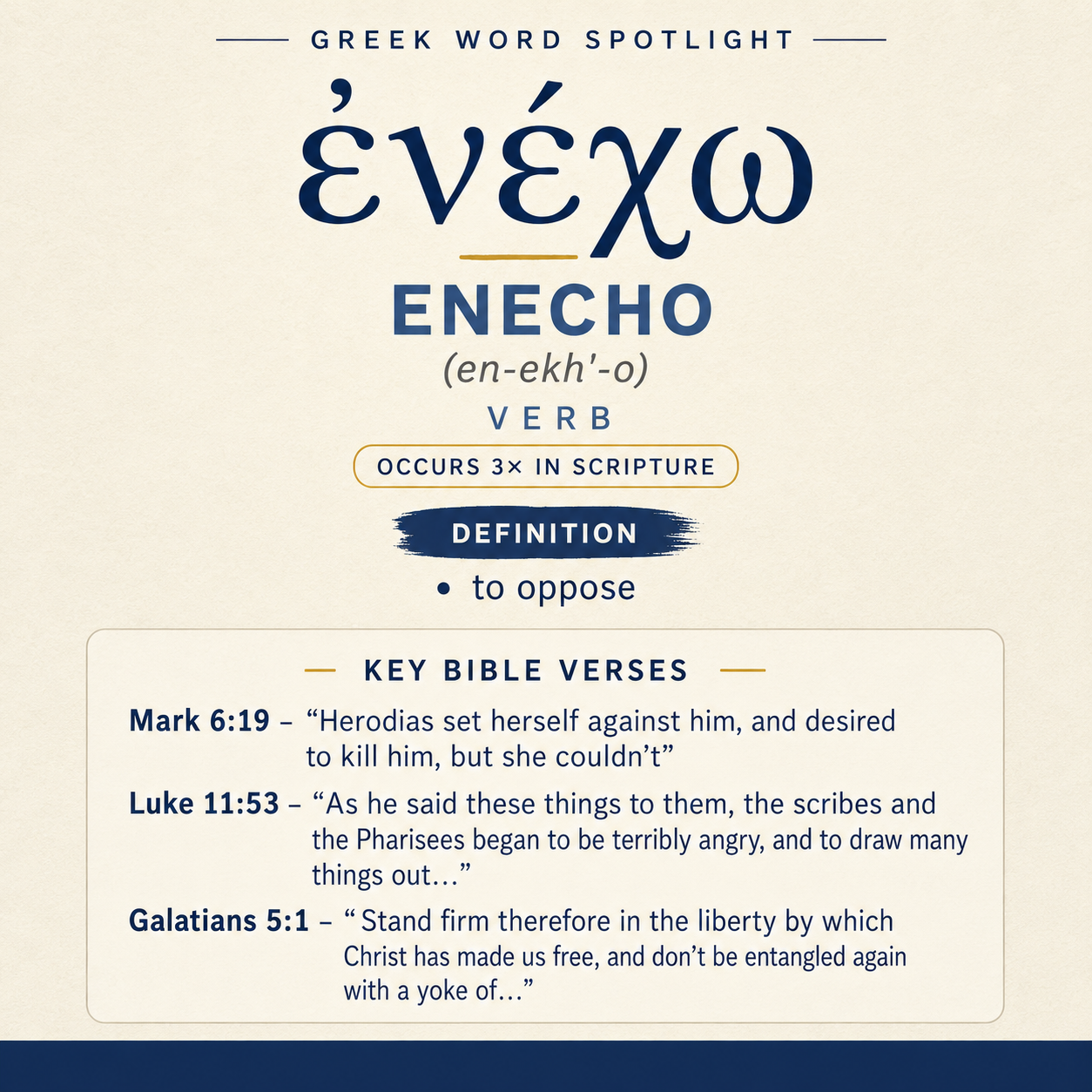
ἐνέχω means “to oppose” and occurs three times in Scripture: Mark 6:19, Luke 11:53, and Galatians 5:1.
Scripture Occurrences
It occurs 3 times in Scripture: Mark 6:19; Luke 11:53; Galatians 5:1.
Learn More →Context Snapshots
In Mark 6:19, Herodias set herself against him and desired to kill him. In Luke 11:53 and Galatians 5:1, the word appears in contexts of strong hostility and entanglement.
Learn More →Enecho means “to oppose.” It appears in scenes of personal hostility (Herodias toward John), escalating antagonism from religious leaders toward Jesus, and a warning against being caught again under bondage.
Root and Related Words
Enecho is connected with en (ἐν), “in/on/among” (Strong’s G1722), and echo (ἔχω), “to have/be” (Strong’s G2192). Together these related forms place the verb within the orbit of “being in” and “having/holding,” language that naturally suits situations where opposition is not merely momentary but is held against someone or pressed upon them.

Occurrences
“Herodias set herself against him, and desired to kill him, but she couldn’t,” (Mark 6:19)
Here Enecho expresses active, sustained opposition in a concrete relationship: Herodias sets herself against “him,” and the following clause (“desired to kill him”) spells out the direction and intensity of that stance. The verb does more than describe dislike; it frames her posture as a fixed adversarial orientation that issues in a lethal intention. The final limitation (“but she couldn’t”) shows that opposition can be real and forceful even when it is frustrated in its outcome. In this setting, Enecho sits at the start of the chain of action: opposition gives rise to desire, and desire seeks an end (killing), even if circumstances prevent it.
“As he said these things to them, the scribes and the Pharisees began to be terribly angry, and to draw many things out of him;” (Luke 11:53)
In Luke’s description, Enecho belongs to a moment where confrontation hardens. The timing (“As he said these things to them”) ties the reaction directly to Jesus’ speech; opposition is triggered and then grows. The verse portrays a combined movement: their emotional state intensifies (“began to be terribly angry”), and their behavior turns probing and adversarial (“to draw many things out of him”). Enecho contributes the sense of resistance and pushback toward the speaker, a stance that shapes how questions are asked and how words are extracted. The scene is not a private grudge but a public antagonism from recognized groups (“the scribes and the Pharisees”), and the verb helps depict opposition as a communal posture that expresses itself through pressure—attempting to elicit “many things” from him, not for learning but as part of the conflict the sentence depicts.
“Stand firm therefore in the liberty by which Christ has made us free, and don’t be entangled again with a yoke of bondage.” (Galatians 5:1)
In Galatians, Enecho appears in exhortation rather than narrative. The command “Stand firm therefore” sets a posture of resistance in the face of a threat, and the threat is pictured as renewed constraint: “don’t be entangled again with a yoke of bondage.” Within this sentence, opposition is directed not at a named person but at a condition that would seize and constrain. The word functions as a call to hold a line: the liberty already granted (“by which Christ has made us free”) is to be maintained against any return to bondage. The imagery of entanglement and yoke places the danger in the realm of being caught and controlled; Enecho thus fits a context where opposition means refusing to come under what would bind. It is a stance meant to protect a present freedom from being overwritten by a fresh enslavement.
Sense and Usage
Across these three passages, Enecho keeps the same core direction: opposition is not neutral disagreement but a posture set against. Mark 6:19 shows it in its most personal and explicit form—one individual turns against another, and the opposition is so settled that it expresses itself as a desire for the other’s death. The verb thereby aligns opposition with intention: what is held against someone is not passive; it seeks an end consistent with its hostility.
Luke 11:53 presents opposition as it gathers momentum in a public religious setting. The verse links inner heat (“terribly angry”) with outward pressure (“to draw many things out of him”), giving opposition both an emotional and a rhetorical profile. Enecho, in such a scene, describes more than a reaction; it marks a relational stance toward “him” that shapes the kind of engagement taking place. Opposition can work through speech, interrogation, and insistence—not necessarily through overt violence, yet still as real resistance aimed at the person.
Galatians 5:1 shifts the domain from interpersonal hostility to resisting a constraining state. The opposition called for is steady (“Stand firm”) and protective, guarding liberty from being replaced by bondage. The wording “don’t be entangled again” implies that the danger is not new in kind—there is an “again” to it—so opposition includes vigilance against a return. In this use, Enecho underscores that opposition can be exercised not only against people who oppose, but against conditions that would take hold. The verse frames such opposition as consistent with freedom already received: the stance is not to achieve liberty but to remain in it.
Taken together, these occurrences show Enecho operating wherever a person or group sets itself against another, or where a community is urged to set itself against a threat of renewed constraint. The verb readily fits situations where opposition is sustained rather than momentary: Herodias’ settled enmity, leaders’ escalating antagonism, and a community’s steadfast refusal to be taken back into bondage.
Imagery
The passages attach vivid textures to opposition. In Mark 6:19, it has the sharp edge of a plotted killing that is nevertheless blocked—opposition with clenched intent but hindered execution. In Luke 11:53, it looks like heat rising in a room and questions pressing in, anger and probing woven together. In Galatians 5:1, the picture becomes bodily and weighty: liberty held fast against cords and a yoke, with the community urged to resist being caught again. Enecho, in these scenes, is opposition as a stance one takes—and one maintains—either against a person or against the forces that would bind.
Sources: Lexical data from Strong’s Exhaustive Concordance and the Translators Brief Lexicon of Extended Strongs for Greek (STEPBible, CC BY). Occurrence data from the Translators Amalgamated Greek New Testament (STEPBible, CC BY). Scripture quotations from the World English Bible (public domain).