Exploring the Meaning of Eneimi in Greek
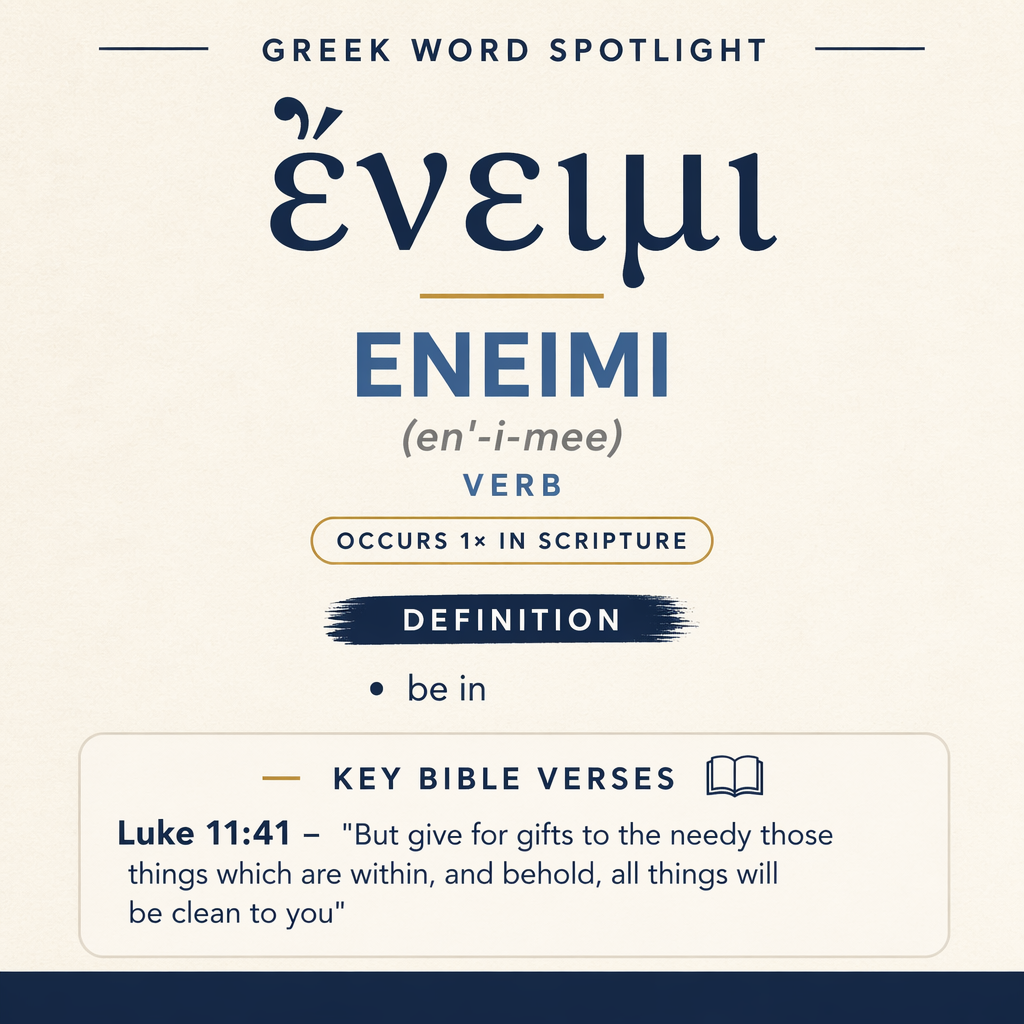
ἔνειμι means “be in” and appears once in Scripture, in Luke 11:41.
Core Meaning
ἔνειμι is defined as “be in.” In Luke 11:41 it relates to “those things which are within.”
Learn More →Scripture Occurrence
This word occurs 1 time in Scripture. The single reference is Luke 11:41.
Learn More →Verse Context
Luke 11:41 says, “give for gifts to the needy those things which are within.” The verse continues, “and behold, all things will be clean to you.”
Learn More →ἔνειμι means “be in” and is attested in the teaching scene recorded in Luke 11:41. In that single setting, it helps express the relation between what is “within” and the cleansing effect described in the verse.
Root and Related Words
ἔνειμι is connected with the verb eimi (εἰμί), “to be” (Strong’s G1510). It is also linked, in derivational notes, with ennomos (ἔννομος), “under law” (Strong’s G1772), another word built on the same basic verb of being.

Occurrences
“But give for gifts to the needy those things which are within, and behold, all things will be clean to you.” (Luke 11:41)
In Luke 11:41, the word serves the line “those things which are within,” locating the relevant “things” as being inside rather than outside. The command is framed as an instruction about giving: the gifts are to come from what is “within,” and the result is expressed in an all-encompassing way—“all things will be clean to you.” The verb’s contribution is to anchor the thought to interiority: the giving envisioned is not merely from what is visible, but from what exists inside, and this interior reference sets the stage for the concluding claim about cleanness.

The verse itself moves in a tight sequence: an imperative (“give”), a specified recipient (“the needy”), an identified source (“those things which are within”), and an outcome introduced with “behold” (“all things will be clean to you”). Within that structure, ἔνειμι supports the source phrase by expressing the reality of being inside. It does not name the “things” in detail; instead, it establishes where they are found—within—and thus shapes how the command is heard: the gifts envisioned arise from internal resources, internal contents, or internal realities as the verse presents them.
Sense and Usage
The sense “be in” functions here as a simple but weight-bearing locator. It marks an “inside” domain as the relevant sphere for what is to be given, and it does so without adding qualifiers about the nature of that inner sphere. Because the statement ends with a broad promise-like conclusion—“all things will be clean to you”—the interior reference becomes the hinge between action and effect: the giving is tied to what is inside, and that inside-oriented giving is placed alongside the envisioned cleanness.
Within the verse’s logic, “within” is not presented as an incidental detail; it is the specific descriptor that narrows the object of giving. The instruction is not merely to give, but to give “those things which are within.” In this way, ἔνειμι supplies a relationship of inclusion: the “things” stand in the relation of being-in to an implied container or interior space. The focus is spatial language used in moral instruction: “within” defines the location of what is to be offered, and that location frames the result as comprehensive—“all things”—rather than partial or limited.
Because the verse contrasts no explicit “without” or “outside” in its wording, the inside-reference operates by positive emphasis rather than by direct comparison. The reader is pushed to attend to the internal sphere as the crucial sphere for generosity. The movement from “within” to “clean” creates a conceptual progression inside the same sentence: an inwardly located source becomes the basis for an outward act of giving, and that act is connected to a declared state of cleanness. The verb’s plain spatial sense therefore carries rhetorical force: it makes interiority the point at which the instruction attaches.
Imagery
The imagery of Luke 11:41 is quietly concrete: it gestures toward an interior space—what is “within”—as the place from which gifts are drawn. In the same breath, it sets that interior-sourced giving alongside the sweeping phrase “all things will be clean to you,” letting the inside/outcome connection stand in a striking, compact form.
Sources: Lexical data from Strong’s Exhaustive Concordance and the Translators Brief Lexicon of Extended Strongs for Greek (STEPBible, CC BY). Occurrence data from the Translators Amalgamated Greek New Testament (STEPBible, CC BY). Scripture quotations from the World English Bible (public domain).