Exploring the Meaning of Enedra in Greek
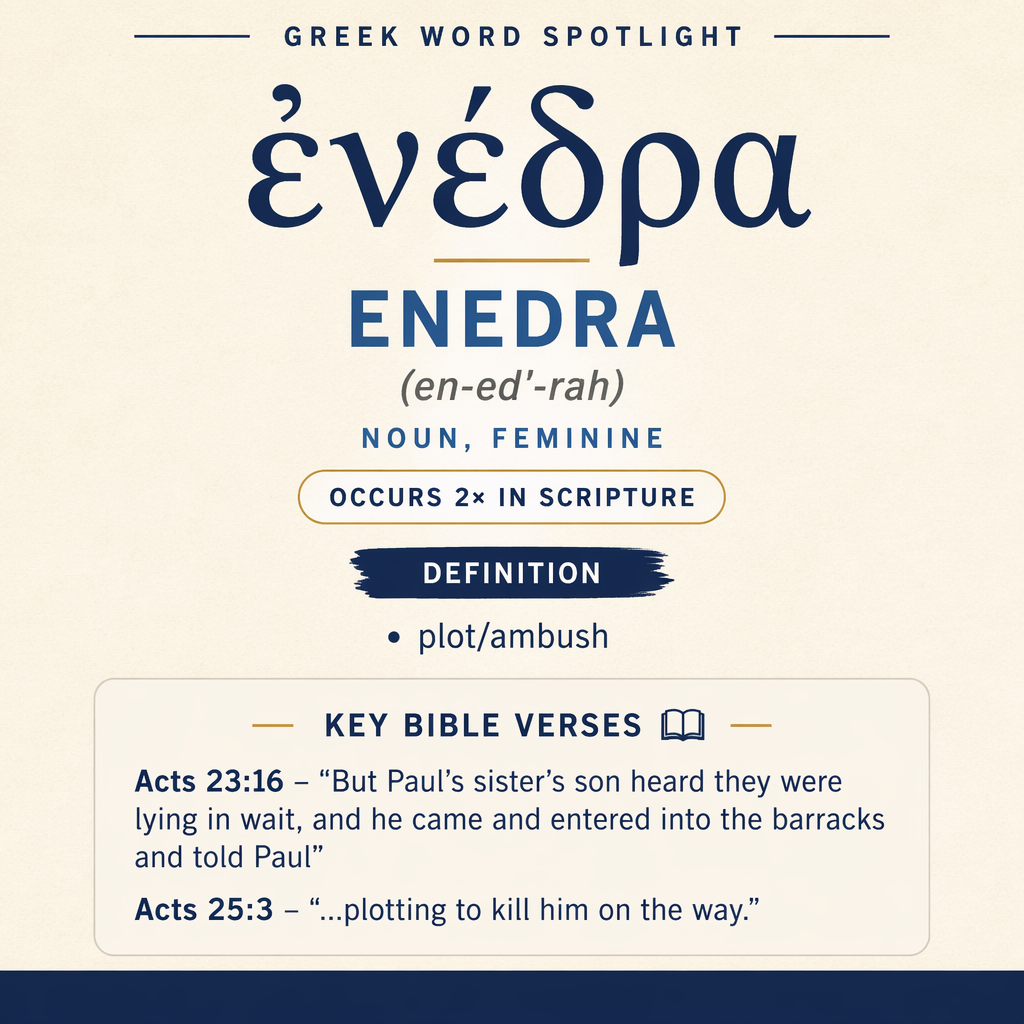
ἐνέδρα means “plot/ambush” and appears twice in Scripture, in Acts 23:16 and Acts 25:3.
Acts 23 Context
In Acts 23:16, Paul’s sister’s son heard they were lying in wait and reported it to Paul.
Learn More →Acts 25 Context
In Acts 25:3, it describes a request to summon Paul to Jerusalem while plotting to kill him on the way.
Learn More →ἐνέδρα means “plot/ambush,” and it appears in the narrative of Paul’s legal troubles in Acts. In both scenes it names a concealed, hostile plan aimed at taking a life rather than a public accusation or open confrontation.
Root and Related Words
ἐνέδρα is linked with two Greek words named in connection with it: ἑδραῖος (hedraios), “steadfast” (Strong’s G1476), and ἐν (en), “in/on/among” (Strong’s G1722). These relationships place ἐνέδρα alongside vocabulary that can mark position (“in/on/among”) and a kind of fixedness (“steadfast”), which suits the idea of an attack prepared and held in place until the moment it is sprung.
Occurrences
“But Paul’s sister’s son heard they were lying in wait, and he came and entered into the barracks and told Paul.” (Acts 23:16)
Here ἐνέδρα belongs to the language of secrecy and danger surrounding Paul. The verse frames the threat as something already set: others are “lying in wait,” and the key development is that the plan is overheard and reported. The word therefore contributes the sense of a hidden arrangement that depends on concealment—an action meant to happen out of sight, with Paul unaware and unprotected. The response is not a counter-argument but a message carried into a secure space: Paul’s nephew “entered into the barracks and told Paul.” In this setting, ἐνέδρα identifies a threat that must be exposed to be neutralized; the telling itself is treated as decisive because it brings the concealed plan into the open where it can be answered by protective custody.
“asking a favor against him, that he would summon him to Jerusalem; plotting to kill him on the way.” (Acts 25:3)
In this later scene ἐνέδρα is tied to a request presented as a “favor.” The verse contrasts the outward form of the petition (“summon him to Jerusalem”) with the inward intent (“plotting to kill him on the way”). The word marks the lethal purpose that rides beneath official procedure, using the travel route as the vulnerable place where the plan can work. It also shows how such a plan can be embedded within lawful-sounding actions: the request concerns a change of venue, but the real goal is violence during transit. In this context ἐνέδρα highlights the calculated nature of the threat—an ambush that relies on movement from one place to another and on the expectation that a prisoner can be attacked “on the way,” away from controlled security.
Sense and Usage
Across these two passages ἐνέδρα consistently points to a concealed, coordinated hostile intention rather than to a spontaneous act. It belongs to situations where the danger is not announced but prepared, and where the success of the attack depends on the target being brought into a vulnerable moment—either by remaining unaware (Acts 23:16) or by being moved along a route where protection can be compromised (Acts 25:3). The word’s force is practical and concrete: it names a plan that has been set up in advance and is waiting for an opportunity.
The two occurrences also show how such a plan intersects with different social mechanisms. In Acts 23:16, the mechanism is surveillance and timing (“lying in wait”), answered by communication into a guarded location (“entered into the barracks and told Paul”). In Acts 25:3, the mechanism is administrative persuasion (“asking a favor… summon him”), with the lethal intention positioned as the hidden underside of a procedural request. In both cases, ἐνέδρα fits naturally with language of movement and access: it is something arranged around where a person will be, who can reach them, and what the surrounding conditions will allow.
Because ἐνέδρα can be attached to a setting of waiting (Acts 23:16) and also to a request that would cause travel (Acts 25:3), it functions as a flexible term for an ambush-plan whether the immediate tactic is already in place or still dependent on securing the target’s movement. The shared element is the calculated concealment: the danger is real, but it is meant to be unseen until it is too late.
Imagery in Acts
The imagery carried by ἐνέδρα in these passages is the vulnerability of a person caught between places—either near a barracks while adversaries wait outside (Acts 23:16), or on a road toward Jerusalem where attackers anticipate a moment to strike (Acts 25:3). In both scenes, the word evokes violence arranged to occur away from public scrutiny, making the exposure of the plan (“heard… and… told Paul”) and the unmasking of motive (“asking a favor… plotting to kill him”) central to how the threat is handled.
Sources: Lexical data from Strong’s Exhaustive Concordance and the Translators Brief Lexicon of Extended Strongs for Greek (STEPBible, CC BY). Occurrence data from the Translators Amalgamated Greek New Testament (STEPBible, CC BY). Scripture quotations from the World English Bible (public domain).