Exploring the Meaning of Emphutos in Greek
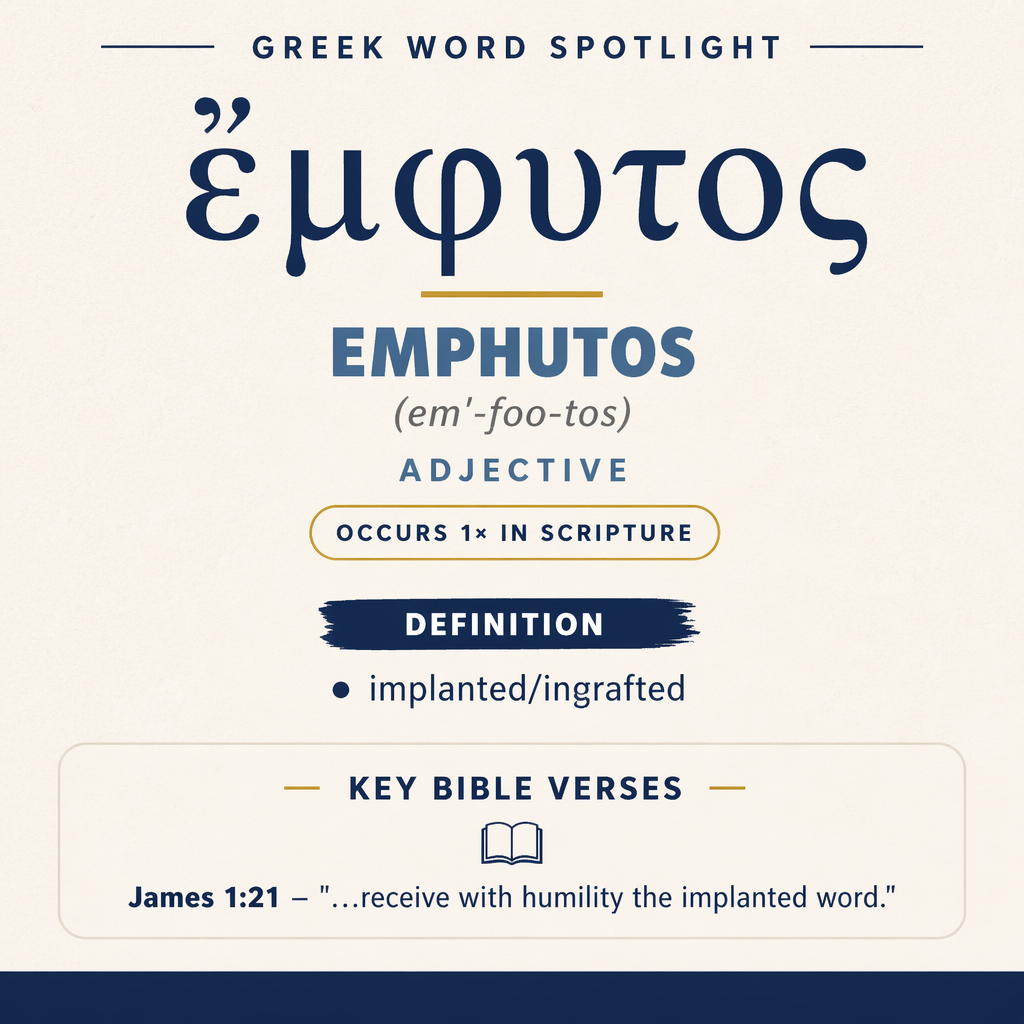
ἔμφυτος means “implanted/ingrafted” and appears once in Scripture, in James 1:21.
James 1:21 Context
In James 1:21 it modifies “word”: “receive with humility the implanted word.”
Learn More →ἔμφυτος describes something as “implanted/ingrafted,” using planting imagery to characterize how something is received and held. It appears in James’s exhortation to “receive with humility the implanted word,” set against the removal of moral defilement.
Root and Related Words
ἔμφυτος (Emphutos) is connected with the preposition ἐν (en), “in/on/among” (Strong’s G1722), and the verb φύω (phyo), “to grow” (Strong’s G5453). Together these related terms frame the adjective’s imagery: something located “in” and associated with “growth.”

Occurrences
“Therefore, putting away all filthiness and overflowing of wickedness, receive with humility the implanted word, which is able to save your souls.” (James 1:21)
In James 1:21, ἔμφυτος qualifies “the word” as something already set within the hearers, not merely placed before them externally. The surrounding commands define the setting in which this “implanted/ingrafted” quality is to be acknowledged: there is an active “putting away” of “all filthiness and overflowing of wickedness,” and, in that cleared moral space, an active “receive with humility.” The adjective supports the logic of the sentence by portraying the word as belonging in a person in a way that coheres with inner moral change; it is something that can be received in a posture of humility because it is suited to take hold within.
The clause “which is able to save your souls” further frames the effect attributed to the “implanted word.” Here ἔμφυτος contributes a concrete picture for an inwardly effective message: the word is not only heard but held in a manner consistent with producing an outcome tied to the person (“your souls”). In this exhortation, James binds together removal (putting away moral corruption) and reception (taking in the word), and ἔμφυτος helps present that reception as an inward, growth-associated placement rather than a surface-level acquaintance.
Sense and Usage
Because ἔμφυτος appears with “the word” and is paired with “receive,” its “implanted/ingrafted” sense functions relationally: it marks the word as something meant to be inside the recipient, with the kind of established placement that planting imagery suggests. The admonition assumes that the appropriate response to such a word is not pride or resistance but “humility,” the posture that matches receiving something set within. The same planting imagery also fits the ethical contrast James draws: “filthiness” and “overflowing of wickedness” are to be removed, while the implanted word is to be welcomed. The adjective thereby helps describe a transfer of what occupies the inner life—something discarded and something received—without shifting the focus from the imperative: the hearer must respond rightly to what is described.
Within this single attestation, ἔμφυτος is not used to label a detached object or an abstract quality standing alone; it is used attributively, describing a particular “word” in a moral exhortation. The imagery implied by “implanted/ingrafted” naturally evokes establishment and continuity: something planted belongs where it is placed, and its presence is not momentary. That impression aligns with James’s concern for integrity between what is put away and what is received. The adjective serves the paragraph’s aim by depicting the word as something intended to be internalized in a way that corresponds with cleansing from corrupt practices.
Imagery
James 1:21 draws on the everyday picture of something planted into a living setting. Against the backdrop of “filthiness” and “overflowing of wickedness” being put away, ἔμφυτος presents “the word” as something set into the person’s inner life, to be accepted “with humility” and recognized as effective toward the saving of “your souls.” The adjective’s planting imagery thus reinforces the passage’s movement from moral removal to inward reception.
Sources: Lexical data from Strong’s Exhaustive Concordance and the Translators Brief Lexicon of Extended Strongs for Greek (STEPBible, CC BY). Occurrence data from the Translators Amalgamated Greek New Testament (STEPBible, CC BY). Scripture quotations from the World English Bible (public domain).