Exploring the Meaning of Emphanes in Greek
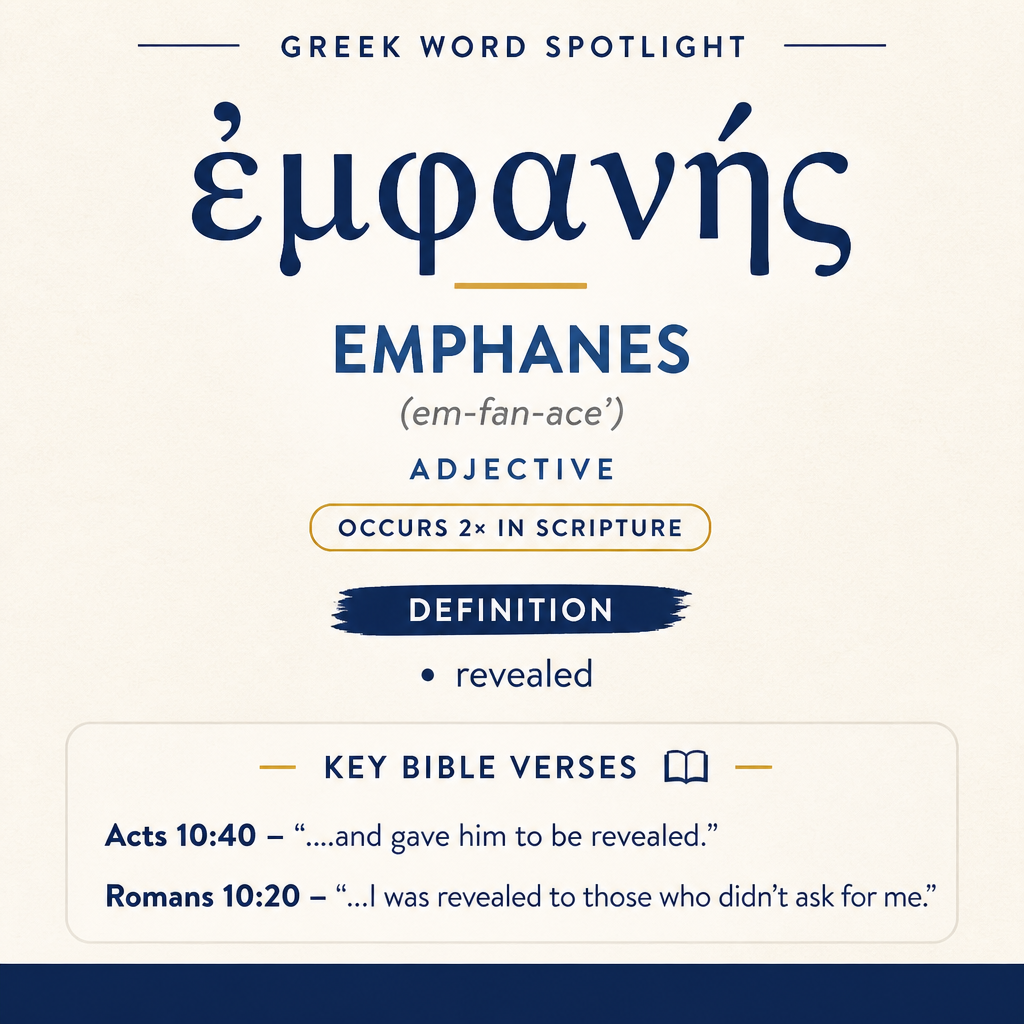
ἐμφανής (Emphanes) means “revealed” and appears twice in Scripture: Acts 10:40 and Romans 10:20.
Core Meaning
ἐμφανής is defined as “revealed.” It describes something made known or shown.
Learn More →Scripture Occurrences
This word occurs 2 times in Scripture. It appears in Acts 10:40 and Romans 10:20.
Learn More →Verse Contexts
In Acts 10:40, God raised Jesus and gave him to be revealed. In Romans 10:20, Isaiah says he was revealed to those who didn’t ask.
Learn More →ἐμφανής expresses the idea of something being revealed. It appears in Acts 10:40 and Romans 10:20, where it describes God’s action of making known what had been hidden.
Root and Related Words
ἐμφανής is connected with en (ἐν), “in/on/among” (Strong’s G1722), and phaino (φαίνω), “to shine/appear” (Strong’s G5316). Together these related terms point to the notion of something coming into view so as to be seen or recognized.

Occurrences
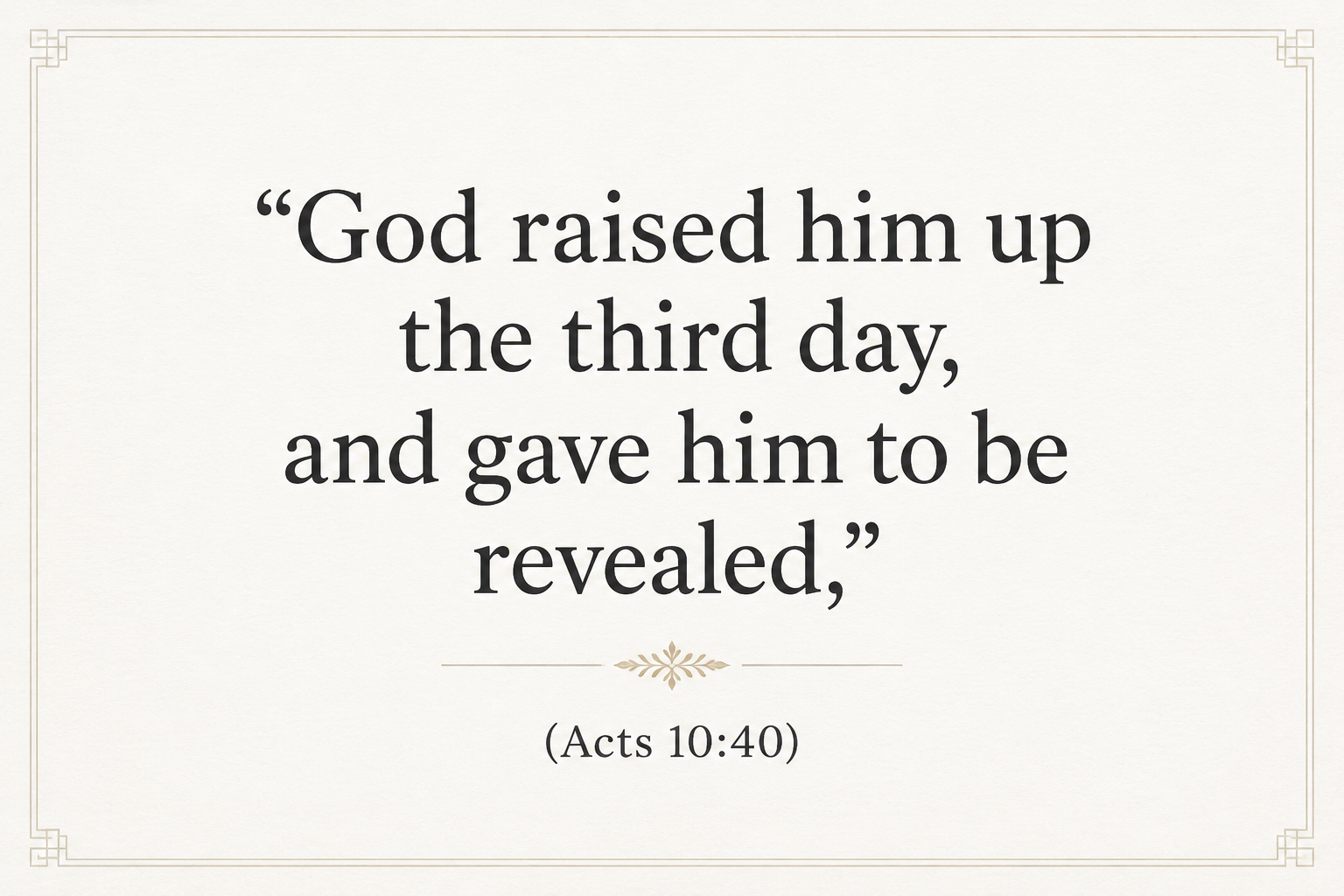
“God raised him up the third day, and gave him to be revealed,” (Acts 10:40)
Here ἐμφανής is tied to a sequence of divine acts: “God raised him up” and then “gave him to be revealed.” The wording presents revelation as something granted—an event that does not happen by accident, nor merely by private experience, but by God’s giving. In the scene, the emphasis is not only that something occurred on “the third day,” but that what occurred was then made openly known. The term belongs to the public side of the statement: it portrays the risen one as brought into a state of being revealed, placed where he can be encountered as one who has been raised.
The sentence also suggests a movement from the fact of resurrection to its disclosure. Resurrection is stated as a completed act (“raised him up”); ἐμφανής belongs to what follows: making that reality manifest. The verb “gave” frames revelation as purposeful and directed—revelation is an intentional bestowal, not simply the passage of time. Thus, in Acts 10:40, ἐμφανής contributes the idea that God’s work includes not only doing, but also unveiling what he has done.
“Isaiah is very bold and says, “I was found by those who didn’t seek me. I was revealed to those who didn’t ask for me.”” (Romans 10:20)
In Romans 10:20, ἐμφανής appears in a first-person declaration: “I was revealed to those who didn’t ask for me.” The revelation is striking because it is set alongside the absence of human pursuit: the same speakers are described as not seeking and not asking, yet the outcome is that they find and receive revelation. The parallel lines (“I was found … I was revealed …”) present revelation as the decisive turning point that explains the finding. The second line intensifies the first: finding is not credited to the seekers, because they were not seekers; instead, the initiative lies with the one who is revealed.
The phrasing keeps the focus on the recipient side of revelation: “to those who didn’t ask for me.” ἐμφανής marks the moment of disclosure as something that reaches people who had not requested it. The result is relational knowledge—being encountered—without the usual preconditions of searching. In this context, revelation is not merely information delivered; it is the self-disclosure of the “I” who becomes knowable to unexpected people.
Sense and Usage
Across these two passages, “revealed” functions as a bridge between reality and recognition. In Acts 10:40, the reality in view is the raising up “the third day,” and revelation is the act that brings that reality into the open where it can be acknowledged. The term therefore sits at the intersection of divine accomplishment and human awareness: what God has done is not left hidden, but is brought into view by God’s own giving. Revelation in this scene is an extension of God’s action, not a separate human discovery project.
In Romans 10:20, the emphasis falls even more strongly on initiative. Revelation comes to people described precisely by what they did not do: they “didn’t seek” and “didn’t ask.” The word thus carries the sense of disclosure that precedes and produces response. The juxtaposition of “found” and “revealed” links discovery to disclosure: the finding occurs because revelation occurs. Here “revealed” expresses a movement outward from the revealer to the recipient, rather than upward from the recipient to the revealer.
Taken together, these uses show revelation operating in two complementary directions. In Acts, the revealed one is “given” to be revealed—revelation is portrayed as a kind of presentation, bringing someone forward into visibility. In Romans, the revealer is “revealed to” others—revelation is portrayed as self-disclosure that reaches beyond the boundaries of seeking. In both, the term does not describe a vague atmosphere of clarity but a definite unveiling in which what is true becomes accessible and encountered.
The related words en (ἐν) and phaino (φαίνω) help frame the imagery suggested by the passages: revelation is like something coming into view where it can be seen “in” the sphere of human perception and experience. Yet the contexts keep that “coming into view” anchored in God’s initiative: in Acts, God “gave” it; in Romans, the revealed one makes himself known even where there was no asking. Thus ἐμφανής serves language of disclosure that is both concrete (something becomes visible/knowable) and purposive (it happens because it is granted and directed).
Imagery
The word’s imagery, as these texts use it, is the shift from hiddenness to open recognition. Acts 10:40 pairs revelation with the public reality of being raised “the third day,” evoking the idea of a decisive event followed by a decisive unveiling. Romans 10:20 evokes surprise: those who “didn’t seek” and “didn’t ask” nevertheless become the recipients of disclosure, so revelation appears as light breaking in where no one was looking for it.
Sources: Lexical data from Strong’s Exhaustive Concordance and the Translators Brief Lexicon of Extended Strongs for Greek (STEPBible, CC BY). Occurrence data from the Translators Amalgamated Greek New Testament (STEPBible, CC BY). Scripture quotations from the World English Bible (public domain).